
Lieferung heute & morgen

Qualitätsgarantie

Willkommens-Angebote freischalten: KOSTENLOSE Lieferung | Bis zu 80 % RABATT | Kostenlose 30-Tage-JoyPlus-Testphase
App herunterladen
A ceiling fan with a light is a 2-in-1 solution that provides pleasant airflow on hot days while simultaneously illuminating the room. In homes and apartments where space is at a premium, this combination offers a practical alternative to separate standing fans and ceiling lights.
This article serves as your guide. It explains key selection criteria and presents a curated selection of models with various features and designs to help you make an informed decision.
Choosing the right model depends on several factors that go beyond pure aesthetics. The following points will help you make a well-founded choice.
The fan's size should be appropriate for the room's dimensions to ensure effective air circulation. For small rooms up to approx. 15 m?, a model with a diameter of under 100 cm is often sufficient. Larger living rooms or bedrooms benefit from models with a diameter of 120 cm or more.
A crucial technical feature is the motor. Modern ceiling fans are often equipped with a direct current (DC) motor. These are typically much quieter in operation than conventional alternating current (AC) motors and consume less energy. A quiet ceiling fan is an essential requirement, especially for use in a bedroom or home office.
The integrated lamp is more than just an add-on. Pay attention to the following features:
Beyond the basic functions, there are other practical features and design aspects to consider:
Here is a selection of models that cater to different functional and design requirements.
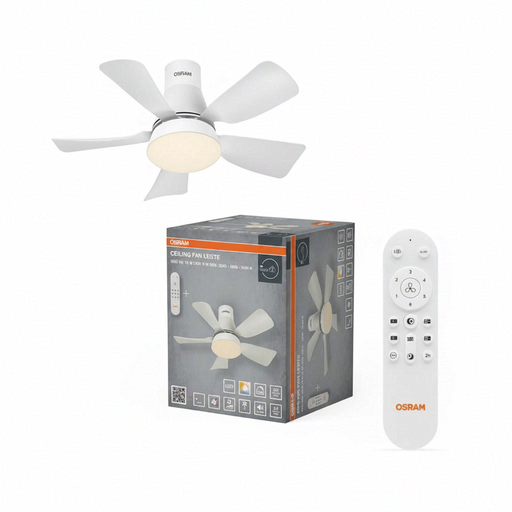
What sets it apart The Osram Leste is a compact model designed specifically for smaller rooms up to 13 m?. Its strength lies in its flexible lighting: the colour temperature can be adjusted in three steps (3000 K, 4000 K, 6500 K), and the brightness is continuously dimmable.
Advantages
Who is it for? This model is an excellent choice for users seeking a space-saving and quiet solution for smaller rooms who also value adaptable lighting.
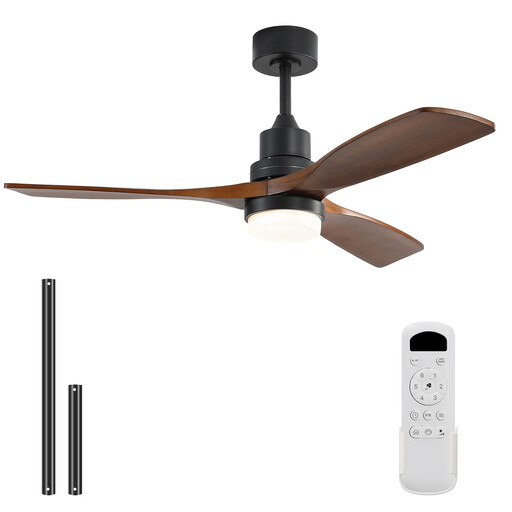
What sets it apart The Sofucor 5247 combines an appealing design featuring solid wood blades with high functionality. With a diameter of 52 inches (approx. 132 cm), it is suitable for larger rooms. The included downrods in three different lengths (12.5 cm, 25 cm, 60 cm) allow for flexible installation with various ceiling heights.
Advantages
Who is it for? Ideal for design-conscious buyers looking for a powerful fan for larger living rooms, dining areas, or covered patios who appreciate the natural aesthetic of wood.

What sets it apart This bladeless ceiling fan from GONEO prioritises safety and a minimalist design. With no exposed rotating blades, it is particularly well-suited for children's rooms or rooms with low ceilings. The brushless DC motor ensures ultra-quiet operation at under 30 dB.
Advantages
Who is it for? This model is aimed at users for whom safety and extremely quiet operation are top priorities. It is a modern solution for bedrooms, children's rooms, and spaces with low ceiling heights.
Are you looking for lighting solutions for a larger or commercial space? While ceiling fans are ideal for residential areas, spaces like restaurants or cafés often require specialised lighting. Discover our selection of pendant lights for the hospitality industry to create the perfect atmosphere for your business.
1. How quiet is a "quiet ceiling fan" really? The volume is measured in decibels (dB). Models considered quiet often operate at levels below 35 dB on their lowest setting. This is roughly equivalent to a whisper or the ambient noise in a library. Fans with high-quality DC motors, like the models presented here, are generally much quieter than older units with AC motors.
2. Can a ceiling fan with a light completely replace a standard ceiling light? Yes, many modern models can serve as the sole light source in a room. Look for the brightness specification in lumens (lm) and features like dimmability and adjustable colour temperature. A ceiling fan with an LED and a luminous output of 1200 lumens or more, like the Osram Leste, can adequately illuminate a medium-sized room.
3. What is the advantage of a ceiling fan with a winter mode? The winter mode reverses the blades' direction of rotation. Instead of a cooling downward airflow, the fan creates a gentle air circulation that pushes warm air from the ceiling down and into the living space. This can help distribute heat more evenly and support the efficiency of your heating system. The model from Sofucor offers this function.