
Lieferung heute & morgen

Qualitätsgarantie

Willkommens-Angebote freischalten: KOSTENLOSE Lieferung | Bis zu 80 % RABATT | Kostenlose 30-Tage-JoyPlus-Testphase
App herunterladen
Choosing the right ceiling light can transform a room—or cast it in the wrong light. Many buyers are drawn in by attractive product photos, but overlook the technical details that determine everyday comfort and functionality. As your Joybuy Product Recommendation Officer, I'm here to help you navigate the common pitfalls and make an informed decision.
Before you invest, you should be aware of three common mistakes that often lead to disappointment:
LED ceiling light labelled as "dimmable," only to find it flickers, hums, or won't adjust at all with your existing wall switch.To avoid these mistakes, it's crucial to be guided by objective parameters rather than marketing buzzwords. Three metrics are of central importance.
In the past, wattage was a reliable indicator of a light bulb's brightness. With modern LED fixtures, however, this value is misleading. Wattage only indicates energy consumption. The actual brightness is measured in lumens (lm). An LED ceiling light can produce 1500 lumens with just 15 watts, whereas an old incandescent bulb would need about 100 watts to achieve the same.
Practical Guideline:
The colour of the light, measured in Kelvin (K), significantly determines a room's mood. Pay attention to precise Kelvin specifications instead of vague descriptions.
living room ceiling light or in the bedroom.kitchen ceiling light or the bathroom.A dimmable ceiling light with adjustable colour temperature offers the greatest flexibility here.
For a bathroom ceiling light, the IP (Ingress Protection) rating is an essential safety feature. It indicates how well a light is protected against the ingress of foreign objects and water.
Based on these objective criteria, we have identified models that represent a well-thought-out solution for specific requirement profiles.
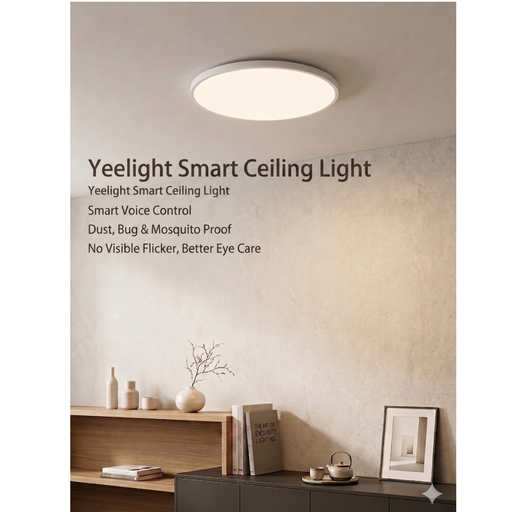
Why This Fits Their Persona: Ideal for users who want full control over their lighting. This `smart home lamp` can be controlled via app or voice (compatible with Alexa, Google Home) to precisely adjust brightness and colour temperature for any situation—from focused work to a relaxing evening.
Solves the Kelvin trap with an adjustable colour temperature and bypasses the compatibility dilemma, as the dimming function is fully integrated into the light and requires no external dimmers.
Seamless integration into popular smart home systems. The moonlight mode provides an extremely dim, glare-free light for the night. The sealed design protects against dust and insects.
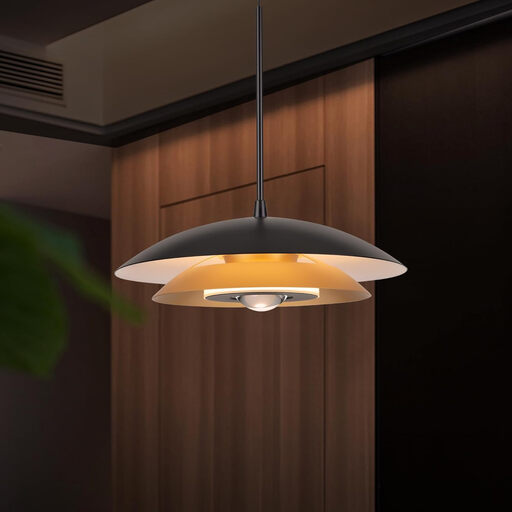
Why This Fits Their Persona: For anyone who sees a light not just as a source of illumination, but as a central design piece. This `black pendant light` with a golden interior is a `modern ceiling light` in an industrial style and makes a strong visual statement as a `dining room hanging light` or over a kitchen island.
The double-shell construction prevents direct glare—a common problem with open-design lights. The golden inner shade ensures a defined, warm light output (3000K) and avoids a sterile atmosphere.
Architectural design with high-quality construction from powder-coated aluminium and steel. The integrated 12W LED module is energy-efficient and long-lasting. The height is adjustable.
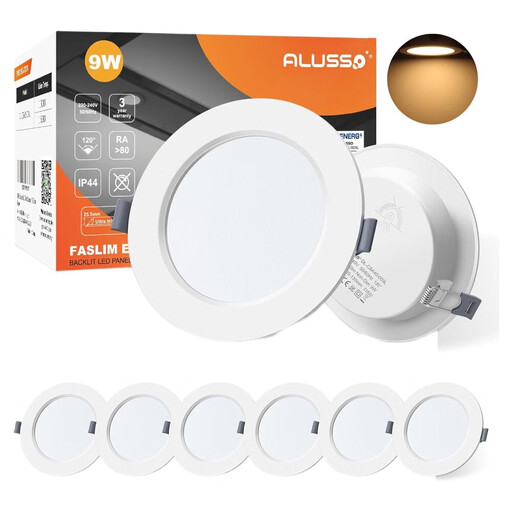
Why This Fits Their Persona: A pragmatic solution for renovation projects, especially in damp areas. This set provides uniform, safe, and easy-to-install lighting for the bathroom, kitchen, or hallway. The shallow installation depth is ideal for suspended ceilings.
The explicit IP44 certification ensures the lights are suitable for use in damp areas and pose no safety risk. The direct connection to 230V without an external transformer simplifies installation and avoids compatibility issues.
Very slim design (25.5 mm installation depth) for ceilings with limited space. High energy efficiency (9W replaces 72W halogen). Delivered in a practical set of 6 for comprehensive room illumination.
We have compiled a complete, real-time list of products that fully satisfy these strict selection criteria and UK safety regulations.
As a rule of thumb for pleasant ambient lighting in a 20-square-metre living room, you should aim for about 2000 to 3000 lumens (20 m? x 100-150 lm/m?). This can be achieved with a single, powerful ceiling light or a combination of multiple light sources. A dimmable light offers the flexibility to adjust the brightness as needed.
No, this is a common source of error. Many older dimmers (leading-edge dimmers) are designed for the high loads of incandescent bulbs and do not work correctly with the low wattage of LEDs. This often leads to flickering or humming. Look for lights with an integrated dimming function (as with smart home models) or ensure your wall dimmer is explicitly designated as "LED-compatible" (often trailing-edge dimmers).
The IP rating indicates the degree of protection against foreign objects (first digit) and water (second digit). For the bathroom, IP44 is the standard recommendation. The first "4" means protection against solid foreign objects >1 mm, and the second "4" means protection against splashing water from all directions. This is sufficient for ceiling lights that are not directly exposed to the water jet from a shower. Directly above a shower cubicle or bathtub, higher protection ratings like IP65 are required.