
Lieferung heute & morgen

Qualitätsgarantie

Willkommens-Angebote freischalten: KOSTENLOSE Lieferung | Bis zu 80 % RABATT | Kostenlose 30-Tage-JoyPlus-Testphase
App herunterladen
A ceiling light affects more than just the brightness of a room. It also influences its proportions and atmosphere. Before buying, UK households should therefore consider more than shape and colour. Unclear specifications can often lead to unnecessary additional costs or mean that the light does not suit how the room is used day to day.
Three common buying misconceptions:
For a living room or dining room ceiling light, the size of the room, ceiling height and additional light sources are all important. Lumens (lm) indicate how much light a fitting emits. As a general guide, around 100 to 150 lumens per square metre can be used for general room lighting. This does not replace an individual lighting plan, but it is helpful for an initial comparison.
A ceiling light with warm white light typically has a colour temperature of around 2,700 to 3,300 Kelvin. 3,000 Kelvin usually creates a cosy atmosphere and is suitable for living rooms, bedrooms, kitchens and hallways. Cool white light of around 6,500 Kelvin appears noticeably more bluish and may be suitable for work areas or rooms where good visibility is important. This colour temperature will not be comfortable for every household in a bedroom.
Also check whether the stated brightness applies to the complete fitting or only to the light source. With an integrated LED, the light source is already built in and cannot later be replaced like an E27 bulb.
A dimmable ceiling light is useful when a room is used for different purposes. More brightness is helpful when reading or cleaning, while a lower setting may be sufficient when watching television or relaxing.
Check the following before buying:
According to the product details, the Brilliant Baarlo has an integrated three-stage dimmer with memory function. This means that the light can be switched between three levels and stores the last selected setting. This does not indicate stepless adjustment or compatibility with every wall dimmer.
A ceiling light with an E27 fitting allows you to choose a suitable bulb. Check the maximum wattage, the bulb shape and the desired colour temperature. E27 models offer flexibility, but usually require the bulbs to be purchased separately.
With a wooden or bamboo ceiling light, you should check the specific material details. “Wood effect”, for example, may mean plastic with a decorative surface, while other models use real wood or FSC-certified bamboo. These are different product characteristics and should not be treated as equivalent terms.
Damp rooms have different requirements from dry indoor areas. The models mentioned here are mainly intended for indoor use and some are rated IP20. IP20 is designed for dry rooms, not bathrooms, outdoor areas or locations exposed to direct splashing water. The electrical connection must only be carried out by a qualified electrician in accordance with the applicable installation regulations.

Why this product suits this profile: This compact LED ceiling light combines 24 watts, 2,400 lumens and 3,000 Kelvin. According to the product details, it is suitable for living rooms, bedrooms, kitchens and hallways.
The details for lumens, Kelvin and the three dimming levels make comparison more transparent than a purely design-focused description. The LED is integrated, so there is no need to search for a suitable bulb.
35 cm diameter, warm white light at 3,000 Kelvin and memory function; FSC details according to the product data.
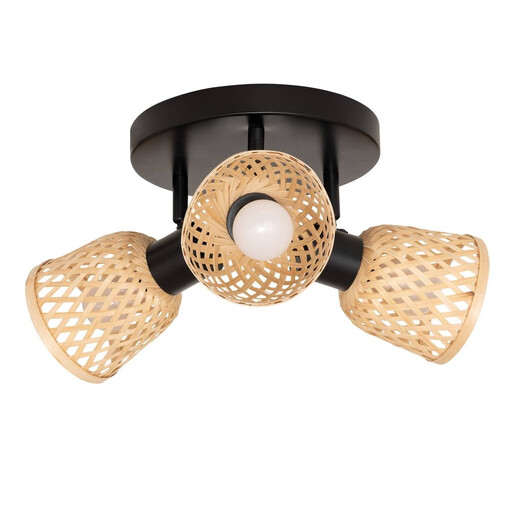
Why this product suits this profile: Three adjustable spotlights and shades made from FSC-certified natural bamboo allow you to direct the light precisely. The fitting is particularly suitable for small rooms and hallways.
The E14 fitting and the statement “bulbs not included” are clearly specified. This allows you to plan for the additional purchase before placing your order.
25 × 25 × 18.8 cm, three adjustable spotlights, metal base and bamboo shades; IP20 for dry indoor areas.
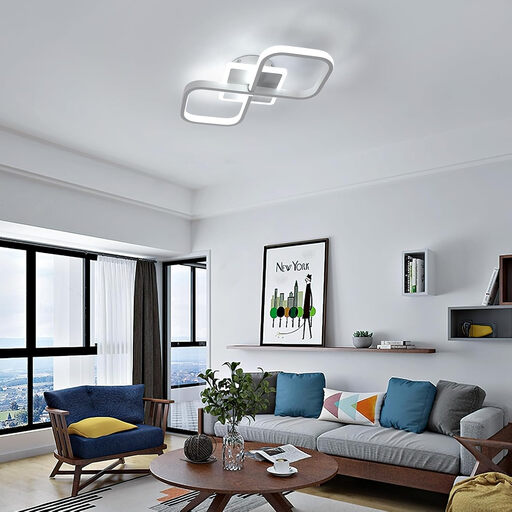
Why this product suits this profile: With 4,000 lumens and cool white light, this model is designed for bright areas such as home offices, kitchens, studies or hallways.
The colour temperature of 6,500 Kelvin is expressly stated. This allows buyers to check in advance whether the more functional light suits the room and its intended use.
36 watts, 4,000 lumens and integrated LED technology; according to the product details, the acrylic shade is designed to provide even light distribution.
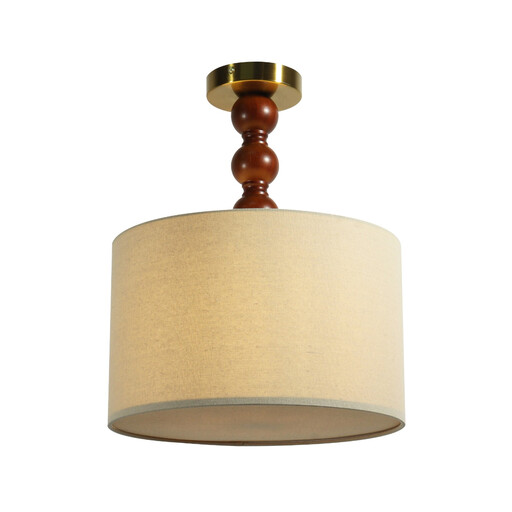
Why this product suits this profile: The E27 ceramic fitting lets you choose your own bulb. This is practical if you want to adjust the colour temperature and brightness later.
The maximum output of 60 watts and the E27 fitting are specified. This helps prevent an unsuitable or overly powerful bulb from being used.
E27 ceramic fitting, fabric shade with a diameter of 35 cm and a design intended for dry indoor areas.
We have put together a complete, regularly updated list of products that fully meet these strict selection criteria and the safety regulations applicable in the EU.
As a general guide, around 100 to 150 lumens per square metre is suitable for general lighting. Furniture, wall colours, ceiling height and additional lamps all affect the actual requirement. An additional direct light source may be useful for work areas.
The lifespan depends on the LED module, operating time, heat dissipation and usage. For integrated LEDs, check the lifespan stated by the manufacturer. If the LED fails, it is not always possible to replace just the bulb; with E27 ceiling lights, however, the individual bulb can be replaced.
You can estimate the running costs using this calculation: Watts ÷ 1,000 × operating hours × electricity price per kilowatt-hour. A 24-watt light uses 24 kilowatt-hours over 1,000 operating hours in theory. The actual amount depends on your electricity tariff and how long the light is used.