
Lieferung heute & morgen

Qualitätsgarantie

Willkommens-Angebote freischalten: KOSTENLOSE Lieferung | Bis zu 80 % RABATT | Kostenlose 30-Tage-JoyPlus-Testphase
App herunterladen
A ceiling light affects more than just brightness. It can also change how a room feels, how much electricity you use and how much effort installation takes. It’s often only after buying that you discover the ceiling light isn’t dimmable, the colour temperature doesn’t suit the way you use the room, or the existing connection point isn’t compatible with the fitting.
Three buying decisions are particularly likely to lead to unnecessary costs:
Check these points before you buy to make a more informed choice that suits your needs.
The brightness of LED lights is given in lumens (lm). Wattage, by contrast, primarily indicates energy consumption. For example, an LED ceiling light with 2,400 lm can provide even general lighting for a medium-sized living area, while a light with considerably fewer lumens may be better suited to a hallway, alcove or supplementary lighting.
Colour temperature also matters:
Choose a living room ceiling light based not only on its design, but also on the room’s size, furniture layout and the way you want the light to spread.
A dimmable ceiling light lets you adjust the brightness to suit different situations. There are several types of system:
If the light takes a replaceable bulb, the bulb itself must be dimmable. For an integrated LED, the product description should include details such as “three-step dimming” or “dimmable via app”. Don’t try to pair a non-dimmable light with an unsuitable dimmer.
Materials influence both appearance and upkeep. A wooden or bamboo ceiling light adds a natural touch to a room, while metal and glass often have a cleaner, more streamlined look. Check whether the light is made from real wood or simply has a plastic surface with a wood-effect finish.
Also check:
IP20 is common for dry indoor spaces. Lights with this rating are not protected against water, so they’re not intended for damp outdoor areas or places directly exposed to water. In Germany, the electrical connection should be installed by a suitably qualified person in accordance with the applicable installation regulations.
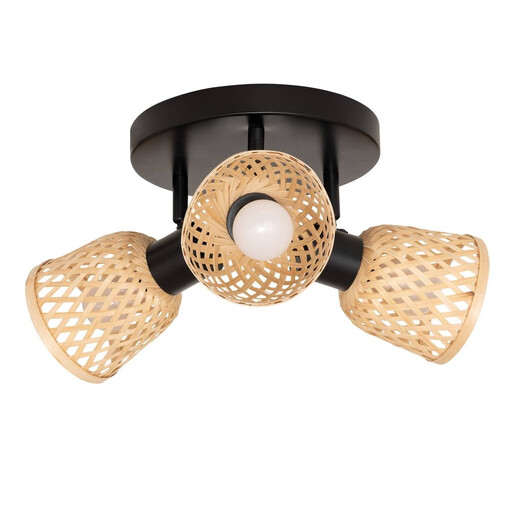
Why this product suits this profile: This compact three-light ceiling fitting is ideal for smaller rooms and hallways. Its three adjustable spotlights let you direct the light where you need it.
The product details specify the diameter, bulb holder type, maximum wattage and that it’s for indoor use only. This makes it easier to check it’s suitable before installation.
Bamboo shades, steel base, three E14 bulb holders and adjustable spotlights. The product details state that bulbs are not included.

Why this product suits this profile: With 2,400 lm, warm white light at 3,000 K and natural wood, this light is well suited to living rooms, bedrooms, kitchens or hallways.
The dimming function is specifically described as built-in three-step dimming with a memory function. So you don’t have to assume it’s dimmable simply because it uses LEDs.
Integrated 24 W LED, 2,400 lm, 3,000 K, 35 cm diameter and FSC certification. IP20 rating for dry indoor spaces.
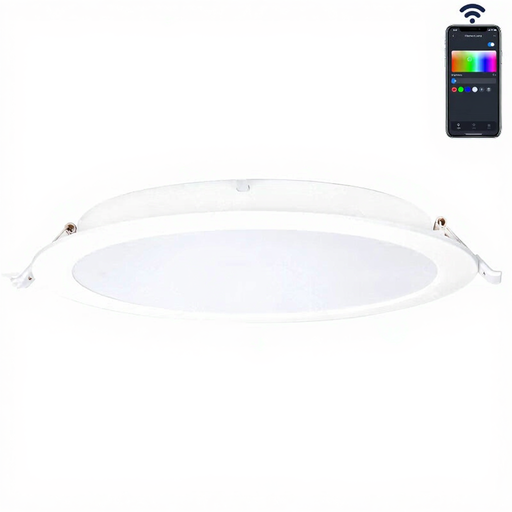
Why this product suits this profile: For anyone who wants to adjust the lighting via an app or voice control and is looking for a recessed fitting with adjustable colour temperature.
The recess dimensions of 200 to 220 mm, IP20 rating and required Bluetooth Mesh connection are all specified. This makes it possible to check the installation requirements in advance.
18 W, 1,760 lm, RGB plus 2,700 to 6,500 K, dimming and timer function. The stated lifespan is up to 30,000 hours.
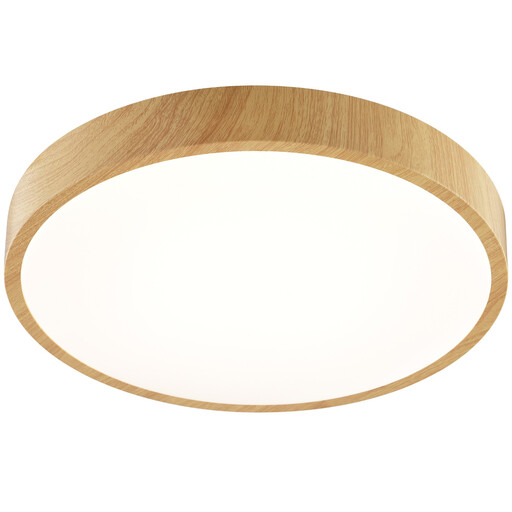
Why this product suits this profile: This light is designed for households looking for fixed, warm white ceiling lighting without changing light colours or a dimming function.
The product details explicitly state “not dimmable”. You can take this limitation into account before buying, rather than planning an unsupported modification.
24 W, 2,300 lm, 3,000 K and a diameter of 38.5 cm. The wood-effect finish is made of plastic, according to the product details.
We’ve put together a complete, regularly updated list of products that meet these strict selection criteria and fully comply with the safety regulations in force across the EU.
It depends on the size of the room, ceiling height, wall colour and any additional lighting. As a guide, around 100 to 150 lm per square metre can work well for general living room lighting. Several ceiling spotlights or additional floor and wall lights can help improve light distribution.
The stated lifespan depends on the model and operating conditions. For example, the Aigostar Smart LED recessed light is rated for up to 30,000 hours. This is a product specification, not a guarantee that every household will get the same amount of use from it.
Running costs depend on the wattage, how many hours you use the light each day and your electricity tariff. The simple calculation is: wattage divided by 1,000, multiplied by the hours of use and the price per kilowatt-hour. A 24 W light uses 0.24 kWh when switched on for ten hours. So it’s worth considering not only the purchase price, but also the power consumption.