
Lieferung heute & morgen

Qualitätsgarantie

Willkommens-Angebote freischalten: KOSTENLOSE Lieferung | Bis zu 80 % RABATT | Kostenlose 30-Tage-JoyPlus-Testphase
App herunterladen
Choosing the right ceiling light affects how bright a room feels, how it looks and how well it works for everyday use. Yet unclear product information often leads to the wrong choice. A light may look just right, but provide too little illumination, have the wrong colour temperature or not dim as expected. Installation is also often overlooked.
These are three of the most common buying mistakes:
Luminous flux is measured in lumens (lm). A model with 2400 lumens may be suitable for a medium-sized living room, kitchen or hallway, depending on the room size, wall colours, ceiling height and desired brightness. For even lighting throughout a room, it’s also important to consider whether the light is spread widely or only reaches specific areas.
An LED ceiling light with integrated LEDs often distributes light more evenly than a light with several individually adjustable spotlights. Black ceiling spotlights with adjustable heads, on the other hand, are a good choice if you want to direct light onto worktops, pictures or reading areas.
Colour temperature is measured in Kelvin (K):
A light with 3000K warm white can help create a cosy atmosphere. However, how it looks also depends on your walls, furniture and existing light sources. A T9 G10q ring lamp with 6500K, by contrast, gives off cool white light, so choose it only if that is the colour temperature you specifically want.
Before buying, compare the diameter, height and fixing points with your existing connection. A flush ceiling light is also suitable for rooms with low ceilings. A model with spotlights usually needs a little more clearance below the ceiling.
For a dimmable ceiling light, check whether you need an external wall dimmer or whether the brightness is controlled by an integrated switch. The Baarlo model is adjusted using a 3-stage dimmer with memory function. This means it has three fixed brightness settings and can save the last setting used.
The IP rating is also relevant. IP20 means the light is intended for dry indoor spaces and offers no protection against water. For bathrooms, covered outdoor areas or other damp environments, check the product information and the IP rating required. Electrical connections must only be carried out by a suitably qualified professional.
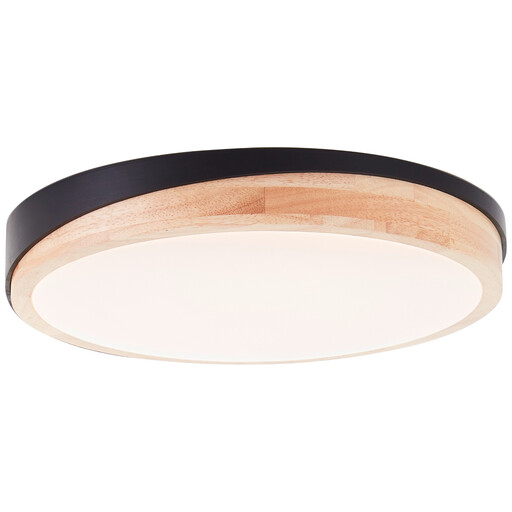
Why this product suits this profile: The integrated LED, 2400 lumens and 3000K warm white light meet typical needs in a living room, bedroom, kitchen or hallway. It measures 35 cm in diameter and 7,5 cm in height.
The product details specify both the luminous flux and the light colour. This makes it easier to choose a light that suits your room, rather than basing your decision on wattage alone.
24 W, 2400 lm, 3000K and an integrated 3-stage dimmer with memory function. The housing combines wood, plastic and metal.
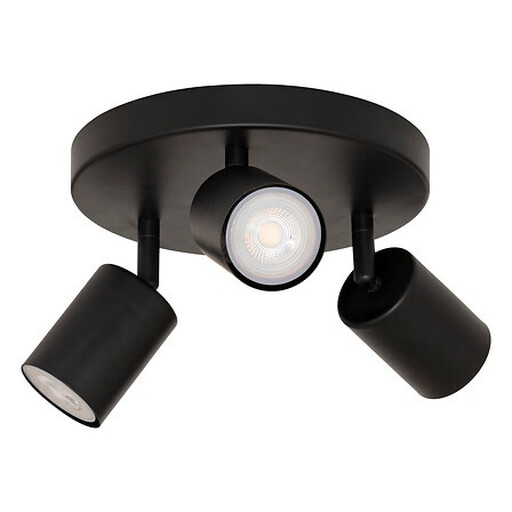
Why this product suits this profile: The black steel housing with three adjustable spotlights is a good choice if you want to direct light onto worktops, pictures or reading areas.
The three lamp heads are adjustable, so you can direct the light where you need it instead of relying on a fixed light distribution to suit every room.
Three spotlights, black steel, 20 cm diameter and 14 cm height. The light is designed for use with suitable bulbs.
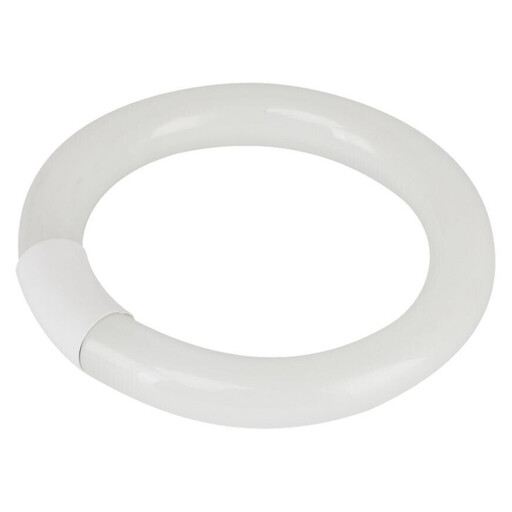
Why this product suits this profile: This bulb is designed for existing round lights with a T9 and G10q fitting. According to the product information, it is currently unavailable, so check availability before buying.
The fitting, diameter and electrical rating are clearly specified. This makes it easier to check in advance whether the replacement bulb will fit your existing light.
T9 G10q, 22 W, 1200 lm, 6500K and 21 cm diameter. The light colour is cool white and the beam angle is specified as 360 degrees.
We’ve put together a complete, regularly updated list of products that meet these strict selection criteria and fully comply with the safety regulations in force in the EU.
It depends on the room size, how you use the space and whether you have any additional lights. A model with 2400 lumens may be suitable for general lighting in a medium-sized room. If you have dark walls, high ceilings or need more light, several light sources may work better than a single fitting.
You can calculate energy consumption using the wattage and how long the light is switched on. A 24 W light uses 24 kWh over 1000 hours of operation. The actual cost depends on your electricity tariff. So it’s worth comparing energy efficiency ratings and consumption figures before buying.
No. Electrical connections and work on your home’s electrical wiring must only be carried out by a suitably qualified professional. Before installation, check the circuit, fixings, permitted wattage and the instructions in the user manual. For a ceiling light with 3 spotlights, you should also check which bulbs and wattages are permitted.