
Lieferung heute & morgen

Qualitätsgarantie

Willkommens-Angebote freischalten: KOSTENLOSE Lieferung | Bis zu 80 % RABATT | Kostenlose 30-Tage-JoyPlus-Testphase
App herunterladen
A ceiling light affects brightness, the feel of a room and your daily electricity consumption. Even so, shoppers often focus on shape and colour first. Important details such as lumens, colour temperature, bulb fitting and installation type are easily overlooked. This can mean that a modern ceiling lamp looks stylish but does not provide enough light in the living room, or feels unpleasantly cold in the bedroom.
Wattage describes energy consumption, not brightness directly. For comparison, the luminous flux in lumens (lm) is more meaningful. An LED ceiling light can produce a high level of brightness with comparatively low wattage. It is also important to consider how evenly the light is distributed around the room.
Colour temperature is measured in kelvin:
A bedroom ceiling light should therefore not automatically have the same colour temperature as a hallway ceiling light or a light for a home office.
With a ceiling lamp with spotlights, the number, direction and bulb fitting are crucial. Check whether bulbs are included and whether the light requires, for example, E14 or E27 bulbs. With integrated LEDs, the light source usually cannot be replaced separately.
Installation also requires careful attention: work on the 230-volt mains supply in Germany should be carried out by a qualified electrician in accordance with the applicable national regulations. A CE mark is a relevant conformity marking, but it does not replace an assessment of the specific installation conditions.
As a general guide, you can estimate the required luminous flux based on how the room is used. Living rooms and bedrooms often need less uniform brightness than work or utility areas. A light with several light sources distributes illumination differently from a centrally emitting LED ceiling light.
Look out for:
The specification “36 W and 4,000 lm” for the white LED acrylic model, for example, describes its specific power and brightness data. Such a light may be suitable for rooms where high visibility is important, provided that the 6,500 K colour temperature is appropriate for how it will be used.
A dimmable ceiling light gives you more flexibility, but the light and dimmer must be compatible. With integrated LEDs, dimmability must be expressly stated in the product specifications. A non-dimmable light should not subsequently be operated with just any dimmer.
Warm white light with a lower colour temperature can be a good choice for a living room. In a home office or areas used for reading and concentrated work, a more neutral light may be more suitable. Your personal preference and any existing room lighting should also be taken into account when choosing.
Materials affect appearance, weight and cleaning requirements:
For damp areas, the IP rating is particularly important. Products with IP20 are intended for dry indoor areas and are not automatically suitable for bathrooms or sheltered outdoor areas.
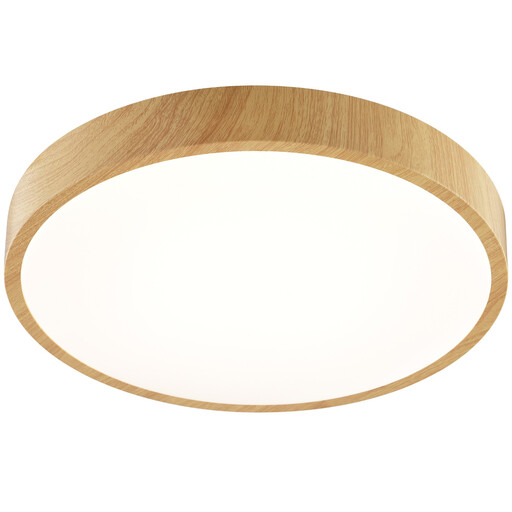
Why this product suits this profile: The integrated LED technology and warm white 3,000 K colour temperature are designed for living rooms, bedrooms, hallways or dining areas.
The product data specifies 2,300 lm, 24 W and explicitly states “non-dimmable”. This makes it easier to assess the features realistically before buying.
24 W LED technology, 2,300 lm, 3,000 K and a diameter of 38.5 cm; plastic with a wood-effect finish.
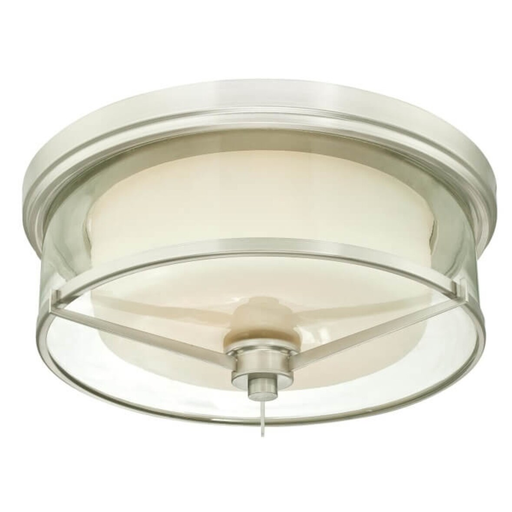
Why this product suits this profile: The combination of a nickel finish with frosted and clear glass is aimed at buyers who value the look and feel of the materials as well as clearly specified bulb requirements.
The light is specified as requiring two E27 bulbs. You should therefore check the brightness and colour temperature of the bulbs fitted separately.
Two E27 light sources, a nickel finish, and frosted and clear glass for indoor use.
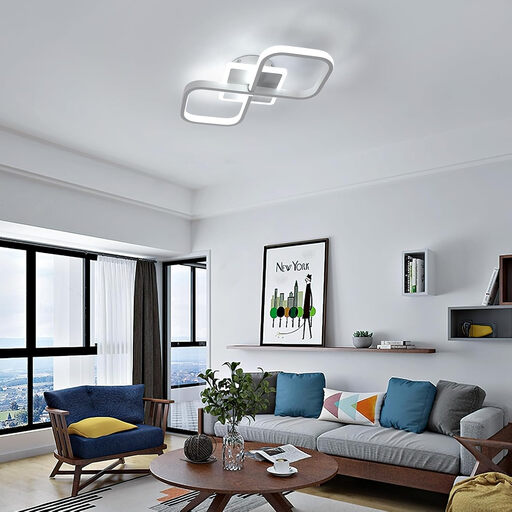
Why this product suits this profile: With 4,000 lm and 6,500 K, this model is designed to provide bright, functional lighting for workspaces, reading areas or places where high visibility is important.
The specifications of 36 W, 4,000 lm and 6,500 K make it clear that this light should not be viewed as warm white ambient lighting.
Geometric acrylic design, 4,000 lm, 36 W and a stated LED lifespan of 50,000 hours.
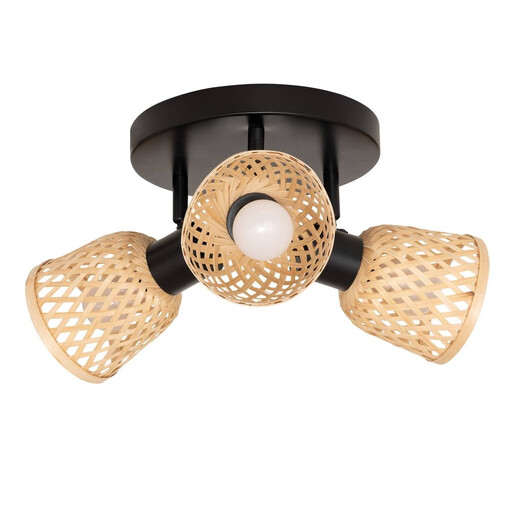
Why this product suits this profile: The three adjustable spotlights and shades made from FSC-certified bamboo are suitable for small indoor areas, such as hallways, entrance areas or compact living spaces.
The product data specifies E14 fittings, three bulbs, a maximum of 25 W per bulb and IP20. This means the bulb requirements and intended area of use can be checked in advance.
Three adjustable spotlights, bamboo shades, 25 × 25 × 18.8 cm and CE and FSC markings according to the product description.
We have put together a complete, regularly updated list of products that fully meet these strict selection criteria and the safety regulations applicable in the EU.
This depends on the size of the room, wall colours, furnishings and any additional lighting. When choosing, compare the stated luminous flux with the intended use rather than looking at wattage alone. Several light sources can provide more even illumination than a single central light.
Its lifespan depends on the LED module, electronics, operating time and heat dissipation. Some product specifications, for example, state 50,000 hours. This is a manufacturer or product specification and is not a guarantee of the actual service life in every household. With integrated LEDs, you should also check whether the module can be replaced.
You can estimate the running costs using this formula:
Wattage ÷ 1,000 × operating hours × electricity price = cost
For a 24 W light used for three hours a day, this equates to 0.072 kWh per day. For a realistic estimate, use your own electricity tariff and actual usage time. Depending on how they are used, dimmable models or replaceable bulbs may also offer greater flexibility.