
Lieferung heute & morgen

Qualitätsgarantie

Willkommens-Angebote freischalten: KOSTENLOSE Lieferung | Bis zu 80 % RABATT | Kostenlose 30-Tage-JoyPlus-Testphase
App herunterladen
A ceiling light needs to illuminate the room properly, be compatible with your existing electrical installation, and perform reliably day in, day out. Yet shoppers often overlook important details when making a purchase. For instance, a high wattage doesn’t automatically mean high brightness, and a decorative lampshade isn’t suitable for every room.
With modern LED ceiling lights, the luminous flux measured in lumens is far more meaningful than wattage. Watts describe energy consumption, whereas lumens tell you how much light the fitting actually emits. An LED ceiling light with 24 W and 2,400 lumens can be noticeably brighter than a fitting with a higher wattage but lower luminous flux.
When choosing, you should also consider the size of the room. A small bedroom typically needs less light than a kitchen or a workspace. The actual effect also depends on the room colour, ceiling height and lampshade.
Not every ceiling light is suitable for damp conditions. A fitting rated IP20 is designed for dry indoor spaces. For bathrooms, kitchens or covered outdoor areas, the IP rating must match the installation location. A waterproof ceiling light with IP65 offers significantly better protection against dust and water than a fitting without the appropriate marking.
However, the IP rating does not replace proper installation. Before buying, you should check the installation instructions, the specific mounting area and the applicable safety requirements.
An E27 ceiling light requires compatible bulbs and enough space for their shape. With integrated LEDs, the light source cannot be replaced separately. On the plus side, you don’t need to buy a separate bulb.
Ceiling height also matters: a flat fitting works well in low rooms, whereas a wide shade or a multi-arm ceiling spotlight can feel intrusive in a small space. During renovations, you must also check whether the existing connection point matches the mounting plate.
Colour temperature is measured in Kelvin:
A warm white ceiling light at 3,000 K, for example, is specified for several of the models mentioned here. A dimmable ceiling lamp offers extra flexibility, but the dimmer must be compatible with the fitting. According to the product description, the ALIPODLAX recessed light requires a trailing-edge dimmer.
A ceiling spotlight with adjustable heads directs light precisely onto furniture, pictures or specific work areas. A recessed spotlight, on the other hand, needs a suitable ceiling cut-out. For the ALIPODLAX fitting, a cut-out of 67 to 75 mm is specified; the light connects directly to 230 V and, according to the description, does not require a transformer.
A classic ceiling light with a central light point distributes illumination more evenly. Models made from wood, bamboo or glass add a decorative touch. Before deciding, you should clarify whether you want even general lighting or directional light.
With an E27 ceiling light, you can choose the bulb separately and replace it later. The Lameke light, for example, has a ceramic E27 socket and is rated for a maximum of 60 W. The Atmosphera Lio light uses three E14 sockets and is supplied without bulbs.
Materials affect the look, cleaning and light effect:
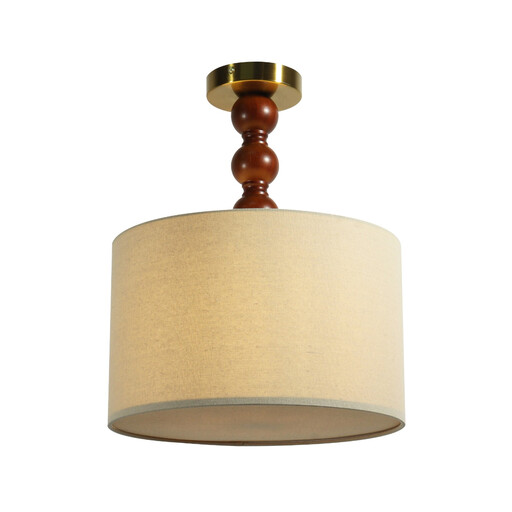
Why this product fits the profile: This light combines a 35 cm linen shade with wooden elements and an E27 socket, so you can choose your own bulb separately.
The maximum power of 60 W and the E27 socket are clearly stated. According to the product description, use is limited to indoor spaces.
Replaceable E27 bulb, fabric shade and wooden elements for dry indoor rooms.

Why this product fits the profile: The integrated LED delivers 2,400 lumens at 3,000 K according to the product data. An internal dimmer offers three brightness levels and a memory function.
Luminous flux, colour temperature, power consumption and dimmer type are all clearly specified. The light is rated IP20 for dry indoor areas.
2,400 lm, warm white 3,000 K and three-step internal dimming with a 35 cm diameter.
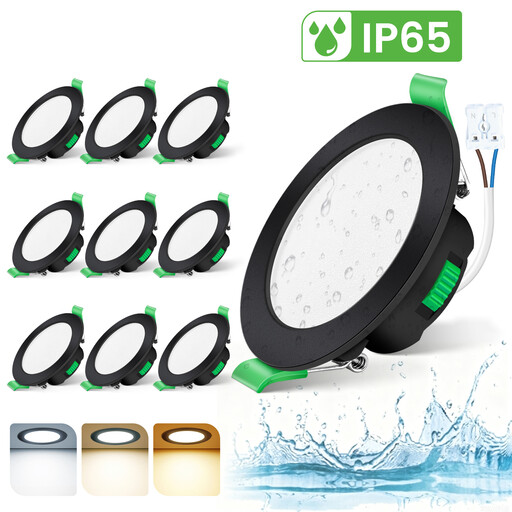
Why this product fits the profile: This six-pack is designed for cut-out openings of 67 to 75 mm and offers 3,000, 4,000 or 6,500 K with dimming from 10 to 100 per cent.
The IP65 rating and the required cut-out size are explicitly stated, making it easier to check suitability before installation.
IP65, three selectable colour temperatures, 600 lm as per specification and direct 230 V connection without a transformer.
We have put together a full, regularly updated list of products that fully meet these strict selection criteria and the safety regulations in force across the EU.
Work on 230-volt mains electricity must only be carried out by suitably qualified persons in Germany. Before installation, the power supply must be switched off and secured against being turned back on. The load-bearing capacity of the ceiling, the position of the connection cables and the fixing materials must all be suitable for the specific light fitting.
For a ceiling light in a living room or bedroom, IP20 is often sufficient. For a hallway ceiling light, the beam angle, overall height and switching convenience are the main considerations. In bathrooms or damp areas, however, the IP rating and installation zone must match. A ceiling light with a motion sensor can be practical in a hallway, provided the range, detection angle and shut-off delay suit your household habits.
For a living room, both a central LED ceiling light and a ceiling spotlight can work well. Warm white 3,000 K is often recommended as suitable for living areas. If your needs change, a dimmable ceiling lamp can adjust the brightness. The room size, luminous flux and desired light distribution remain the deciding factors.
The lifespan depends on the LED module, heat dissipation, operating time and ambient temperature. For the ALIPODLAX light, an average of 30,000 hours is stated in the product information. This figure is a technical manufacturer specification and not a guarantee of identical service life in every household.
The running costs depend on the power, daily usage time and electricity tariff. The simple calculation is: power in kilowatts × operating hours × price per kilowatt-hour. A 24 W light uses 0.024 kWh for one hour of operation. For a realistic comparison, you should also consider the luminous flux, dimming level and actual switch-on time.