
Lieferung heute & morgen

Qualitätsgarantie

Willkommens-Angebote freischalten: KOSTENLOSE Lieferung | Bis zu 80 % RABATT | Kostenlose 30-Tage-JoyPlus-Testphase
App herunterladen
The right ceiling light should illuminate the room adequately, complement your décor, and perform reliably day in, day out. Yet attractive product images and generic marketing claims don’t always lead to the right purchase decision. What really matters are the technical specifications: luminous flux, colour temperature, energy consumption, installation type and room size.
A modern ceiling light may look appealing, but it could still give out too little light for a large room. Wattage alone is no longer a reliable benchmark. With LED lights, you should pay attention to the luminous flux in lumens (lm). The higher the lumen value, the more visible light the fitting generally emits.
As a rough guide:
The actual effect also depends on ceiling height, wall colour, the shape of the fitting and how the light is distributed.
A warm white ceiling light at around 2,700 to 3,000 Kelvin is often a good choice for living rooms, bedrooms and dining rooms. It creates a cosy, inviting atmosphere. However, the label “LED” or “warm white” does not mean the brightness can be adjusted.
If you’re looking for a dimmable ceiling light, check the following:
For example, the Brilliant Teranon LED Ceiling Light is specified with a colour temperature of 3,000 K and is listed as not dimmable. That can work well for even background lighting, but it won’t suit every use case.
A ceiling light for the living room isn’t always straightforward to install yourself. Particularly with pendant lights that have a fixed connection – for example above a kitchen island – installation by a qualified electrician is recommended. Before buying, you should check whether:
When working on the electrical installation, always switch off the circuit at the fuse box. Follow the manufacturer’s installation instructions and comply with local regulations.
Luminous flux is measured in lumens and describes the amount of light emitted. Electrical power is measured in watts. A light with a low wattage can still produce sufficient luminous flux thanks to modern LED technology. For a realistic assessment, it’s worth looking at the ratio of lumens to watts.
According to the product specifications, the Brilliant Teranon LED Ceiling Light delivers 2,300 lm at 24 W. It also has a diameter of 38.5 cm and an energy efficiency class of F. The energy efficiency class should be considered when comparing different models, but on its own it doesn’t tell you the actual running costs. Those depend on how long the light is used and your electricity tariff.
Colour temperature is measured in Kelvin:
The colour rendering index (Ra or CRI) can also be important. A higher value supports more natural colour perception, which is especially relevant in kitchens, dressing rooms and dining areas. If this information is missing, don’t guess – look for a product that provides it.
A ceiling light with a motion detector typically switches on when movement is detected. A presence detector ceiling light can, depending on its technical design, also pick up smaller movements. However, these terms aren’t always used consistently in the trade.
Before buying, check the specific details on detection range, delay time, sensitivity and manual operation. Sensor lighting can be very practical in hallways, utility rooms or entrance areas. In living rooms and bedrooms, however, an overly sensitive sensor could cause unwanted switching.
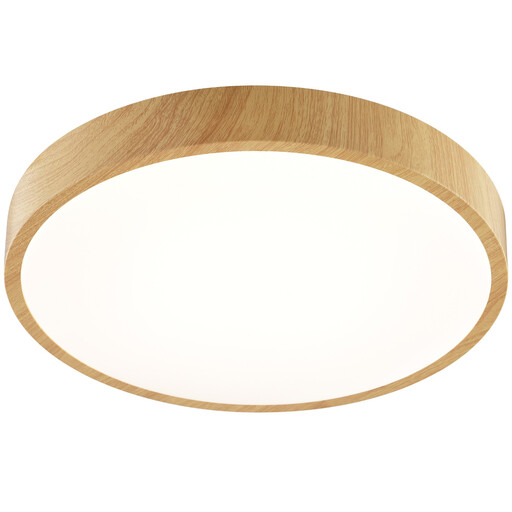
Why this product fits the profile: The built-in LED lighting and compact dimensions make it a good choice for anyone looking for a simple ceiling light for a hallway, bedroom or smaller living area.
The product specifications clearly state 2,300 lm, 24 W and 3,000 K. This makes it much easier to assess the expected background lighting than with a purely design-focused description.
2,300 lm luminous flux, warm white 3,000 K lighting and a diameter of 38.5 cm. Not dimmable.
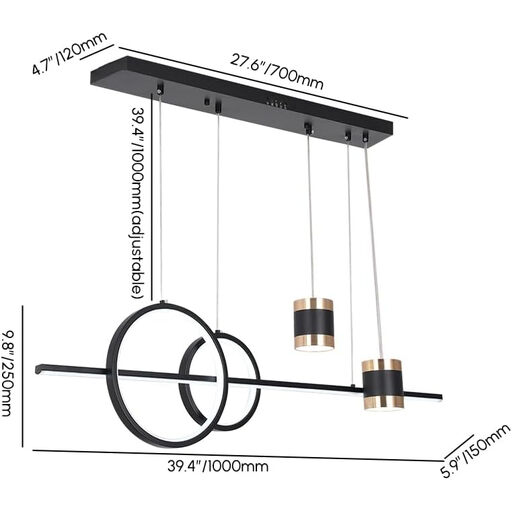
Why this product fits the profile: The four-light design with geometric metal and silica styling is aimed at dining rooms and kitchen islands, creating a clear focal point in your décor.
The specifications clearly state that it requires a fixed connection and recommends installation by a qualified electrician. The installation effort is not hidden.
Four LED light sources, 220 V, remote control with dimming function, and dimensions of 125 × 100 × 12 cm according to the product description.
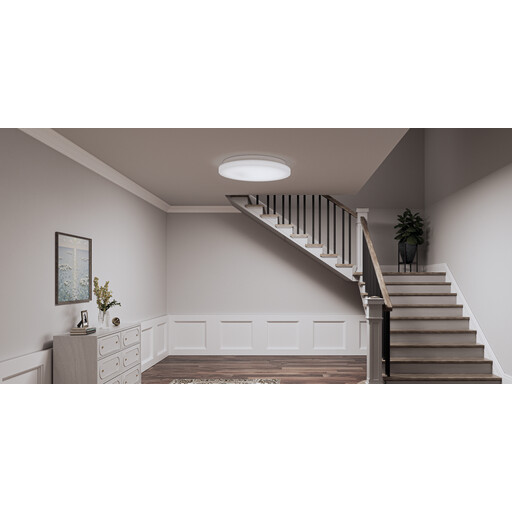
Why this product fits the profile: The model name indicates a sensor light with presence detection. This makes it an interesting option for areas where you want the light to activate on demand.
Rather than choosing a random motion-detector ceiling light based on the name alone, you should check the specific sensor range and delay time on the product page before buying.
Sensor-oriented design according to the model name. Before use, check the detection range, operating options and installation instructions.
We’ve put together a full, regularly updated list of products that meet these strict selection criteria and comply with all EU safety regulations.
That depends on the room size, how you use it and the lighting effect you want. For a small hallway, around 1,000 to 1,500 lm is often enough. Kitchens, living rooms and dining rooms usually need more. In large rooms, a combination of a ceiling light, wall lights and indirect lighting can be more effective than a single very bright fitting.
The running costs are determined by the wattage, daily usage time and your electricity tariff. A simple calculation is: wattage ÷ 1,000 × hours of use × price per kilowatt-hour. For example, at 24 W and three hours of daily use, the annual consumption works out at around 26.3 kWh. The exact amount depends on your individual tariff.
The lifespan depends on factors such as heat dissipation, hours of use, switching cycles and component quality. You should check the lifespan stated by the manufacturer and the warranty conditions. With built-in LEDs, it’s also worth knowing whether individual components can be replaced if a repair is needed, or whether the entire light has to be replaced.