
Lieferung heute & morgen

Qualitätsgarantie

Willkommens-Angebote freischalten: KOSTENLOSE Lieferung | Bis zu 80 % RABATT | Kostenlose 30-Tage-JoyPlus-Testphase
App herunterladen
A new ceiling light should illuminate the room well, complement your décor and be safe to install. Yet product descriptions can often lead to the wrong purchase. Terms such as ‘ultra-slim’, ‘energy-efficient’ or ‘suitable for bathrooms’ are only useful if the technical specifications back them up.
Colour temperature is measured in Kelvin and describes whether light appears warm, neutral or cool. 3,000 Kelvin typically produces warm white light, while 6,500 Kelvin looks distinctly cool white. However, the Kelvin rating tells you nothing about brightness. For that, the key figure is luminous flux, measured in lumens.
An LED ceiling light with 2,400 lumens can illuminate a larger room more evenly than a model with significantly fewer lumens. When choosing, consider the room size, ceiling height, wall colours and how you plan to use the light.
An IP44 rating protects against solid objects and water splashes from different directions. It does not mean a light is suitable for direct jets of water, persistently high humidity or immersion. So, choose a bathroom ceiling light to suit its installation zone and the conditions in the room.
Models rated IP20 are generally intended for dry indoor spaces. This type of low-profile ceiling light could, for example, suit a bedroom, living room or hallway, but should not be installed directly in damp areas.
With LED recessed spotlights, the visible diameter isn’t the only thing to consider. You’ll also need to check:
An oversized cut-out is not easy to correct. Measure the existing ceiling cut-out carefully before placing your order.
Wattage mainly indicates energy consumption, not actual brightness. So, compare the lumen rating first. A wide beam angle spreads light over a larger area, while ceiling spotlights with adjustable heads let you highlight specific areas.
For a living room ceiling light, even light distribution can be a good choice. In a kitchen, hallway or work area, several LED recessed spotlights or adjustable ceiling spotlights can provide more focused lighting.
A dimmable ceiling light needs to be compatible with a suitable dimmer. Not all LED lights can be dimmed. Some models let you choose the brightness using an integrated three-step switch, while others require an external leading-edge or trailing-edge dimmer.
Also check whether the colour temperature is fixed or adjustable. A model with a 3CCT function, for example, can switch between 3,000, 4,000 and 6,500 Kelvin. This gives you more flexibility, but you’ll need to set it correctly before or during installation.
The IP rating must be suitable for the room. IP20 is often used for dry rooms such as bedrooms and living rooms. IP44 may be appropriate in areas exposed to splashes. Your final choice and installation should comply with current electrical regulations.
Work on a 230-volt connection must only be carried out by a suitably qualified electrician. Before installation, switch off the power at the fuse box and make sure it cannot be switched back on.
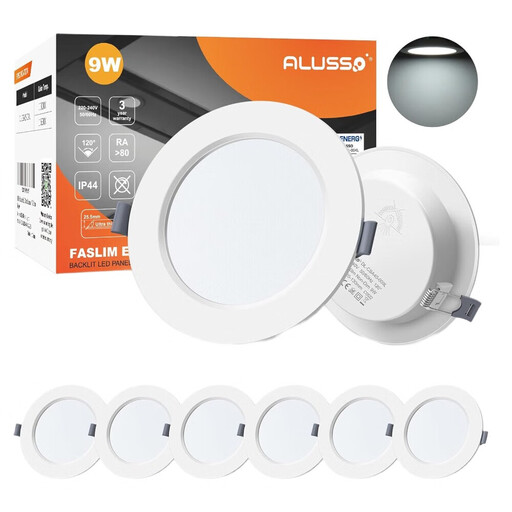
Why this product suits this profile: This set of six is ideal if you’re renovating and need several low-profile light points, with a direct 220–240-volt connection. The stated recess depth is 25.5 mm.
The product specifications clearly state the recess depth, ceiling cut-out of 115–135 mm, luminous flux and IP44 rating. This makes it easier to check the available space and suitability for the room before buying.
9 W, 720 lumens, 6,500 Kelvin, IP44 and a stated lifespan of over 30,000 hours. According to the product specifications, this model is not dimmable.

Why this product suits this profile: This integrated LED ceiling light combines a compact design with warm white light and an integrated three-step brightness control. It is designed for living rooms, bedrooms, kitchens and hallways.
The specifications clearly distinguish between power, luminous flux and colour temperature. The 3,000 Kelvin rating indicates warm white light; the three brightness levels are not a substitute for a freely adjustable dimmer.
2,400 lumens, 24 W, 35 cm diameter, memory function and three-step dimming. It has an IP20 rating, making it suitable for dry indoor spaces.
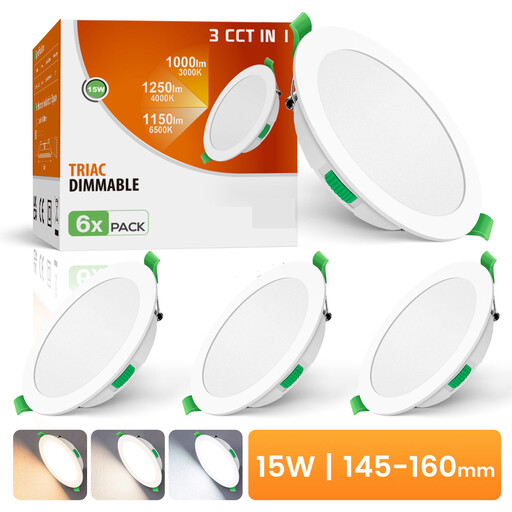
Why this product suits this profile: If you want different lighting effects for different situations, you can choose between 3,000, 4,000 and 6,500 Kelvin. The brightness can also be adjusted from 10 to 100 per cent.
The product description specifies a required ceiling cut-out of 145–160 mm and notes that a compatible phase-control dimmer is needed. The IP44 rating is described as protection against water splashes only.
15 W, 1,200 lumens, 120-degree beam angle, 3CCT switching, dimmable and IP44 rated. The stated recess depth is 32 mm.
We’ve put together a complete, regularly updated list of products that meet these strict selection criteria and fully comply with the safety regulations in force in the EU.
Low-profile ceiling lights or LED recessed spotlights with a shallow recess depth are practical choices for rooms with low ceilings. Before buying, check the ceiling cut-out, visible dimensions and colour temperature. Warm white light of around 3,000 Kelvin is a popular choice for bedrooms and living areas.
The amount you need depends on the size of the room, how you use it and how many light sources you have. Check the luminous flux in lumens rather than looking at wattage alone. Several ceiling spotlights can direct light more precisely, while a central LED ceiling light can provide more even ambient lighting.
Running costs depend on the light’s power, how many hours you use it each day and your electricity tariff. For a rough estimate, use: wattage ÷ 1,000 × hours of use × electricity price. For example, a 24 W light uses 0.24 kilowatt-hours when switched on for ten hours. Use your own electricity tariff to work out the actual cost.