
Lieferung heute & morgen

Qualitätsgarantie

Willkommens-Angebote freischalten: KOSTENLOSE Lieferung | Bis zu 80 % RABATT | Kostenlose 30-Tage-JoyPlus-Testphase
App herunterladen
The right ceiling light should illuminate a room sufficiently, complement your interior style, and work reliably day in, day out. Yet product images and marketing claims don’t always lead to a good purchasing decision. All too often, people focus only on the design or the wattage, while important details about the fitting, colour temperature, installation and dimmability are overlooked.
Three common buying mistakes are particularly worth noting:
When assessing an LED ceiling light, the lumen (lm) value is crucial. It describes the amount of light emitted. A 24-watt light can vary significantly in brightness depending on the LED technology used.
As a practical guide:
A 36-watt LED ceiling light from our selection is specified at 4,000 lumens and 6,500 Kelvin. This colour temperature is cool white and may be suitable for work areas, but in a cosy living room it can feel more clinical than warm white light. The product description also mentions an expected lifespan of 50,000 hours. Such figures should be understood as product specifications and not equated with a guarantee of actual usage duration.
If you want the flexibility to change bulbs, you can choose a ceiling light with an E27 fitting or an E14 fitting. In this case, pay attention to the maximum permitted wattage. The Brilliant Retro ceiling light has an E27 fitting and, according to the product description, is designed for bulbs up to 40 watts. External dimming is possible with a compatible dimmable bulb and a suitable dimmer switch.
The Atmosphera Lio light uses three E14 fittings. Bulbs are not included. This means buyers can choose their own colour temperature and brightness, but will need to budget for three matching bulbs separately.
Before installation, you should check:
Work on a 230-volt connection should be carried out by a qualified electrician in accordance with current safety regulations.
A modern ceiling light with a large diameter can look oversized in a small hallway. For rooms with low ceilings, flat models are usually more practical. For a dining area or kitchen island, on the other hand, a pendant light with directional light can make more sense.
The material also affects the overall effect:
Also pay attention to protection ratings such as IP20. This marking is common for lights intended for dry indoor spaces. Different requirements apply for damp rooms. A kitchen ceiling light should not automatically be used in areas exposed to direct splashing water.
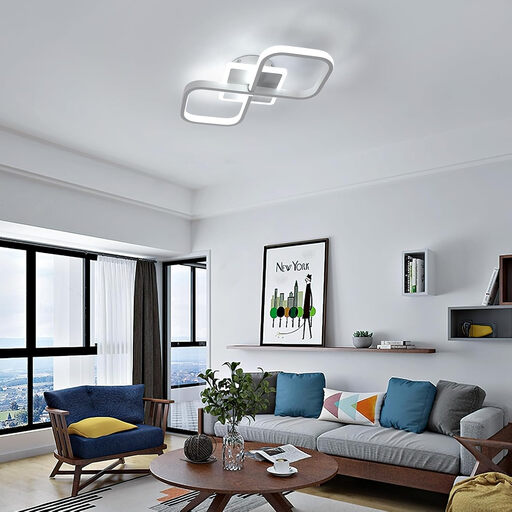
Why this product suits the profile: The integrated LED technology and specified light output make this model interesting for rooms where a bright, general light is needed.
The product details list both wattage and lumens as well as colour temperature. This makes it easier to assess brightness than relying on wattage alone.
36 W, 4,000 lm, 6,500 K and acrylic cover according to the product description; suitable for bright work and living areas.
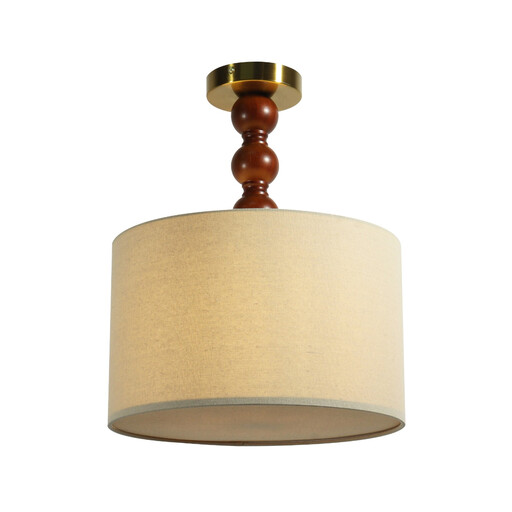
Why this product suits the profile: Wood details, gold-toned elements and a linen shade appeal to households looking to combine decorative materials with a classic E27 fitting.
The fitting, maximum wattage, mounting plate and cable details are all clearly listed. This makes checking before installation much easier.
E27 ceramic fitting, linen shade and wood component; maximum bulb wattage 60 W according to the product description.
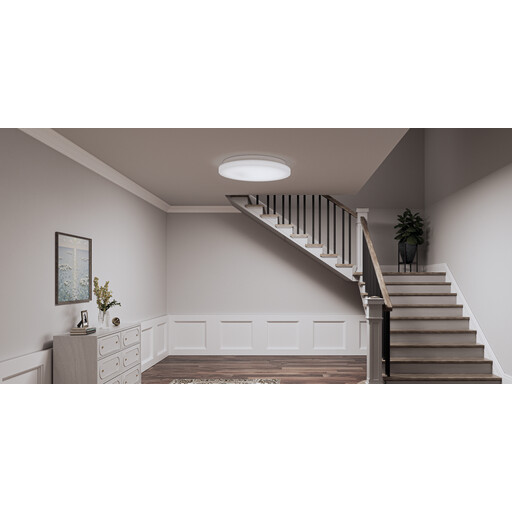
Why this product suits the profile: The stated presence detection feature is aimed at users looking for a ceiling light with a motion or presence sensor for hallways, entrance areas or frequently used rooms.
The sensor function is clearly listed as a specific feature. Before buying, you should check the detection range, delay time and installation requirements in the full details.
Presence detection according to the product name; designed for automatic light control indoors.
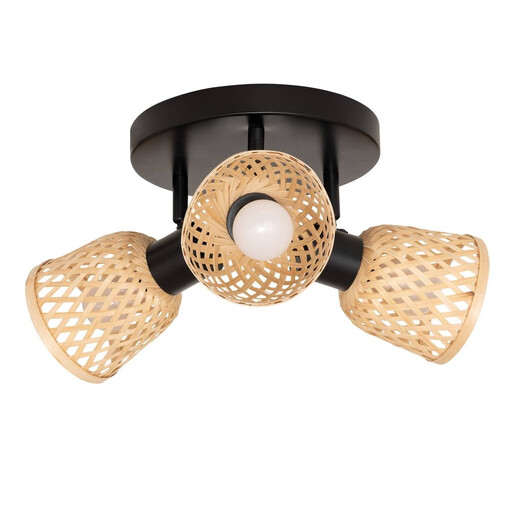
Why this product suits the profile: Three adjustable light points and woven bamboo shades are ideal for small rooms, hallways or areas where you want to highlight specific zones.
The dimensions of 25 cm, the E14 fitting and the maximum wattage of 25 watts are all specified. This makes it easier to match the model to your room size.
Three adjustable spots, bamboo shades with FSC certification and IP20 rating for dry indoor areas according to the product description.
We have put together a complete, regularly updated list of products that fully meet these strict selection criteria and the safety regulations in force in the EU.
For a ceiling light in the living room, warm white colour temperatures around 2,700 to 3,000 Kelvin are often a good choice. Also important are the room size, the desired brightness and any additional lights you already have. A dimmable ceiling light can be useful if you want to use the lighting both for reading and for creating a more relaxed atmosphere.
The lifespan depends on the LED module, operating time, heat dissipation and usage. Manufacturer or product specifications such as 50,000 hours are guideline figures and not a guarantee for every situation. With an integrated LED, the bulb usually cannot be replaced as it can with an E27 or E14 fitting. This difference should be considered before you buy.
The consumption depends on the power rating and the daily operating time. An energy-saving ceiling light with LED technology typically requires less power for the same usage time than older bulbs. To calculate running costs, you can use: wattage ÷ 1,000 × hours of use × electricity price per kilowatt-hour. You should also check whether a sensor, dimmer or remote control offers the convenience you want without causing unnecessary operating times.