
Lieferung heute & morgen

Qualitätsgarantie

Willkommens-Angebote freischalten: KOSTENLOSE Lieferung | Bis zu 80 % RABATT | Kostenlose 30-Tage-JoyPlus-Testphase
App herunterladen
A new ceiling light should illuminate your room effectively, suit your décor and be safe to install. However, product images and brief marketing claims don’t always help you make the right choice. Important details such as luminous flux, bulb type and IP rating are often tucked away in the small print.
These are three of the most common buying mistakes:
Check a few technical details before you buy to avoid these pitfalls and choose more confidently between LED ceiling lights, ceiling spotlights and ceiling lights with adjustable spots.
Flush lights and compact spotlights are well suited to smaller spaces such as hallways, entrance areas and storage rooms. A living room ceiling light, on the other hand, can have a wider spread and higher luminous flux. It’s not just the diameter that matters: the position of the light source and the direction of the shades also make a difference.
A ceiling light with adjustable spots is a good choice if you want to highlight specific areas. For example, swivel or adjustable spotlights can be directed towards a reading nook, dining table or picture on the wall. For general room lighting, an even spread of light is usually more important than a tightly focused beam.
Before you buy, check:
Colour temperature is measured in kelvins. Warm white light at around 2,700 to 3,000 kelvins is a popular choice for living rooms, bedrooms and dining areas. Cooler, more neutral colour temperatures can be useful in kitchens, studies and utility rooms.
For LED lights, luminous flux in lumens is more informative than wattage alone. Wattage mainly indicates energy consumption, while lumens tell you how much light the product gives off. An integrated LED ceiling light can therefore provide a particular level of brightness while using relatively little power.
Also check that the dimming function is compatible with your setup. A dimmable ceiling light may be controlled by a wall switch, remote control or app, but these systems aren’t always compatible with one another. If you’re choosing smart bulbs, check the Wi-Fi or Bluetooth requirements and which app you’ll need to use.
A wooden ceiling light or a ceiling light with bamboo details can add a natural touch to your room. Check the precise material description, care instructions and suitability for indoor use. Glass can also affect the quality of the light: an amber glass shade creates a different atmosphere from clear or frosted glass.
For bulb holders, check the fitting type and maximum wattage. E27 and E14 fittings are common. If bulbs aren’t included, you’ll need to buy them separately. With integrated LEDs, the light source usually can’t be replaced like a standard bulb, so check the stated lifespan and warranty information before you buy.
The IP rating indicates protection against solid objects and water. IP20 is intended for dry indoor spaces and isn’t suitable for areas exposed to splashing water. A bathroom ceiling light needs an appropriate IP rating for its installation location and must meet the relevant installation requirements.
The products below vary in design, materials, lighting technology and installation type. The details are based on the descriptions provided for each product.
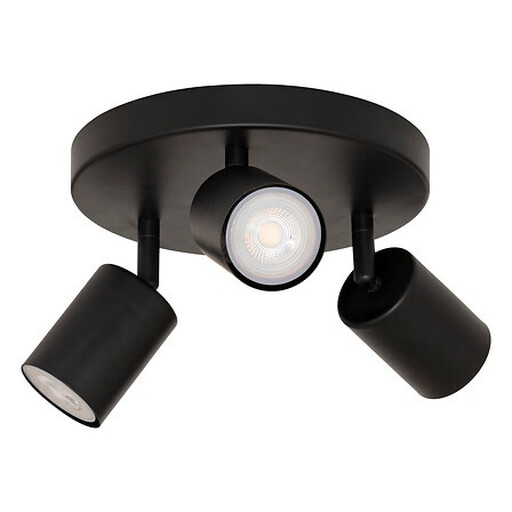
Why it suits this profile: This compact black metal light has three adjustable spots, making it a good fit for smaller rooms, hallways or areas that need focused lighting.
The 20 cm diameter and three spots are clearly stated, making it easier to judge whether the light is right for your room.
Steel construction, three adjustable spotlights and a height of 14 cm.

Why it suits this profile: The wood-effect finish, integrated LED and three-stage dimming make this light a versatile choice for living rooms, bedrooms, kitchens and hallways.
Luminous flux, colour temperature, power consumption and dimming levels are all clearly specified, making it easier to assess the technical details.
24 W, 2,400 lm, 3,000 K, 35 cm diameter, integrated LED and three-stage dimming with memory function.
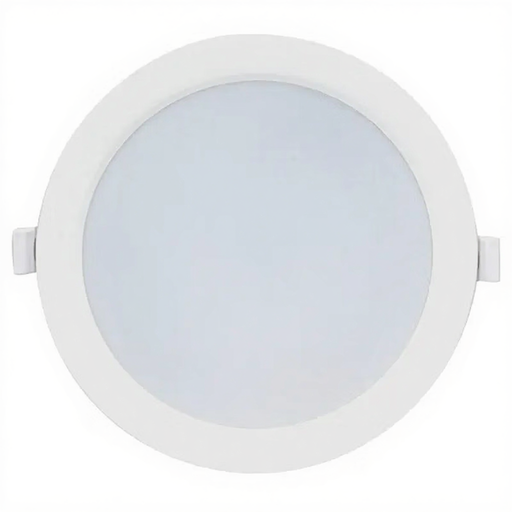
Why it suits this profile: This recessed light is for anyone who wants to adjust the colour temperature and brightness, and control the light via an app or voice commands.
The required ceiling cut-out of 150 to 160 mm and IP20 rating are specified, so you can check in advance whether it’s suitable for a dry indoor space.
15 W, 1,430 lm, adjustable colour temperature from 2,700 to 6,500 K, plus Bluetooth and Wi-Fi control.
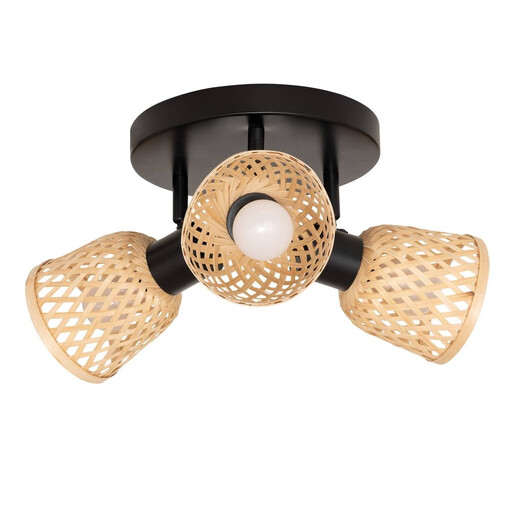
Why it suits this profile: Three adjustable lights with bamboo shades make this a good choice for hallways, bedrooms and smaller living spaces with natural décor.
The light is rated IP20 for indoor use. The E14 fitting, maximum wattage and fact that bulbs aren’t included are also clearly stated.
Bamboo shades, FSC information, three E14 light points, 25 cm width and adjustable spots.
A ceiling light should be connected to the mains in Germany by a suitably qualified person. Before installation, check the circuit, fixing points and weight of the light. For recessed lights, you’ll also need to check the ceiling cut-out and recess depth.
Power consumption is important when working out running costs. As a simple guide:
Power in kilowatts × hours of use × electricity price = electricity costs
One hour of use for a 24-watt light is equivalent to 0.024 kilowatt hours. The actual cost depends on how long you use it and your current electricity tariff. An integrated LED can reduce the need to replace bulbs, but if it fails, it may not be possible to replace it separately.
We’ve put together a complete, regularly updated list of products that meet these strict selection criteria and fully comply with the safety regulations in force in the EU.
Warm white light at around 2,700 to 3,000 kelvins is a popular choice for bedrooms. A dimmable ceiling light lets you adjust the brightness for general lighting or a softer, more relaxing evening atmosphere. It’s also important to choose the right size and look for an even spread of light.
Lifespan depends on the LED module, operating conditions, heat dissipation and usage. Check the manufacturer’s stated lifespan, as well as the warranty and guarantee information. If the light has an integrated LED, it’s also worth checking whether the module can be replaced.
The main factors are wattage, how many hours the light is used each day and the cost of electricity. For a realistic estimate, convert the power consumption from watts to kilowatts, then multiply it by the annual hours of use. Claims such as ‘energy-saving’ are no substitute for a specific power consumption figure.