
Lieferung heute & morgen

Qualitätsgarantie

Willkommens-Angebote freischalten: KOSTENLOSE Lieferung | Bis zu 80 % RABATT | Kostenlose 30-Tage-JoyPlus-Testphase
App herunterladen
A new ceiling light needs to light the room properly, suit your interior style, and be safe to install. In practice, however, unclear technical specifications, unsuitable protection ratings and overestimated design features often lead to the wrong purchase. If you are looking for an LED ceiling light, a smart LED ceiling light or a decorative ceiling light with spots, you should pay attention to more than just the look and the price.
Wattage primarily describes power consumption. For actual brightness, the luminous flux in lumens is what matters. An 18-watt LED can, for example, deliver up to 1,800 lumens, while another light with a similar power draw produces significantly less light. For comparison, you should always consider lumens, light distribution and room size.
Moisture and splashing water place special demands on a light fitting. The IP rating shows how well a product is protected against the ingress of foreign objects and water. A light with IP54 is protected against limited dust ingress and splashing water from any direction. A light with IP20, on the other hand, is only intended for dry indoor areas.
The protection rating alone does not replace proper planning. In the bathroom, you must also consider the installation zones and applicable electrical regulations. Connection to the mains should be carried out by a qualified electrician.
With a dimmable ceiling light, the brightness control can be implemented in different ways. Some models require a suitable wall dimmer, others have a built-in 3-step dimmer or can be controlled via an app. Before buying, you should be clear about which control method is compatible with your existing electrical installation.
Colour temperature is given in Kelvin:
A light with adjustable colour temperature can be used more flexibly. For a ceiling light for the living room or ceiling light for the bedroom, warm white light is usually preferred. In the kitchen, neutral white light can offer a more practical orientation.
Also pay attention to the colour rendering index (CRI) . A value above 80 is common for many indoor lights. It describes how naturally colours appear under the light.
A ceiling light with even light distribution is suitable for general room lighting. A ceiling light with spots, on the other hand, distributes the light more precisely and can highlight specific areas or furniture. With three adjustable light points, the direction can be individually adjusted.
For small rooms, a compact light with around 1,000 to 1,800 lumens may be sufficient, while larger living or working areas may need more light sources. Furniture, wall colours and ceiling height also affect the effect. A single light does not automatically replace a multi-part lighting plan.
Before buying, you should check whether it is a classic ceiling mount, a recessed light or a model for an existing junction box. Recessed spots often require a defined cut-out and a separate transformer. With a 12 to 24 volt model, it must not be connected directly to 220 to 240 volts.
The included components are also relevant. Some lights contain bulbs, others use E14 or E27 sockets and are supplied without bulbs. With decorative models such as a wooden ceiling light or bamboo light, you should also check the maximum permitted wattage.
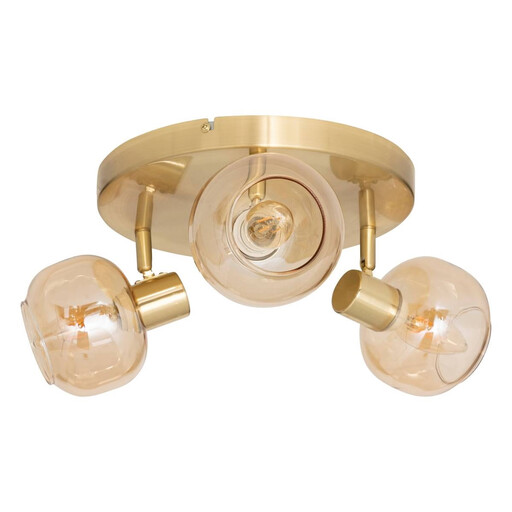
Why this product fits the profile: The compact light with three adjustable spots is suitable for living rooms, hallways or bedrooms and does not require a separate lamp housing at the junction box.
The three light points are adjustable, so the lighting does not depend on a single fixed direction. The specifications also mention the material, a diameter of 25 cm and a CE marking.
Steel and amber glass; three adjustable spots; intended for dry indoor areas.
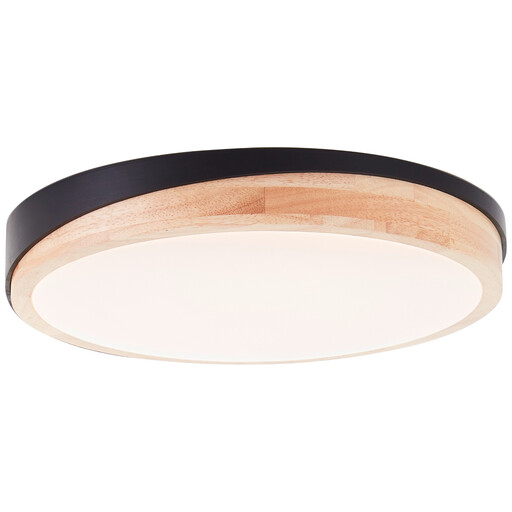
Why this product fits the profile: The combination of a wood-effect finish, integrated LED module and warm white light suits living and sleeping areas when you are looking for a decorative, permanently installed modern ceiling light.
The product data lists not only the power consumption, but also 2,400 lumens, 3,000 Kelvin, three dimming levels and a memory function.
24 W LED, 2,400 lm, 3-step dimmable, 35 cm diameter, warm white light at 3,000 K.
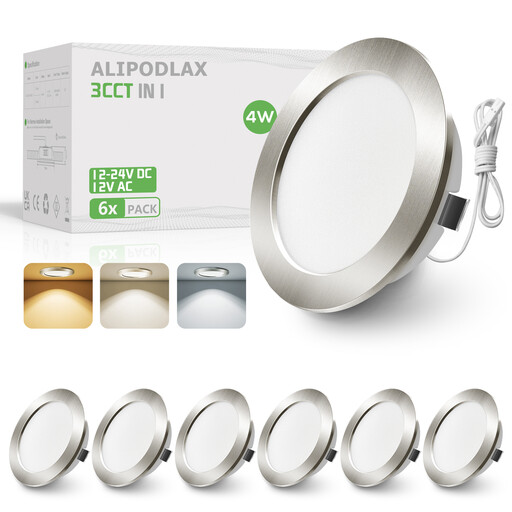
Why this product fits the profile: The low-profile spot is suitable for cupboards, under-counter areas, kitchens and selected damp indoor areas when an unobtrusive recessed light is needed.
The required cut-out of 55 to 58 mm and the installation height of 14.5 mm are specified. Important: a compatible 12 to 24 volt transformer is required and not included.
4 W, 270 lm, three selectable light colours at 3,000, 4,000 or 6,000 K, IP44, aluminium housing.
A smart LED ceiling light can be controlled via an app, voice assistant or automation. The Hama model with Matter support works, according to the product information, with Apple Home, Google Home, Samsung SmartThings, Amazon Alexa, Home Assistant and Smart Life. In addition, RGBW colours, adjustable white from 2,700 to 6,500 K and stepless dimming are provided.
Before buying, smart home users should check their existing Wi-Fi. When using the Hama Home app, the light connects directly to a 2.4 GHz Wi-Fi network; a separate hub is not required for this. Matter can make integration into compatible systems easier, but it assumes that the hub and app you are using support the desired functions.
For bathrooms, kitchens or cellars, the stated protection rating of IP54 is relevant for this model. However, the light must not be submerged or exposed to a direct water jet. Installation at 220 to 240 volts should be carried out by a qualified electrician.
We have put together a complete, regularly updated list of products that fully meet these strict selection criteria and the safety regulations in force in the EU.
That depends on the room size, ceiling height, wall colour and additional lighting. For the general lighting of a small to medium-sized living room, around 1,500 to 3,000 lumens can be a useful guideline. Even light distribution is crucial, not just the wattage.
The lifespan is given by the manufacturer in operating hours. With integrated LEDs, replacing the bulb is often not possible. Therefore, check the product data, warranty conditions and the possibility of repair before you decide on a fixed LED ceiling light.
The annual electricity costs can be calculated: Power in kilowatts × operating hours × electricity price. A 24-watt light uses 24 kilowatt-hours over 1,000 operating hours. The actual price depends on your individual electricity tariff. Also pay attention to the stated energy efficiency class and the luminous flux, so that consumption and brightness can be assessed together.