
Lieferung heute & morgen

Qualitätsgarantie

Willkommens-Angebote freischalten: KOSTENLOSE Lieferung | Bis zu 80 % RABATT | Kostenlose 30-Tage-JoyPlus-Testphase
App herunterladen
A new ceiling light should illuminate the room sufficiently, complement your interior style and be reliable and easy to use every day. Even so, choosing the right one is not always straightforward. Product images can disguise the actual size, descriptions such as “bright” are of little use without a lumen value, and an integrated LED usually cannot be replaced like a conventional bulb if it develops a fault.
When comparing ceiling lights for living rooms, bedrooms, hallways or home offices, you should therefore look beyond the design. Three common buying concerns deserve particular attention:
For choosing an LED ceiling light, luminous flux in lumens is the most important comparison value. A small bedroom generally needs less light than a large living room or kitchen. The colour of the room, ceiling height and number of additional light sources also affect how bright the light appears.
As a practical guide:
The specifications should always be checked in the relevant product data sheet. For example, one 36 W light may be listed as producing 4,000 lumens, while another light with a similar power consumption may emit considerably less light.
Colour temperature is measured in kelvins (K). A modern ceiling light at 3,000 K produces warm white light and is often used in living rooms, bedrooms or hallways. Light at 4,000 K appears more neutral and can be suitable for work areas. At 6,500 K, the light looks noticeably cooler and is better suited to rooms where high visibility is required.
A dimmable ceiling light gives you additional flexibility. However, check whether the light:
“Dimmable” is therefore not one uniform technical feature. You should be clear about the exact control method before buying.
With a ceiling light with an E27 fitting, you can choose the bulb separately and replace it later. Check the number of fittings and the permitted maximum wattage. A lamp with three E27 fittings can create a different lighting effect from a single fitting with a higher-powered bulb.
A wooden ceiling light, or one with a wood-effect finish, brings a natural look to the room. It is important to distinguish between genuine wood and plastic with a wood-effect finish. Glass and fabric shades affect both light distribution and cleaning requirements. For dry indoor rooms, a light without a specific moisture-protection rating is often sufficient. For bathrooms, covered outdoor areas or other damp environments, the stated IP rating must be suitable for the intended location.
The electrical connection should be carried out in accordance with the manufacturer’s instructions and national installation regulations. Hard-wired ceiling lights must be installed by a qualified electrician.
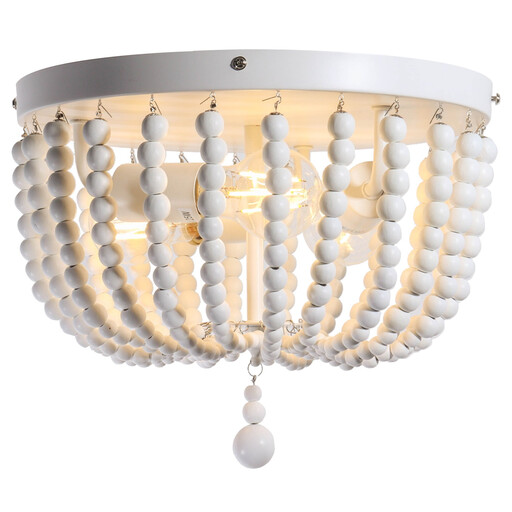
Why this product suits this profile: The light has three ceramic E27 fittings, allowing you to pair it with bulbs of your choice for hallways, bedrooms or smaller living areas.
The replaceable bulbs avoid the limitation of a permanently integrated LED. The maximum output of 25 W per bulb must be observed.
Three ceramic E27 fittings and a shade made from white wooden beads; designed for indoor use.

Why this product suits this profile: This ceiling light combines a wood-effect finish with warm white light and three brightness levels. It is well suited to living rooms and bedrooms where you want to adjust the light intensity easily.
The product data specifies 2,400 lm, 3,000 K and three-stage internal dimming. This makes the key brightness and light-colour specifications easy to verify.
24 W, 2,400 lm, warm white 3,000 K, three dimming levels with memory function and FSC certification.
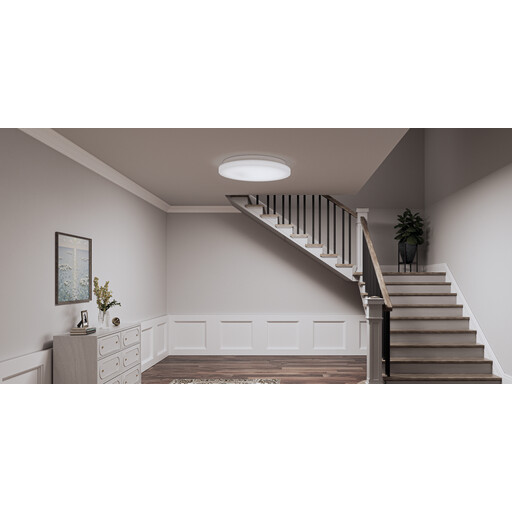
Why this product suits this profile: The name indicates presence detection. This could be useful for hallways, entrance areas or households looking for automatic lighting control.
Rather than judging the sensor function from promotional images alone, check the range, detection angle, adjustment options and compatibility before buying.
Model with a stated presence-detection function; suitable for buyers looking for a ceiling light with a motion or presence sensor.
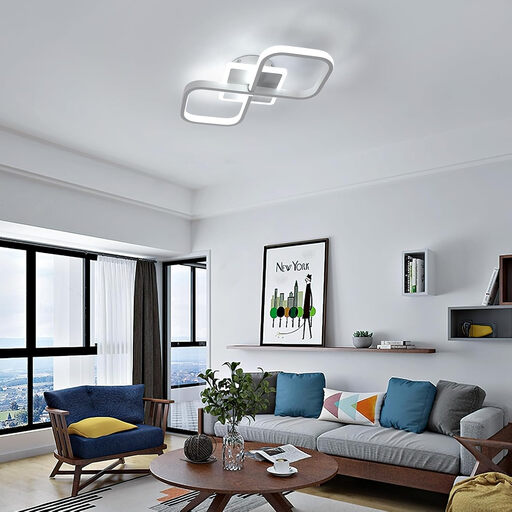
Why this product suits this profile: The stated power of 36 W and luminous flux of 4,000 lm are intended for rooms where bright, cool illumination is needed for reading, studying or working.
The product description gives specific values for lumens, kelvins and power. The 6,500 K colour temperature should be chosen deliberately, as it is noticeably cooler than warm white light.
4,000 lm, 36 W, integrated LED technology and an acrylic cover with, according to the product description, even light distribution.
Before placing your order, check the existing ceiling outlet, mounting method and dimensions. A light measuring 35 or 38.5 cm in diameter needs enough space and should not clash with doors, cupboards or tall furniture.
Also bear the following in mind:
Warm white models at around 2,700 to 3,000 K are often suitable for living rooms. You should also consider the size of the room, lumen value, light distribution and the level of dimming you require. In larger rooms, combining a ceiling light with floor and wall lights can be a sensible option.
Consumption depends on the power rating in watts and how long the light is used each day. A 24 W light uses 0.024 kWh when operated for one hour. To calculate the running cost, multiply this figure by the usage time and your contracted electricity price. You should also check the energy efficiency class in the product data sheet.
Integrated LEDs are often given an expected service life. This figure is supplied by the manufacturer and can be affected by operating time, heat generation and the quality of the electrical installation. With E27 lights, the bulb can be replaced independently of the light fitting.