
Lieferung heute & morgen

Qualitätsgarantie

Willkommens-Angebote freischalten: KOSTENLOSE Lieferung | Bis zu 80 % RABATT | Kostenlose 30-Tage-JoyPlus-Testphase
App herunterladen
A suitable ceiling light should illuminate the room sufficiently, complement your interior style and work reliably in everyday use. However, there are clear differences in technology, installation and operation between an LED ceiling light for the living room, a black ceiling light for the hallway and a dimmable ceiling lamp for the bedroom.
Many disappointing purchases are not caused by the design, but by three common pitfalls:
Luminous flux is measured in lumens (lm). The higher the value, the more visible light a fitting generally emits. When choosing, you should consider the room size, ceiling height, wall colours and intended use.
As a general guide:
These figures are intended as a guide only. A living room ceiling lamp should not be selected solely according to its maximum brightness. A directional ceiling spotlight can also be useful for a workspace, reading corner or kitchen worktop.
Colour temperature is measured in Kelvin (K):
A dimmable ceiling light allows you to adjust the brightness to suit the time of day and how the room is being used. It is important to check whether dimming is controlled via a wall switch, remote control or app. Some models also offer different colour temperatures. You should also check whether a memory function is included and whether the last selected setting is retained when the light is switched on again.
Before buying, measure the available ceiling space. Models with a diameter of 20 to 35 cm are often suitable for smaller rooms or as an additional light source. Larger lights can illuminate a wider area, but require sufficient space.
Materials such as metal, aluminium, plastic, glass or wood-effect finishes affect the weight, appearance and maintenance requirements. A black ceiling light made from metal, for example, complements modern, industrial or minimalist interiors. Glass shades diffuse the light, while adjustable spotlights allow you to direct it precisely.
IP20 is commonly used for dry indoor areas. This rating means that the light has no special protection against moisture. For bathrooms, covered outdoor areas or damp rooms, you must follow the manufacturer’s information regarding the IP rating.
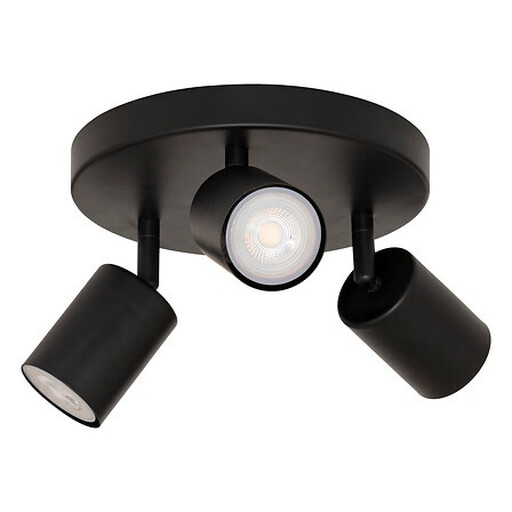
Why this product suits this profile: Measuring 20 cm in diameter, this compact light has three adjustable spotlights, allowing you to direct the light towards specific areas.
The adjustable spotlights reduce the risk of ending up with a purely decorative light that provides no targeted illumination. Check the bulbs and permitted wattage against the instructions before installation.
Black steel housing, three adjustable lamps and a weight of 0,617 kg.

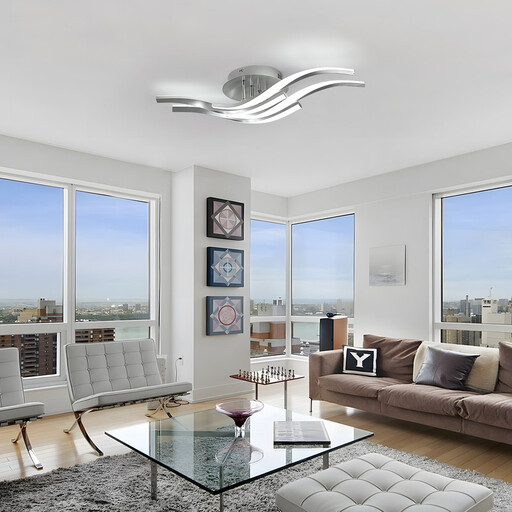
Why this product suits this profile: Integrated LED technology, 2,400 lumens and warm white light at 3,000 Kelvin combine practical specifications with a wood-effect finish.
The stated lumen, wattage and Kelvin values make it easier to assess brightness and colour temperature. The integrated three-stage dimmer is clearly specified.
24 W, 2,400 lm, 3,000 K, 35 cm diameter, integrated LED and memory function.
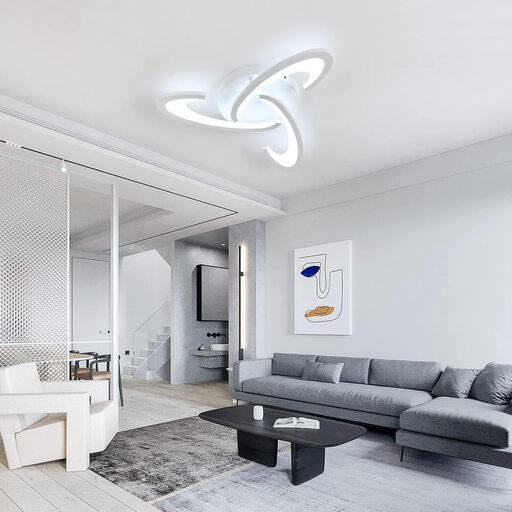
Why this product suits this profile: This integrated LED light is designed for indoor spaces of around 10 to 20 m² and creates a cool white atmosphere with a colour temperature of 6,500 Kelvin.
The recommended room size and colour temperature are specified. This allows you to check before buying whether the light is suitable for an office, kitchen or bedroom and matches your personal lighting preference.
32 W, integrated LED technology, geometric design and stated suitability for 10 to 20 m².
Why this product suits this profile: This three-light LED fitting offers stepless brightness adjustment and a colour temperature ranging from 3,000 to 6,500 Kelvin.
The control method, dimming range of 5 to 100 per cent and colour temperature are described in specific terms. This reduces the risk of expecting a control feature based solely on an advertising claim.
Remote control, stepless dimming, 3,000 to 6,500 K and memory function.
An energy-efficient ceiling lamp should be assessed not just by its label, but by its power consumption and operating time. A 24 W light uses 24 kWh over 1,000 operating hours. The actual cost depends on your individual electricity tariff and daily usage.
With integrated LEDs, there is no need to replace individual bulbs regularly. However, depending on the design, the entire light may need to be replaced if a fault develops. Models with E27 fittings allow bulbs to be replaced separately. Before buying, therefore, check whether you prefer a permanently installed LED or a replaceable light source.
Before carrying out any work on the electrical installation, switch off the power supply and ensure it cannot be switched on again accidentally. The light should be installed according to the instructions by a qualified electrician. Pay attention to:
We have put together a complete, regularly updated list of products that fully meet these strict selection criteria and the safety regulations applicable in the EU.
This depends on the room size and any additional lights already in place. Around 2,000 to 4,000 lumens may be suitable for a medium-sized living room. Several light sources usually distribute brightness more evenly than a single, very powerful lamp.
Both solutions offer different advantages. A remote control allows you to adjust the brightness and colour temperature from your seat or bed. A wall switch does not rely on batteries and is usually easy to reach near the entrance. The key factor is which type of control is most practical for the room in question.
The lifespan depends on the LED module, electronics, heat dissipation, operating time and manufacturing quality. Manufacturer specifications should be treated as a guide. Good ventilation, observing the permitted power rating and cleaning with a soft, dry cloth help support the intended operation.