If you regularly make celery juice, a slow juicer is a natural place to start. In a small kitchen, check the footprint, filling height, pulp outlet and cleaning requirements of the specific model. A compact vertical slow juicer prioritises a small footprint, while a horizontal model designed for fibrous produce could be worth considering if you often make pure celery juice, though it may take up more space. A centrifugal juicer is more of an alternative if speed and a variety of ingredients matter more. ETM TESTMAGAZIN describes slow juicers as suitable for celery and centrifugal juicers as a fast alternative, but this does not provide a comparative assessment of how much celery juice the individual models listed here produce.
Which juicer is right for you?
If you juice celery every day
If you often juice fibrous celery, give more weight to the juicing method and how easily you can access the pulp outlet than to high processing speed. Bluepick and ETM TESTMAGAZIN both describe long celery fibres as a challenge for juicers.
If you have limited worktop space
If you have a small kitchen, consider not just the appliance’s dimensions but also the height needed for filling and the space required for the juice and pulp containers. Hurom’s and Bosch’s specifications show that the height and footprint vary from model to model.
If you want to keep cleaning to a minimum
If you use your juicer often, look for parts that come apart easily and check how to clean the sieve and pulp outlet. ETM TESTMAGAZIN considers cleaning an important factor; Unold says the non-electrical parts of the Sam 78275 are dishwasher-safe.
What should you look for when buying?
Compact vertical slow juicer
A good fit if: You want to juice celery regularly but have limited space, and can measure the height and filling clearance carefully.
Consider: A small footprint doesn’t prove that the model handles long celery fibres well or is easy to clean.
Horizontal slow juicer for fibrous produce
A good fit if: You mainly make pure celery juice and are considering a model with a juicing attachment designed for celery.
Consider: Check the dimensions and cleaning requirements of the specific appliance before setting aside extra worktop space for it.
Centrifugal juicer
A good fit if: You only juice celery occasionally and prioritise quick preparation for a variety of ingredients.
Consider: A large feed chute alone doesn’t prove that a juicer is particularly suited to fibrous celery.
| Priority |
What to check when buying |
Who will find it especially important? |
| Juicing fibrous celery |
Check the manufacturer’s guidance on celery and cutting length, as well as access to the pulp outlet. Bluepick explains how long fibres can affect the pulp passage. |
If I often juice celery on its own, I want to know how the appliance handles the long fibres and pulp. Around 31% of consumers put celery processing first. |
| Footprint and height |
Check the appliance’s width, depth and height against your worktop, wall cupboards and the space for both containers. |
If I have little free worktop space, I want to fit the appliance, filling clearance and collection containers together. Around 25% of consumers prioritise the space it takes up. |
| Cleaning after frequent use |
Check which parts can be taken apart and are dishwasher-safe; remember to consider the sieve and pulp outlet. |
If I juice regularly, I want to clean the sieve and pulp outlet without awkward steps. Around 25% of consumers put cleaning first. |
| Preparation and speed |
Check the feed chute, cutting instructions and cleaning guidance against the ingredients you use most often. |
If celery only goes into my juice occasionally, speed and a variety of ingredients matter more to me. Around 19% of consumers prioritise quick preparation and juicing. |
Buying decisions that could cause problems
-
Choosing based only on a small footprint
An appliance’s dimensions won’t tell you whether there’s enough room to fill it beneath a wall cupboard or to fit the juice and pulp containers alongside it.
Measure the space available on your worktop and the height clearance, and allow room for the containers you plan to use while juicing.
If there isn’t enough space for the containers or to fill the appliance, it may take up additional worktop room.
-
Assuming a large feed chute means it’s suitable for celery
Long celery fibres can put different demands on the juicing process and pulp passage than large, firm pieces of fruit. The width of the feed chute alone won’t tell you how a particular appliance handles celery.
Check the model’s instructions for guidance on celery and cutting length, and find out how to access the pulp outlet.
Depending on the model, extra time may be needed to chop the celery first or remove fibres.
-
Assuming an overall ranking means the model has been tested with celery
The slow juicer ranking published by COMPUTER BILD is not based on a verified, consistent celery test covering every model listed. Results with other types of produce cannot necessarily be applied to celery.
Before using a rating to decide which juicer is right for making celery juice regularly, check which produce and cleaning conditions were used in the assessment.
Relevant brands at a glance
Hurom
The vertical H310A slow juicer is an option for shoppers looking for a compact appliance.
- Hurom lists the H310A’s dimensions as 16 × 17,2 × 39,5 cm and says it has a multi-auger with fewer individual parts.
- Its dimensions and design don’t tell you how much celery juice it will produce or whether it will take less time to clean.
Bosch
The VitaExtract Slow Juicer MESM731M is a vertical option with a narrow footprint.
- Bosch lists the dimensions as 42,7 × 15,2 × 15,2 cm (H × W × D), a 1.000-ml juice container and dishwasher-safe parts.
- Check the clearance beneath your wall cupboards and allow room for the containers; these features don’t prove how much celery juice the model will produce.
Unold
The Sam 78275 slow juicer comes with specific details on its feed chute, dimensions and removable parts.
- Unold lists a 110-mm feed chute, reverse function and dishwasher-safe non-electrical parts. Its dimensions are 17,8 × 19 × 39,8 cm (L × W × H).
- The width of the feed chute alone doesn’t show whether long celery stalks can be juiced without preparation; always follow the instructions.
Kuvings
The REVO830 is a slow juicer option for shoppers thinking about how to prepare long ingredients.
- Kuvings lists two feed chutes and an automatic cutting function.
- The manufacturer’s claims about convenience or yield aren’t an independent comparison. Check the full dimensions to make sure it will fit in your kitchen.
Philips
The HR1856/70 centrifugal juicer is an alternative for a variety of ingredients and occasional celery juicing.
- Philips lists a 75-mm feed chute and a pre-clean function.
- The manufacturer’s specifications don’t prove that it’s particularly suited to making pure celery juice regularly.
Joybuy products for juicing
This selection mainly includes appliances described as slow juicers; the final product is described as a beverage processor. For fibrous celery, check the instructions for the specific appliance, as well as its juicing method, space requirements and cleaning guidance.
 No image available
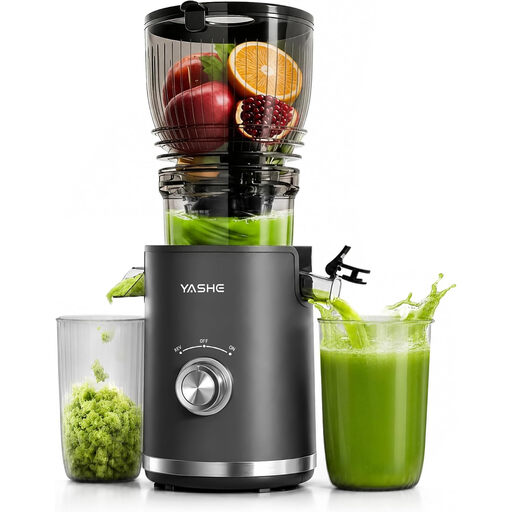
YASHE SJ300V slow juicer, 300 W
As a slow juicer, this model could be suitable for making celery juice; its type alone doesn’t prove how well this particular model handles celery.
The product name lists 300 W, a 148-mm chute for whole fruit and vegetables, and a reverse function.
Joybuy
 No image available
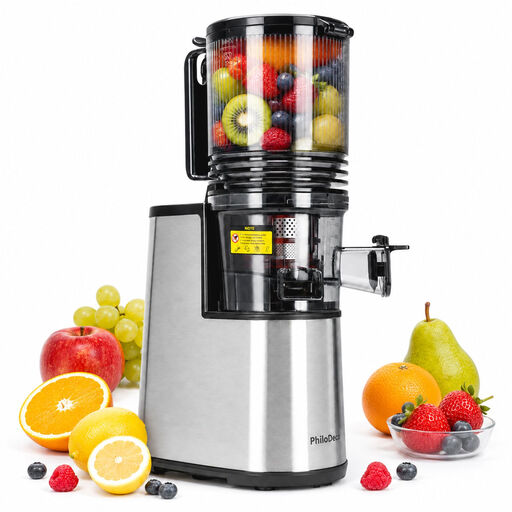
PhiloDeco JE-06 cold press slow juicer
As a cold press slow juicer, this model belongs to a type of appliance that ETM TESTMAGAZIN considers suitable for celery; this doesn’t tell you how much juice this particular model will produce.
The product name lists 250 W, a 145-mm feed tube, a 1.000-ml pulp container and a REV reverse function.
Joybuy
 No image available
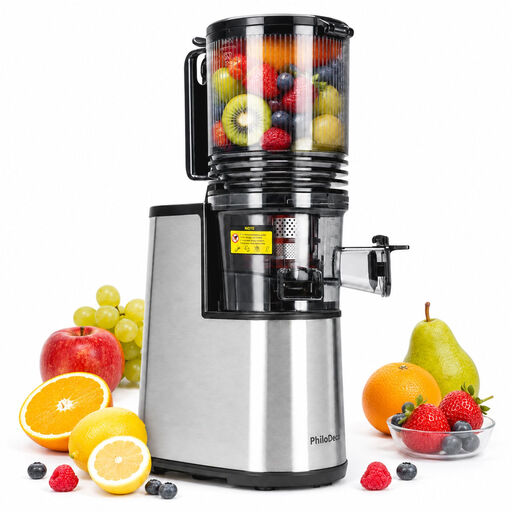
Cold press slow juicer with a 110-mm feed chute
As a slow juicer, this appliance could be suitable for making celery juice; the large feed chute alone doesn’t prove that it’s particularly suited to celery.
The product name lists a 110-mm feed chute, 40 Nm and a reverse function.
Joybuy
 No image available
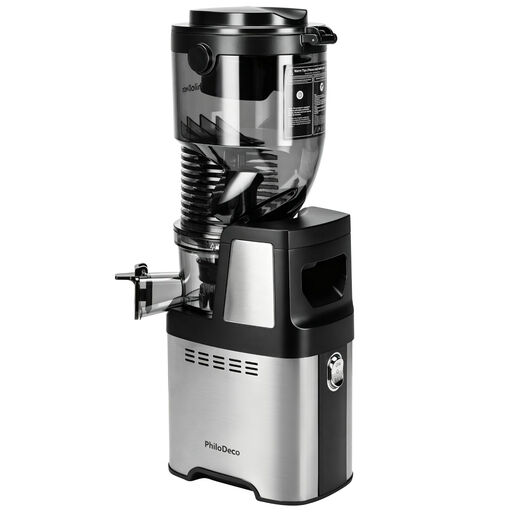
Slow press juicer with a 9,5-cm opening
As a slow press juicer, this model could be suitable for making celery juice; check its instructions for guidance on celery and fibrous residue.
The product name lists a 9,5-cm opening, a 250-W motor and a REV reverse function.
Joybuy
 No image available
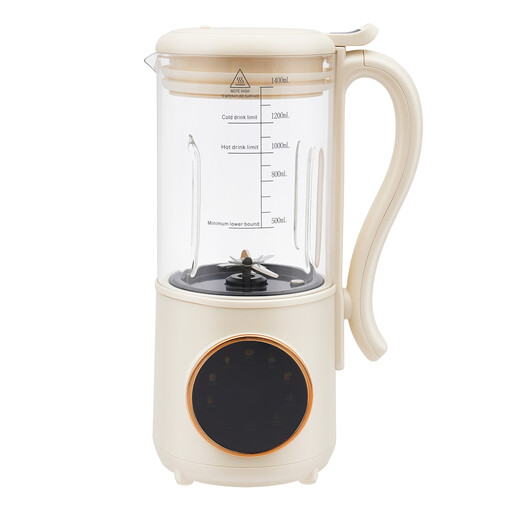
Borosilicate glass beverage maker, 1.400 ml
The product name describes this appliance as a beverage processor, not a slow juicer. Before buying, check the product description to see whether it’s actually designed to juice celery.
The product name lists 16 stainless steel blades, 600 W heating power, 200 W blending power and an EU 220 V plug.
Joybuy
Frequently asked questions
Do I need to chop celery stalks before juicing?
It depends on the appliance and its instructions. Chopping fibrous celery first can help prevent fibres and potential blockages; a large feed chute doesn’t replace the manufacturer’s cutting instructions.
How should I clean a juicer after making celery juice?
Remove any fibres and clean the parts that come into contact with the juice after use, following the model’s instructions. Pay particular attention to the sieve and pulp outlet. For the Unold Sam 78275, the manufacturer specifically says that the non-electrical parts are dishwasher-safe.
What should I check about the warranty and spare parts?
Your statutory consumer rights with the seller are separate from any voluntary manufacturer’s or retailer’s guarantee. Check the guarantee terms and the availability of spare parts for the exact model version; Bosch, for example, has a service and spare parts page for the MESM731M/01.
What does the CE marking tell me about a juicer?
According to the European Commission, the manufacturer is responsible for conformity assessment, technical documentation and CE marking. The marking isn’t an independent performance test and doesn’t prove that a particular model is especially good at juicing celery.
Can I put a juicer that’s reached the end of its life in my household bin?
No. According to the Federal Ministry for the Environment, used electrical appliances must be taken to an authorised collection point, a manufacturer or a retailer obliged to take them back. The take-back obligations that apply to retailers depend, among other things, on the retailer’s and appliance’s size.


