
Lieferung heute & morgen

Qualitätsgarantie

Willkommens-Angebote freischalten: KOSTENLOSE Lieferung | Bis zu 80 % RABATT | Kostenlose 30-Tage-JoyPlus-Testphase
App herunterladen
Ceramic cookware may seem straightforward at first glance: a smooth surface, modern colours and often a promise of easy cleaning. However, it is worth taking a closer look at the material, hob compatibility and what is included before you buy. Not every product described as “ceramic” is made entirely from ceramic. It is often aluminium or stainless steel with a ceramic inner coating.
This difference affects how the cookware is used, its weight, care requirements and suitability for oven use. The following selection is designed to help you interpret marketing claims and find a suitable product for your household.
A ceramic frying pan may consist of a metal body with a ceramic coating. This is the case with many lightweight frying pans and ceramic frying pan sets. This construction usually heats up quickly and is suitable for everyday use. A ceramic roasting dish or a stoneware or cast-iron cocotte, on the other hand, has different properties: the material is heavier, retains heat for longer and is more sensitive to sudden temperature changes.
Before buying, you should therefore decide whether you are looking for a coated frying pan or a fully ceramic vessel.
A non-stick ceramic frying pan can make cleaning easier, but the surface is still sensitive to metal utensils, abrasive scourers and excessive heat. The description “dishwasher-safe frying pan” should also be read carefully: with some sets, only the cookware bodies may be placed in the dishwasher, while handles, lids and accessories must be washed by hand.
If you want to preserve the coating for as long as possible, use wooden, silicone or nylon utensils and avoid heating the pan empty for extended periods.
For households with an induction hob, induction-compatible cookware is essential. A ceramic stoneware pot should generally not be placed directly on a hob or over an open flame. With coated metal cookware, on the other hand, suitability depends on the base.
There are also differences between gas, halogen and infrared hobs. The product description should therefore explicitly state which types of hob can be used.
Pay attention to the exact material specification:
Claims such as PFAS-free cookware, PTFE-free or PFOA-free should be understood as manufacturer statements and not confused with a general health claim. According to the product description, Redchef products feature a coating free from PTFE, PFOA and PFAS. The specific construction and care instructions remain the deciding factors.
For one person or individual side dishes, 0.47 to 0.7 litres may be sufficient. A 20-cm ceramic frying pan is suitable for smaller portions, while 24 to 28 cm is more practical for family meals, vegetable stir-fries or slow-cooked dishes.
With a ceramic-coated cooking pot, you should also take the pot’s height into account. A deep 28-cm sauté pan with a lid offers more capacity than a shallow frying pan, but it also requires more storage space.
These properties do not automatically apply to every accessory. With removable handles, the handle must be removed before placing the cookware in the oven. Lids may have a lower maximum temperature than the cookware body.
For example, according to the product specifications, the 0.7-litre STAUB Ceramic Cocotte is oven-safe up to 300 °C and suitable for microwave, freezer and dishwasher use. However, the cocotte must not be used over direct heat. With ceramic cookware, it is also important to consider the risk of thermal shock: a hot vessel should not be placed directly on a cold surface or in cold water.
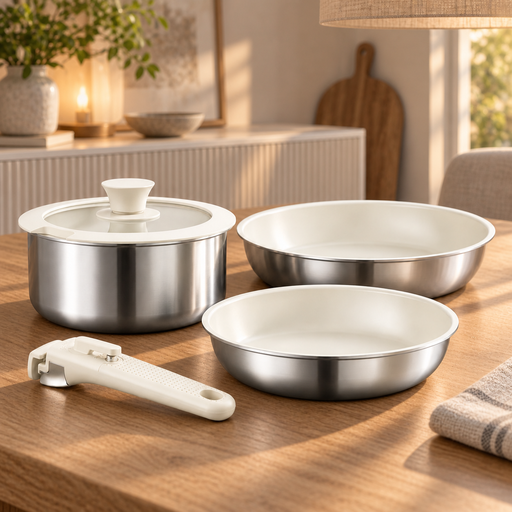
Why this product suits this profile: The set includes a 20-cm pot, two frying pans measuring 20 and 26 cm, a lid and a removable handle. It is specified as suitable for induction, gas, electric, ceramic, halogen and infrared hobs.
The material specification explicitly states that it has a metal body with a ceramic inner coating. This makes it easier to assess its suitability for the hob and oven: the cookware body is specified for use up to 230 °C without the removable handle, lid and accessories.
Space-saving storage thanks to the removable handle; according to the product specifications, the cookware bodies are dishwasher-safe.
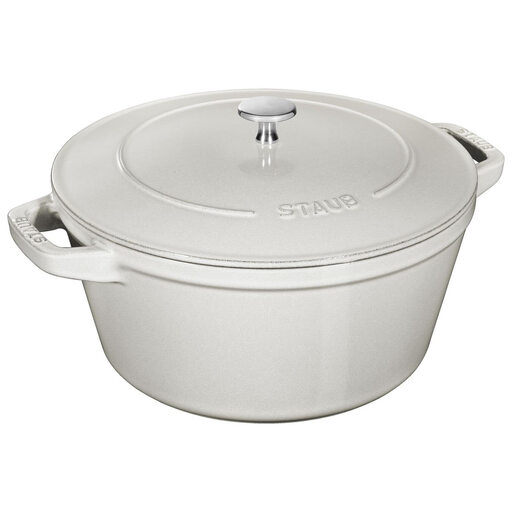
Why this product suits this profile: The set contains a 4.2-litre cocotte, a 1.9-litre pan, a lid and edge protectors. Enameled cast iron is designed for slow-cooked dishes and gentle cooking.
The material is clearly specified as enameled cast iron rather than a lightweight ceramic frying pan. Its stated suitability for induction and all common types of hob makes choosing the right cookware easier.
4.2-litre capacity, lid and oven suitability up to 260 °C according to the product specifications; the edge protectors help with storage.
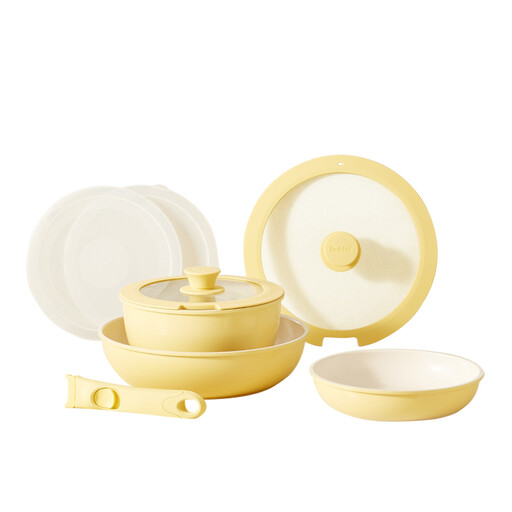
Why this product suits this profile: The set contains several frying pans and pots, lids, storage lids and a removable handle. According to the product specifications, it is suitable for induction, gas, electric, halogen and infrared hobs.
The contents are listed in detail. The handles can be removed for oven use and storage; the locking mechanism must be checked before use.
According to the product description, the removable handles save up to 75% of storage space; the coating is specified as free from PTFE, PFOA and PFAS.
We have put together a complete, regularly updated list of products that fully meet these strict selection criteria and the safety regulations applicable in the EU.
Not necessarily. Fully ceramic stoneware vessels are generally not designed for direct use on an induction hob. Coated metal frying pans, on the other hand, may be induction-compatible if the base has been designed accordingly. The specific manufacturer’s instructions are what matter.
Its service life depends on the coating, temperature, utensils and cleaning method. Frequent heating while empty, high temperatures and harsh cleaning can put greater strain on the surface. Without a product-specific guarantee, it is not possible to give a reliable exact lifespan.
This specification may be relevant to buyers who want to avoid certain coating materials. On its own, however, it says nothing about hob compatibility, weight, heat distribution, what is included or the care required. These criteria should be assessed together with the material and coating specifications.