
Lieferung heute & morgen

Qualitätsgarantie

Willkommens-Angebote freischalten: KOSTENLOSE Lieferung | Bis zu 80 % RABATT | Kostenlose 30-Tage-JoyPlus-Testphase
App herunterladen
A ceramic fan heater can quickly provide extra warmth in the bedroom, home office or living room. However, a low price or high wattage does not automatically mean you are making the right choice. Some appliances are noisy, while others offer imprecise temperature control or need more space than expected.
If you are looking for an electric fan heater for indoor spaces, you should therefore look beyond advertising claims such as ‘fast heating’ or ‘energy saving’. The key factors are clear information about power, controls, safety features and intended use.
A 2,000-watt appliance can heat a room quickly, but at full power it also uses more electricity than a 1,000-watt model. The basic calculation is:
Power in kilowatts × operating time in hours × electricity price = electricity cost
A 2,000-watt fan heater uses a maximum of around 2 kWh during one hour of operation. Actual consumption depends on whether the appliance heats continuously or switches off periodically via the thermostat or ECO mode. An energy-efficient fan heater therefore cannot be identified by its maximum wattage alone.
Claims such as ‘suitable for 15 to 20 m²’ are guidelines, not a guarantee of a specific room temperature. Insulation, ceiling height, outside temperature, window area and the desired temperature all have a significant effect on performance.
A small portable fan heater may be sufficient for a workstation or a clearly defined seating area. A larger, poorly insulated room, on the other hand, will need more time or a different heating solution. The manufacturer’s recommended room size should therefore be considered alongside the conditions in your home.
Oscillation, a remote control and a timer make an appliance easier to use. However, they do not prevent a heater from being covered, placed too close to curtains or operated unattended. Even a fan heater with overheat protection must not be placed under clothing, blankets or towels.
A PTC fan heater uses a ceramic heating element with an electrical resistance that varies according to temperature. Product specifications often describe this design as providing rapid heat output and flame-free heating. This does not mean that the casing or air outlet stays cool: parts of the appliance may become hot during operation.
Look out for:
A compact tabletop appliance fits on a desk or sturdy surface. Before buying, compare the external dimensions with the space where you intend to place it. The Aigostar model, for example, is listed as measuring 175 × 128 × 237 mm and having a 1.3-metre cable.
The cable should reach the wall socket without an extension lead or multiway adaptor. High-power heaters should be connected directly to a suitable socket. Plug-in extension boards with other high-power appliances may increase the electrical load.
A fan heater with tip-over protection switches off automatically if it falls over, depending on its design. Overheat protection interrupts operation when an excessively high internal temperature is detected. Both features are useful, but neither replaces supervision.
Also check:
A CE marking is a legally required declaration of conformity by the manufacturer or party placing the product on the market; it is not an independent quality assessment. The Aigostar product also lists CE, RoHS and VDE. Interested buyers should compare these details with the documents provided for the product.
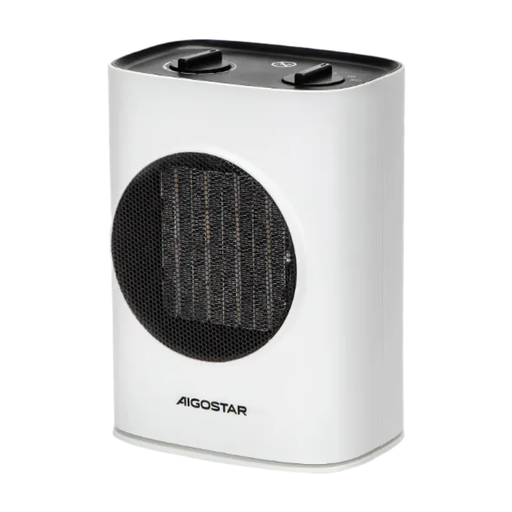
Why this product suits the profile: This compact tabletop heater has mechanical controls and two power settings. It is suitable for users looking for a straightforward solution without a display or remote control for a workstation or smaller indoor spaces.
The stated dimensions, cable length and two heat settings make it easier to check whether the appliance suits the intended space and use.
1800 watts, 45° oscillation, PTC heating element, plus tip-over and overheat protection according to the product details.

Why this product suits the profile: This model is designed for households that want to combine temperature control, a timer and different operating modes in one portable room heater.
The ECO mode is described as automatically adjusting to the surrounding temperature. This allows more precise control of operation than a simple on-off setting.
Five operating modes including ECO mode, adjustable thermostat, 24-hour timer, plus overheat and tip-over protection according to the product description.
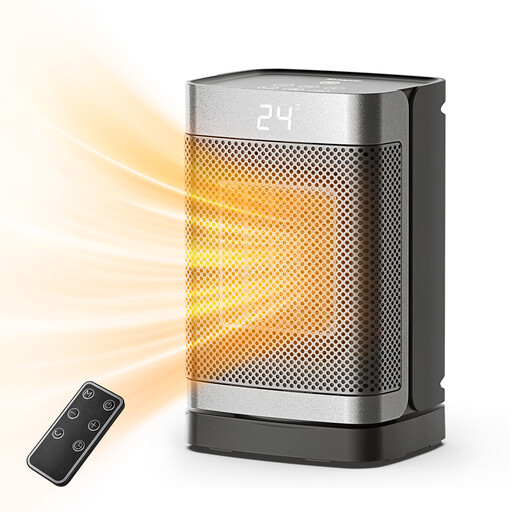
Why this product suits the profile: The remote control, LED display and timer are practical when you want to operate the fan heater regularly from a distance in the bedroom, office or living area.
The timer and temperature display make the selected running time and setting easier to understand. Before buying, check the power settings stated in the offer, as the product description contains differing information.
PTC technology, two heat modes, 12-hour timer, LED display, remote control, plus tip-over and overheat protection according to the supplier’s information.
We have put together a complete, regularly updated list of products that fully meet these strict selection criteria and the safety regulations applicable in the EU.
A ceramic fan heater should be placed on a level, hard and dry surface. Keep the air outlet clear and leave sufficient space around curtains, furniture, paper and bedding. Several of the product warnings provided specify a distance of around one metre from easily flammable materials.
For bedrooms, bear in mind that a timer and thermostat can make operation easier, but the appliance should not be covered or left running unattended for extended periods. According to the product information, the appliances listed are not intended for use in bathrooms, utility rooms or other damp areas.
Before cleaning or moving the appliance:
It depends on the selected power setting and operating time. At full power, a 2,000-watt fan heater uses a calculated 2 kWh per hour. A thermostat, timer or ECO mode can reduce the actual heating time. For an accurate estimate, multiply the consumption by your current electricity price.
Many appliances have a timer and overheat or tip-over protection. Nevertheless, a fan heater should not be covered or operated right next to bedding. Always follow the operating instructions and safety information for the specific model. A timer is a useful control feature, but it is not a substitute for safe positioning and appropriate supervision.
Its lifespan depends on operating time, exposure to dust, storage conditions and build quality. Keeping the air inlets clear, storing the appliance in a dry place and avoiding knocks can help support its service life. If the cable or casing is damaged, or the appliance develops an unusual smell, stop using it.