
Lieferung heute & morgen

Qualitätsgarantie
App herunterladen
Kategorien
A ceramic heater uses Positive Temperature Coefficient (PTC) ceramic heating elements. This technology enables rapid and uniform heat generation. Unlike heaters with glowing wires, PTC elements self-regulate upon reaching a specific temperature. This reduces the risk of overheating and ensures a consistent heat output. These devices are ideal as a supplementary electric heater for creating targeted heat zones in living rooms, offices, or workshops.
Choosing the right model depends on objective technical parameters. The following criteria are essential for making an informed decision.
The heating power, specified in watts (W), determines how quickly and effectively a room can be heated. Models ranging from 1500W to 2000W are sufficient for most single rooms. An integrated heater with a thermostat is crucial for energy efficiency. It measures the ambient temperature and automatically turns the device off once the target temperature is reached, then on again when it drops. This prevents unnecessary continuous operation. An ECO mode dynamically adjusts the power output to meet heating demands, which can further optimise electricity consumption. An energy-saving heater is therefore primarily defined by its smart controls.
Safety is a key consideration for any electric heater. Two features are fundamental in this regard:
Additionally, the housing and plug should be made from V0 flame-retardant materials to meet safety standards.
For use in quiet environments, such as a heater for the bedroom or office, a low operating noise is essential. The volume is measured in decibels (dB). Models below 45 dB are considered quiet.
Additional comfort features enhance the user experience:
The following models have been analysed based on their technical specifications and range of features.
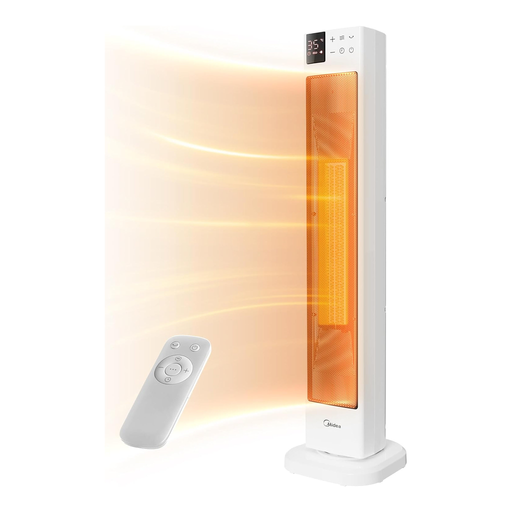
Product Feature Analysis: The Midea NTH20-22GR(WH) is a tower heater with a 2000-watt output. Its tower design and 75° oscillation are engineered to heat larger areas of up to 30 m². According to the manufacturer, its PTC heating technology provides heat-up in 3 seconds. The ECO mode, combined with the adjustable thermostat (5–35°C), serves to maintain a constant temperature while optimising energy consumption. It can be operated via a digital display or the included remote control.
Technical Advantages:
Best for: Users seeking a powerful supplementary heater for medium to large rooms, such as living rooms or open-plan offices, who value wide heat distribution and convenient controls.
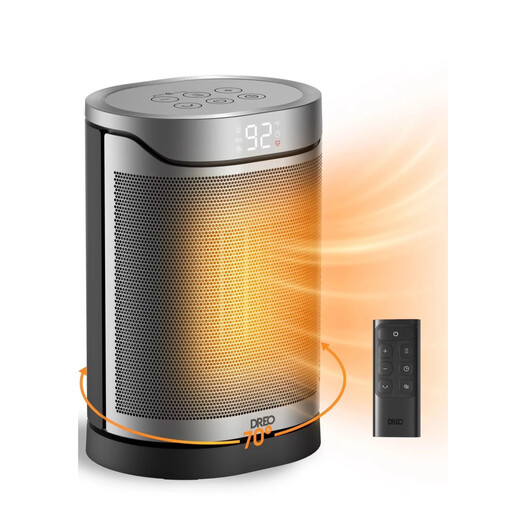
Product Feature Analysis: The DREO Atom 318 is a compact PTC heater with a 1500-watt output. A key feature, according to the manufacturer, is its very quiet operation, with a noise level between 25 and 42 dB, making it a very quiet heater. Its Hyperamic heating technology is designed to provide heat-up in 2 seconds. The device features a precise thermostat (5–35°C in 1°C increments) and multiple power modes (900/1300/1500W). The Shield360˚ safety system includes 8 protection mechanisms, among them tip-over and overheat protection.
Technical Advantages:
Best for: Users who need an exceptionally quiet and safe heater for a bedroom, home office, or child's room. Its compact size and precise controls are optimised for small to medium-sized rooms.
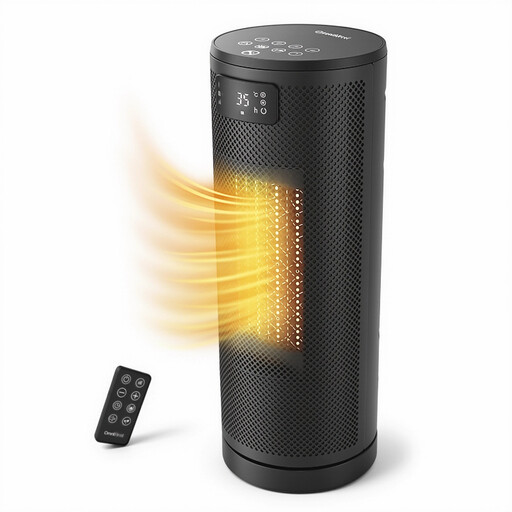
Product Feature Analysis: This model from OmniHeat offers a power output of 1800 watts and four heating modes (including a fan-only function). The noise level is adjustable in three stages, with a minimum of 38 dB. The ECO mode automatically switches between heating levels to efficiently maintain the set temperature. The device features an adjustable thermostat (5–35°C), a 24-hour timer, oscillation, and a remote control. Its safety equipment includes overheat and tip-over protection.
Technical Advantages:
Best for: Users looking for a versatile all-rounder for various rooms like bedrooms, studies, or living rooms. The device combines solid performance with quiet operation and modern comfort features.
If the models presented here do not exactly meet your requirements, the market offers a wide variety of other solutions with different performance and feature profiles. You can find a broader selection of devices in our Heating & Thermostats category.
1. What is a PTC heater? A PTC heater uses ceramic heating elements with a Positive Temperature Coefficient. This means their electrical resistance increases as the temperature rises, which in turn reduces current draw and heating power. This self-regulating property makes them safer and more efficient than conventional heaters with heating coils.
2. How energy-efficient is a ceramic heater? Energy efficiency largely depends on the control system. A model with a precise thermostat and an ECO mode is significantly more economical. It only heats when necessary, avoiding constant full-power operation. Compared to central heating, an electric heater is often the more cost-effective solution for warming a single room, as it doesn't require heating the entire house.
3. Is a ceramic heater suitable for the bedroom? Yes, especially models designed to be quiet heaters (under 45 dB) are well-suited for the bedroom. Features like a timer, a dimmable display, and a remote control enhance comfort for nighttime use. The integrated tip-over protection and overheat protection ensure the necessary safety.