
Lieferung heute & morgen

Qualitätsgarantie

Willkommens-Angebote freischalten: KOSTENLOSE Lieferung | Bis zu 80 % RABATT | Kostenlose 30-Tage-JoyPlus-Testphase
App herunterladen
A ceramic fan heater can quickly warm up bedrooms, home offices or smaller living areas. At first glance, choosing one seems straightforward: select the power rating, pick a colour and place your order. In practice, however, unclear room-size specifications, missing safety features and misleading energy claims often lead to disappointing purchases. The following guide explains which technical details really matter in UK households.
A 2000 W fan heater can produce heat quickly, but at full power it also uses 2 kWh per hour of operation. Electricity consumption can be estimated using:
Power in kW × operating time in hours × electricity price per kWh
A 1500-watt appliance uses 1.5 kWh when operated for one hour. An ECO mode, thermostat and several heat settings can reduce operating time or power output. However, they do not turn an electric fan heater into an inherently low-consumption appliance. What matters is how long the heater actually runs and which setting you use.
Specifications such as “for 20 m²” are only comparable to a limited extent without further information. Ceiling height, insulation, window area and the desired temperature all affect heating requirements. A 2000 W appliance may be sufficient for a well-insulated room measuring 15 to 20 m², while a poorly insulated room will take considerably longer to heat up.
A remote control, timer and oscillation make a heater more convenient to use. They do not stop it from being positioned too close to curtains, furniture or textiles. A fan heater with overheat protection and tip-over protection should be placed on a firm, level and non-combustible surface. These safety features provide additional protection, but they are not a substitute for supervising the appliance while it is operating.
PTC ceramic fan heaters use a ceramic heating element with a positive temperature coefficient. Many models offer settings such as 750, 1000, 1500 or 2000 watts. A lower setting is often sufficient for maintaining the temperature and can help limit electricity consumption compared with continuous operation at the highest setting.
A 1500 W model may be enough for smaller rooms or a home office. For larger or draughty rooms, 1800 or 2000 watts may be suitable. The manufacturer’s room-size specification should be treated as a guide rather than a guarantee of heating performance.
A fan heater with a thermostat adjusts its heat output according to the measured room temperature. Models that allow you to set the target temperature in small increments are particularly practical. According to the product specifications, the OmniHeat 1800W Ceramic Space Heater offers a range of 5 to 35 °C. The DREO Solaris SH628, Atom 416 and Atom 318 models also specify 5 to 35 °C, with adjustment in 1-degree increments.
Important: The reading on the appliance does not automatically represent the temperature at every point in the room. Do not place the heater directly next to a window, door or another heat source, as this may affect the measurement.
For bedrooms and offices, it is worth checking the stated noise level. Depending on the model, the DREO models specify ranges from 25 to 42 dB or up to 34 dB. OmniHeat states three operating levels ranging from 38 to 50 dB. These figures come from the product specifications and may be perceived differently depending on distance, room acoustics and the selected operating level.
Automatic oscillation distributes warm air across a wider angle. The Ozeanos fan heater specifies 120 degrees, while several DREO and Komodo models offer 70 or 90 degrees respectively. A fan heater with a timer can switch off after a set period. This is particularly convenient, but it should not lead you to leave the appliance running unattended for extended periods.
At a minimum, look for:
A CE mark indicates declared conformity with applicable EU requirements, but it is not an independent quality seal. Where possible, use a suitable wall socket. With an 1800 or 2000 W appliance, any extension lead must be expressly rated for the relevant power output. In damp areas, only use a model whose instructions clearly permit the intended application. An IP rating on its own does not replace the manufacturer’s safety instructions.

Why this product suits this profile: This model combines 750 and 1500 watts with fan and ECO modes. An LED display, remote control and a timer ranging from 1 to 12 hours cover the essential requirements for bedrooms, home offices or small rooms.
The four operating modes mean you do not have to rely on a single maximum setting. According to the product description, overheat and tip-over protection are included.
1500 W output, ECO mode, 12-hour timer and remote control in one compact appliance.

Why this product suits this profile: According to the product specifications, this model is designed for 15 to 25 m² and offers temperature control from 5 to 35 °C, 70-degree oscillation, a remote control and a noise level of 25 to 42 dB.
The adjustable power settings and thermostat help you avoid running the appliance continuously at 2000 watts. Overheat, tip-over and child safety features are also specified.
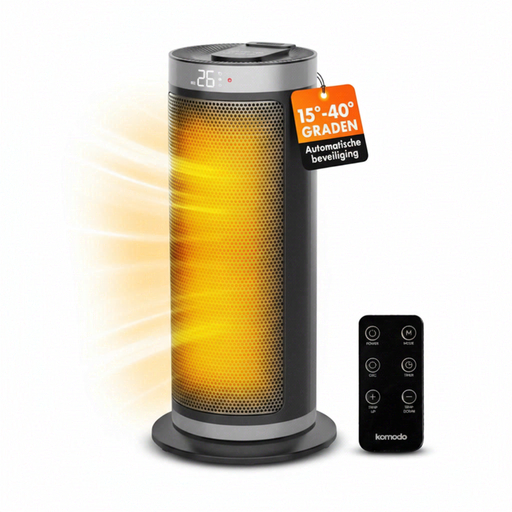
Why this product suits this profile: Three power settings from 750 to 2000 watts, 90-degree oscillation, ECO mode, thermostat, LED display and remote control make it suitable for changing rooms and regular use.
The multiple power settings reduce the need to heat every room at maximum output. Overheat and tip-over protection are specified.
Temperature range from 15 to 40 °C according to the product specifications, 1.5 kg weight and compact dimensions for mobile use.
We have put together a complete, regularly updated list of products that fully meet these strict selection criteria and the safety regulations applicable in the EU.
At full power, the calculated consumption is 2 kWh per hour. Actual consumption may be lower if the thermostat switches the heating off periodically or an ECO mode reduces the power output. To calculate the cost, multiply the consumption by the price shown on your electricity bill.
A timer and thermostat can limit usage to a set period. Even so, you should follow the operating instructions and avoid running the appliance unattended. Keep it away from bedding, curtains and furniture, do not cover the fan heater and unplug it if you will be away for an extended period.
Its service life depends on operating time, exposure to dust, storage conditions and the quality of the cable, fan and thermostat. Clean the air inlets regularly while the appliance is switched off and has cooled down. If you notice a burning smell, sparks, unusual noises or a damaged cable, stop using the appliance immediately.