
Lieferung heute & morgen

Qualitätsgarantie

Willkommens-Angebote freischalten: KOSTENLOSE Lieferung | Bis zu 80 % RABATT | Kostenlose 30-Tage-JoyPlus-Testphase
App herunterladen
A ceramic fan heater can warm rooms quickly and can be moved flexibly between the bedroom, living room and office. However, appliances vary considerably in terms of heat settings, noise levels, thermostats and safety features. Focusing only on a high wattage or terms such as “Eco” and “instant heat” means overlooking important buying criteria.
A 2000-watt fan heater can provide warm air quickly, but at full power it may use up to 2 kWh per hour of operation. The actual cost depends on your electricity tariff and how long the appliance runs. A heater with a thermostat or several power settings can reduce operating time, but it does not automatically lower consumption when running at full heating power.
A quiet fan heater should be described with a specific noise level in decibels. Terms such as “whisper-quiet” are difficult to assess without a measured value. Product specifications, for example, list figures of 25 to 42 dB for certain DREO models and under 51 dB for the Adler AD 7727. Your actual perception will also depend on the room acoustics, fan setting and distance from the appliance.
Overheat protection and tip-over protection can reduce operating risks, but they cannot prevent incorrect use. A heater must not be covered and needs to be kept away from curtains, furniture, paper and other flammable materials. A stable, level and non-flammable surface, together with a distance of around one metre from textiles, are essential safety precautions.
A 1500 W appliance may be sufficient for small, well-insulated rooms. Models with 2000 watts offer more power in reserve, but should not automatically be considered suitable for every room size. Important factors include:
Manufacturers’ room-size recommendations should be treated as a guide. A portable fan heater cannot replace a permanently installed heating system and is not suitable as a long-term solution for every living situation.
A PTC fan heater uses a ceramic heating element with a positive temperature coefficient. In practice, what matters most is whether several power settings are available. Appliances with 750, 1500 and 2000 watts allow for more precise adjustment than a model with just one setting. This can be useful in smaller rooms or when maintaining a temperature that has already been reached.
However, the PTC designation alone says nothing about total energy consumption. Running costs depend on the power level actually selected and the operating time.
A fan heater with a thermostat can monitor the target temperature and switch the heating function on and off according to the selected setting. Other useful features include:
Automatic switch-off is particularly useful, but it should not be taken as an invitation to leave the appliance running unattended or while you are asleep.
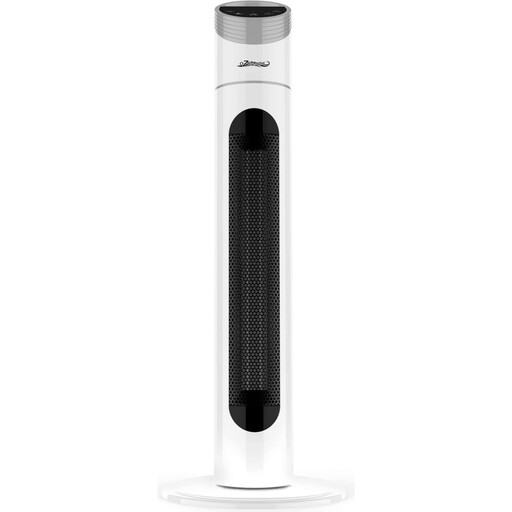
Why this product suits the profile: This compact PTC appliance offers 2000 W, two power settings and 120° oscillation for occasional use in the living room or office.
The two heating settings mean maximum power is not the only operating option. The product specifications state that tip-over and overheat protection are integrated.
2000 W heating power, 120° oscillation and a portable design.
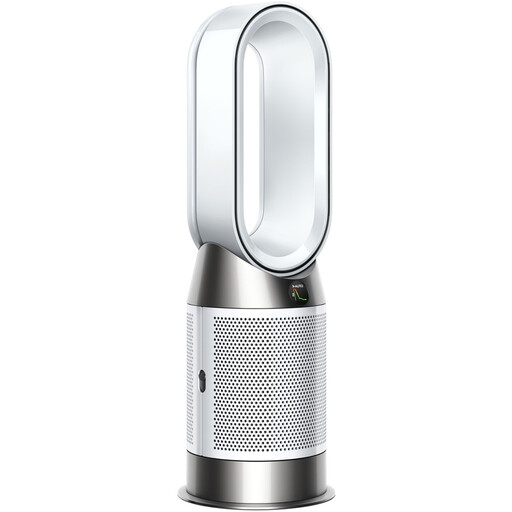
Why this product suits the profile: This 3-in-1 appliance combines heating and fan functions with a sealed HEPA and activated carbon filtration system, as well as app and remote control.
The product data provides specific technical details about the filter, dimensions, weight and controls, rather than relying solely on general comfort-related terms.
App control, remote control and a sealed glass-fibre HEPA/activated carbon filtration system, according to the product description.
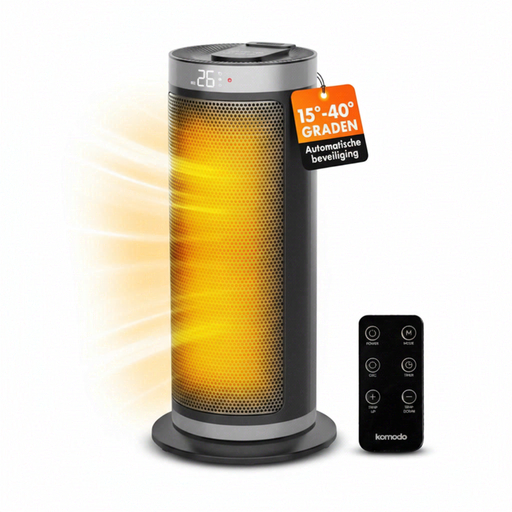
Why this product suits the profile: Three power settings, a thermostat from 15 to 40 °C, 90° oscillation, Eco mode and remote control are practical for varied household use.
Adjustable power and the timer can help to avoid unnecessary operation at full load. The stated IP66 rating should be checked against the instructions before using the appliance in damp areas.
750/1500/2000 W, thermostat, LED display and remote control, according to the product data.

Why this product suits the profile: This model is described as operating at 25 to 42 dB, with 1500/1300/900 W, a 12-hour timer and remote control, making it suitable for an office or study.
The specific decibel range is more meaningful than an undefined label such as “silent”. Several power settings allow for more flexible use.
Stated noise range of 25 to 42 dB, timer, oscillation and 5 to 35 °C thermostat.
We have put together a complete, regularly updated list of products that fully meet these strict selection criteria and the safety regulations applicable in the EU.
At full power, consumption is approximately 2 kWh per hour. You can estimate the cost using this formula: power in kW × operating hours × electricity price per kWh. A thermostat or Eco mode can affect the operating time, but does not guarantee a specific saving.
A model with a low stated noise level, thermostat and timer may be suitable for limited use in the bedroom. However, a fan heater should not be left running unattended while you are asleep. Safety distances, unobstructed airways and the requirements in the instruction manual must be observed.
Service life depends on operating time, exposure to dust, maintenance and the quality of the components. The air inlet and outlet should be cleared of dust regularly when the appliance is switched off and has cooled down. If the appliance is damaged or switches off due to overheating, do not use it again until the cause has been identified.