
Lieferung heute & morgen

Qualitätsgarantie

Willkommens-Angebote freischalten: KOSTENLOSE Lieferung | Bis zu 80 % RABATT | Kostenlose 30-Tage-JoyPlus-Testphase
App herunterladen
A ceramic fan heater can warm rooms quickly without requiring permanent installation. However, for bedrooms, studies, living rooms or offices, wattage is not the only factor that matters. An electric fan heater rated at 2000 watts can be noisy, impractical or costly to run if you choose the wrong model.
As Joybuy Product Recommendation Officer, I filter the most important product details and assess them according to typical usage scenarios. This makes it easier to distinguish marketing claims from understandable technical specifications.
A 2000-watt fan heater uses approximately 2 kWh per hour of operation when running at full power. The actual cost depends on the operating time and electricity tariff. A 1500- or 1800-watt appliance may be sufficient for smaller, well-insulated rooms. Room height, insulation, outside temperature and the desired heat-up speed are also important.
A stated room size should therefore be treated as a guide, not a fixed guarantee. Particularly in older buildings or poorly insulated rooms, the actual heating performance may differ.
A portable fan heater works with a blower. Descriptions such as “whisper-quiet” or “low-noise” are only of limited value for comparison without a measured figure. Some product descriptions specify concrete values, such as 25 to 42 dB or 50 dB. You should check whether the figure applies to the lowest setting and under what measuring conditions it was recorded.
For a fan heater for bedrooms and offices, additional features such as a switchable sound signal, dimmable display or night mode may also be important.
A fan heater with overheat protection and tip-over protection can switch off automatically in certain fault situations. However, these features do not make it safe to cover the appliance or operate it directly next to curtains, bedding or furniture. A fan heater should be placed on a stable, dry and non-flammable surface. The air outlet and air inlet must remain unobstructed.
CE or RoHS information is important product information, but it is not a licence for every type of use. The operating instructions and the specific clearances for the model in question remain decisive.
A PTC ceramic fan heater uses a ceramic heating element with a positive temperature coefficient. Depending on the appliance, the models available offer several power settings, such as 750, 1500 and 2000 watts or 900, 1300 and 1500 watts. Multiple settings allow you to continue heating at reduced power once the basic temperature has been reached.
Look out for:
A quiet fan heater should ideally have a clearly stated decibel rating. Oscillation of 45, 70, 90 or 120 degrees can help distribute warm air around the room. However, it cannot replace sufficient heating power and is not necessary in every small room.
The following features are also practical:
Check whether the model has overheat protection, tip-over protection and automatic switch-off. The appliance should be plugged directly into a suitable wall socket. Multi-socket adaptors and extension leads can be problematic at high power levels unless they are expressly suitable for the required load.
Moist rooms have particular requirements. The IP rating must be suitable for the specific environment. Even where the manufacturer provides a corresponding rating, you should follow the operating instructions and never position the appliance where it could fall into water.
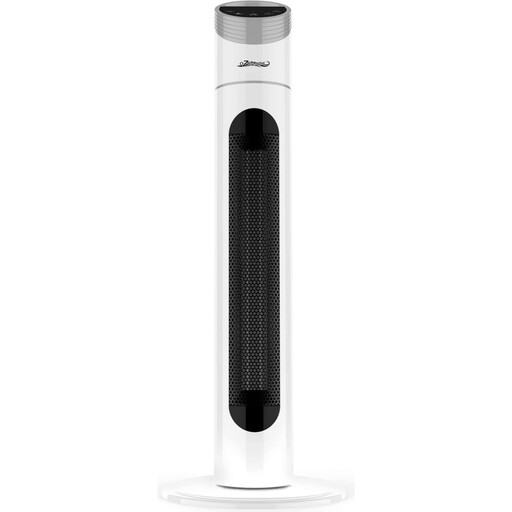
Why this product suits the profile: This compact PTC ceramic fan heater offers two power settings and can be moved between smaller indoor spaces as a portable fan heater.
The product details specify 2000 W, PTC technology, 120° oscillation and tip-over and overheat protection. The safety features should nevertheless not be treated as a substitute for unobstructed positioning.
2000 W maximum power, 120° oscillation, compact design and stated quiet operation.
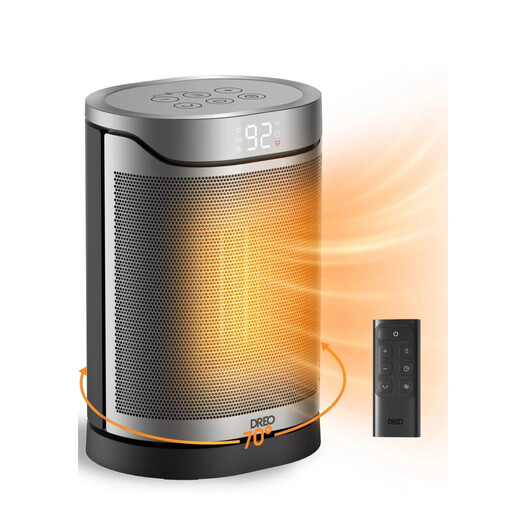
Why this product suits the profile: This model combines several power settings, a temperature range of 5 to 35 °C, remote control, timer and oscillation for bedrooms, studies and offices.
The specifications state noise levels of 25 to 42 dB and adjustable power consumption. The manufacturer’s stated energy saving of up to 40% should be understood as a manufacturer’s claim and depends on how the appliance is used.
5–35 °C thermostat, 12-hour timer, remote control, oscillation and stated overheat and tip-over protection.
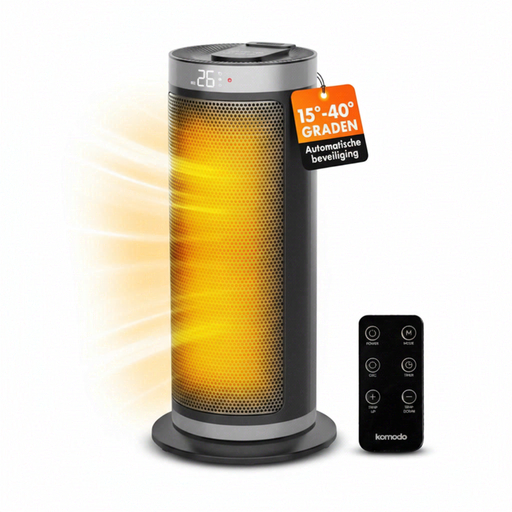
Why this product suits the profile: Three power settings, thermostat, Eco mode, LED display and remote control are ideal for users who frequently want to switch between comfort and lower power consumption.
The power can be set to 750, 1500 or 2000 W. This means you do not have to use the highest setting continuously. The stated IP66 rating should be checked against the instructions before using the appliance in damp areas.
750/1500/2000 W, 15–40 °C thermostat, 90° oscillation, Eco mode, timer and tip-over protection according to the product description.

Why this product suits the profile: An adjustable temperature range of 5 to 35 °C, several modes and a remote control support use at your desk or in the bedroom.
The product description specifies three noise levels ranging from 38 to 50 dB, along with timer, Eco and mute functions. The lowest figures do not automatically apply when the heater is operating at full power.
1800 W, 24-hour timer, 5–35 °C thermostat, remote control, oscillation and overheat and tip-over protection according to the supplier’s specifications.
We have put together a complete, regularly updated list of products that fully meet these strict selection criteria and the safety regulations applicable in the EU.
The simple formula is:
Power in kW × operating time in hours × electricity price per kWh = electricity cost
An appliance rated at 2000 watts is equivalent to 2 kW. Operating it for three hours uses a calculated 6 kWh, provided it runs continuously at full power. A thermostat can shorten the heating phases once the target temperature has been reached. However, this does not automatically mean that every model operates more efficiently over the long term. Room insulation, settings and actual operating time are the decisive factors.
The service life depends on how often the appliance is used, dust exposure, storage conditions and the quality of its electrical components. Clean the air inlet and outlet regularly, unplug the appliance before cleaning and store it in a dry place. If the cable is damaged or you notice an unusual smell or smoke, stop using the fan heater immediately.
In principle, a portable fan heater can be suitable for the bedroom if the model is intended for indoor use and is positioned safely. Look for a low noise rating, timer, thermostat and switch-off function. Do not leave the appliance running unattended, and maintain at least the distance from textiles and furniture specified in the instructions.
A 1500-watt appliance uses less electricity than a 2000-watt model when operated for the same length of time. However, the 2000-watt model may heat a room more quickly. Total costs therefore depend not only on the rated power, but also on heat-up time, thermostat control, insulation and daily operating time.