
Lieferung heute & morgen

Qualitätsgarantie

Willkommens-Angebote freischalten: KOSTENLOSE Lieferung | Bis zu 80 % RABATT | Kostenlose 30-Tage-JoyPlus-Testphase
App herunterladen
A ceramic fan heater can warm individual rooms quickly and can be moved flexibly between the bedroom, living room and home office. However, wattage and design are not the only considerations when buying one. Focusing solely on advertising claims such as “instant heat” or “energy saving” often means overlooking important details.
A 2,000-watt electric fan heater can provide plenty of heat, but when running at full power it uses a calculated 2 kWh per hour of operation. The actual cost depends on your electricity tariff and how long the appliance actively heats. An energy-saving fan heater does not automatically reduce consumption simply because it uses a PTC element. What matters is having selectable power levels, a precise thermostat and an Eco mode that reduces the heating output once the target temperature has been reached.
An advertised “quiet fan heater” may produce different noise levels depending on the operating setting. Check whether the manufacturer specifies a particular measurement range. Figures such as 25–42 dB or below 51 dB are more informative than an unexplained claim such as “whisper quiet”. For bedrooms and offices, display brightness, fan mode and the availability of a sleep mode are also relevant.
A fan heater with overheat protection and tip-over protection will switch off automatically in certain fault conditions. This does not mean that it should be operated unattended or placed on soft surfaces. The air intake and outlet must remain unobstructed. Curtains, paper, duvets and furniture should be kept at a safe distance. A fan heater should always be placed on a stable, level and non-flammable surface.
For smaller personal spaces, 1,000 to 1,500 watts may be sufficient. In larger or poorly insulated rooms, a 2,000-watt model may be more suitable. However, the stated room coverage is only a guide. Ceiling height, insulation, outdoor temperature and the existing heating system all affect the result.
Look for a combination of:
A PTC ceramic fan heater uses a ceramic heating element and a fan. This is not the same as a heating system that fundamentally requires less energy to produce the same amount of heat. However, a thermostat can prevent the appliance from running continuously at full power.
A fan heater with thermostat is suitable for users who want to set a target temperature and have the heating output adjusted automatically. A fan heater with timer can limit the operating time, for example when preheating a room for a set period. Check whether the timer only switches the appliance off or can also start it at a scheduled time.
An oscillating fan heater distributes warm air across a specific angle. Figures such as 45°, 70°, 90° or 120° describe the movement range, not necessarily the actual room coverage. A limited angle may be sufficient for a desk or small seating area; in a larger room, a wider range is more practical.
Useful features include:
A CE marking indicates the manufacturer’s declared conformity with relevant EU requirements. It is not an independent quality seal and does not replace checking the instruction manual. Appliances for use in damp rooms should only be used if the specific instructions and protection rating clearly permit it. For standard fan heaters, the rule is simple: do not use them in the bathroom or close to water.

Why this product suits the profile: Four modes, including a 750-watt setting and Eco mode, allow for more controlled use in the bedroom, study or office. The remote control, LED display and 1–12-hour timer make it easy to operate.
The multiple power levels mean you do not have to use maximum output for every situation. The timer and tip-over protection address unnecessary running time and the risk of the appliance being knocked over.
1,500 watts, Eco mode, 12-hour timer, oscillation, plus overheat and tip-over protection according to the product description.

Why this product suits the profile: According to the supplier, this model is designed for rooms measuring 15–25 m² and combines 2,000 watts, 70° oscillation, a remote control and a temperature setting of 5–35 °C.
The supplier specifies a noise range of 25–42 dB and eight safety features. These verifiable details are more meaningful than a general promise of silent operation.
2,000 watts, stated coverage of 15–25 m², 5–35 °C thermostat and 12-hour timer according to the product data.
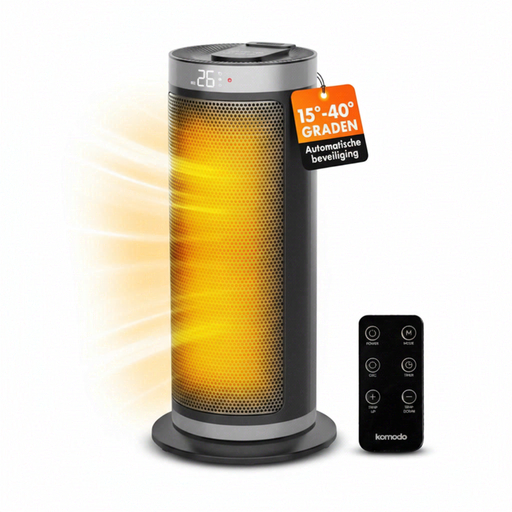
Why this product suits the profile: Three power levels from 750 to 2,000 watts, Eco mode, 90° oscillation, a thermostat and remote control provide several configuration options for regular indoor use.
The adjustable output prevents the appliance from being used exclusively at 2,000 watts. Before using it in damp areas, carefully check the specific appliance’s protection rating and instruction manual.
750/1,500/2,000 watts, Eco mode, adjustable range of 15–40 °C and 90° oscillation according to the product description.

Why this product suits the profile: According to the supplier, this compact appliance is designed for 10–20 m² and has a noise range of 25–42 dB. The remote control, 12-hour timer and 5–35 °C thermostat support use in quiet rooms.
The specific decibel range makes the noise rating easier to assess. In smaller rooms, the lower rated output may be a more suitable starting point than a more powerful appliance running continuously.
1,500 watts, 25–42 dB, 70° oscillation, 8-layer protection according to the supplier, plus compact dimensions.
We have put together a complete, regularly updated list of products that fully meet these strict selection criteria and the safety regulations applicable in the EU.
At full power, the calculated consumption is 2 kWh per hour. If the appliance only runs intermittently or a thermostat reduces the output, actual consumption may be lower. For a rough cost calculation, multiply the number of operating hours by 2 kWh and your personal electricity rate.
There is no universal recommendation. Check the instruction manual, timer, thermostat, overheat protection and tip-over protection. Position the appliance in a clear space on a hard, stable surface, keep it away from textiles, and do not run it under blankets or immediately next to the bed. A timer can limit the operating time, but it does not replace safe use.
The service life depends on operating time, exposure to dust, storage and build quality. Clean the air inlets regularly when the appliance is switched off and has cooled down. A damaged cable, unusual smell, sparks or repeated automatic shut-offs are all reasons to stop using the appliance and contact customer service.