
Lieferung heute & morgen

Qualitätsgarantie

Willkommens-Angebote freischalten: KOSTENLOSE Lieferung | Bis zu 80 % RABATT | Kostenlose 30-Tage-JoyPlus-Testphase
App herunterladen
A ceramic fan heater can quickly provide individual rooms with additional warmth. This makes a portable room heater practical for rented homes, home offices, bedrooms or chilly student rooms. However, eye-catching advertising claims do not automatically lead to the right purchasing decision.
Bear these three common pitfalls in mind before buying:
A PTC ceramic heating system warms the air using a ceramic heating element and a fan. Typical power settings are 750 W, 1500 W and 2000 W. More watts initially mean a higher maximum heat output, but not automatically even heating throughout the entire room.
Pay attention to:
A lower setting may be sufficient for small, well-insulated rooms. In larger or poorly insulated rooms, a 2000 W model is more suitable for providing additional heat quickly. A fan heater generally does not replace a permanently installed heating system.
A fan heater with a thermostat switches the heating function on and off depending on the set target temperature. This can prevent the appliance from running continuously at full power. However, a thermostat does not automatically make the appliance energy-efficient: during the heating phase, electricity consumption depends on the selected mode.
An energy-saving fan heater should therefore ideally offer the following functions:
If you are choosing a fan heater with remote control, it is also useful to check whether the most important functions are available directly on the appliance. The remote control should not be a substitute for safe manual operation.
A quiet fan heater is usually described using a decibel rating. Noise levels can vary depending on the power setting. Ratings such as 25–42 dB or below 51 dB should therefore always be considered in relation to the relevant operating mode.
Oscillation distributes the warm airflow across a wider angle. A fan heater with oscillation can therefore reach several seating or working areas. However, this function does not increase the heating output itself.
For safe operation, follow the instructions for the relevant appliance. The models considered here specify the following points, among others:
A fan heater with overheating protection switches off if its internal temperature becomes too high. A fan heater with tip-over protection can switch off automatically if it falls over. Both functions reduce certain risks, but neither prevents unsafe positioning.
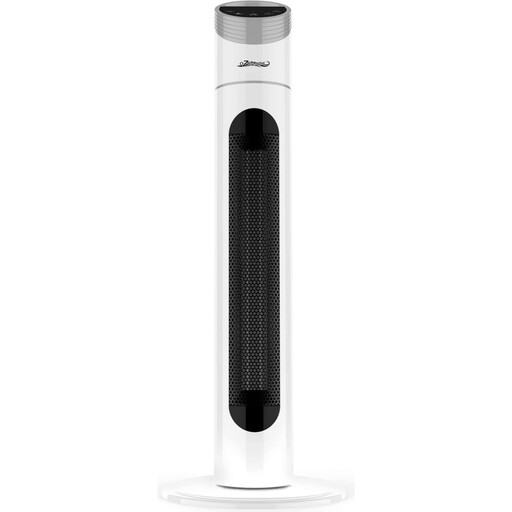
Why this product suits this profile: This compact model offers 2000 W, two heating settings and 120° oscillation for straightforward, portable additional heating in living spaces or offices.
The product details clearly specify the heating output, two settings, oscillation, as well as overheating and tip-over protection, rather than using only general comfort claims.
2000 W PTC ceramic heating, 120° oscillation, compact design and integrated tip-over protection.

Why this product suits this profile: For bedrooms and workspaces, the supplier specifies a noise range of 25–42 dB, a 12-hour timer, remote control and a temperature setting of 5–35 °C.
The noise level is given as a numerical range. The product data also lists a timer, thermostat, tip-over protection and overheating protection.
2000 W output, 70° oscillation, remote control, 12-hour timer and adjustable thermostat.
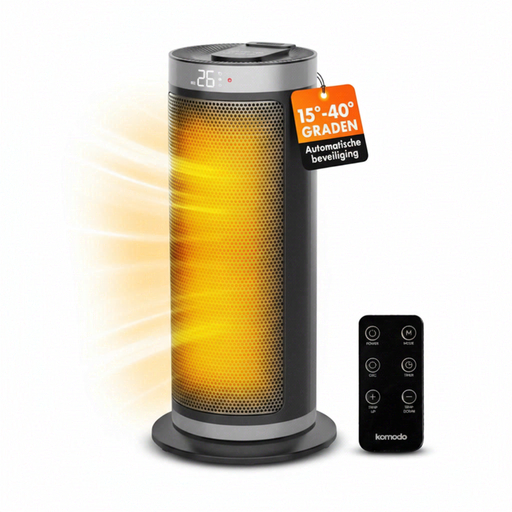
Why this product suits this profile: The three power settings, temperature range of 15–40 °C, Eco mode and stated IP66 rating will appeal to users who need flexible settings. Suitability for damp rooms must be checked solely against the instructions and the manufacturer’s information.
The power settings and temperature range are clearly specified. Despite its IP66 rating, the appliance must not come into contact with water and must be positioned in accordance with the operating instructions.
750/1500/2000 W, thermostat, Eco mode, 90° oscillation, remote control and automatic shut-off.

Why this product suits this profile: With 1500 W, compact dimensions, remote control, a 12-hour timer and a stated noise range of 25–42 dB, this model is designed for offices, bedrooms or student accommodation.
The lower maximum output offers an alternative to continuous 2000 W operation. The thermostat, adjustable power and timer make controlled use easier.
1500/1300/900 W settings, temperature range of 5–35 °C, timer, oscillation and tip-over protection.
We have put together a complete, regularly updated list of products that fully meet these strict selection criteria and the safety regulations applicable in the EU.
The cost of running an electric fan heater depends on its power, operating time and electricity tariff. The simple formula is:
Power in kW × operating hours × electricity price per kWh = cost
A 2000 W appliance is equivalent to 2 kW. Running it for two hours would use 4 kWh. The actual cost depends on your individual tariff. A thermostat or Eco mode can reduce the amount of time the heating function runs once the desired temperature has been reached. It is not possible to confirm a general saving without specific room and usage data.
This depends on the output, insulation, ceiling height and starting temperature. For example, the manufacturers of the models mentioned specify room sizes ranging from around 10 to 25 m². These figures are intended as a guide and do not guarantee a particular room temperature.
As a portable supplementary heater, a ceramic fan heater can warm individual areas temporarily. For permanently heating a home, you need to consider energy consumption, room size and the available electrical capacity. The existing central or building heating system should not be replaced without further assessment.
Its service life depends on operating time, exposure to dust, storage conditions and the condition of the cable and casing. With the appliance unplugged, carefully clean the air inlets and outlets, and stop using it if the cable, plug or casing is damaged. The fan heater should be allowed to cool down completely before being stored.