
Lieferung heute & morgen

Qualitätsgarantie

Willkommens-Angebote freischalten: KOSTENLOSE Lieferung | Bis zu 80 % RABATT | Kostenlose 30-Tage-JoyPlus-Testphase
App herunterladen
A ceramic fan heater can warm rooms quickly and can easily be moved between the home office, bedroom and living room. However, choosing the right model is often more complicated than it first appears. If you only look at “2000 watts”, rapid heating or an eye-catching display, you may overlook important differences in controls, noise levels and safety.
A 2000-watt fan heater can provide plenty of heat, but at full power it also uses 2 kWh per hour of operation. Based on an assumed electricity price of 0.35 euros per kWh, that works out at around 0.70 euros per hour. The actual cost depends on your tariff, operating time and selected power setting.
Depending on the model, a PTC ceramic fan heater regulates heat output using several power settings, a thermostat or an ECO mode. This does not automatically mean that the appliance uses less electricity than another heater with the same power rating. What matters is how long it runs and which setting you use.
Specifications such as “up to 25 m²” are intended as guidance. Insulation, ceiling height, window area, outdoor temperature and the temperature you want to achieve all affect the actual heating performance. In a poorly insulated room, even a small portable room heater with a high rated output may only be suitable as an additional source of heat.
A fan heater with overheat protection and tip-over protection reduces certain risks, but it cannot prevent every instance of misuse. The appliance must not be covered and should be positioned with sufficient clearance from curtains, textiles and furniture. Manufacturer specifications such as IP ratings should also not automatically be understood as approval for use directly next to water. The instruction manual takes precedence.
For smaller rooms, 900 to 1500 watts may be sufficient, while larger or more thoroughly chilled rooms may benefit from a higher maximum output. Multiple settings allow more precise adjustment than simple on/off operation. Combinations of low, medium and high power, together with an ECO mode, are particularly practical.
A fan heater with a thermostat adjusts its heating output according to the room temperature it detects. Check the adjustable range and whether the temperature can be changed in individual degree increments. A broad range such as 5 to 35 °C offers more flexibility, but it does not replace an accurate room thermometer.
A quiet fan heater is particularly useful in bedrooms, children’s rooms and offices. Manufacturer noise ratings in decibels should be treated as a basis for comparison, as the operating mode and fan setting affect the noise level.
Oscillation distributes warm air across a wider angle. Models with 70- or 90-degree oscillation can therefore reach several areas of a room. A remote control, timer and easy-to-read display make the appliance more convenient to use, but they are not key safety features.
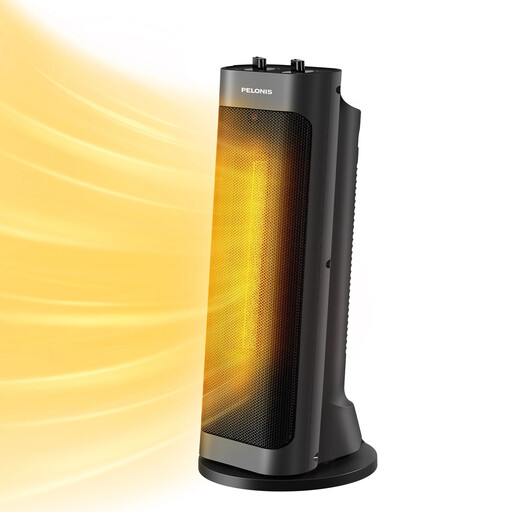
Why this product suits this profile: According to the product specifications, this model offers four heating modes, an adjustable thermostat and 70° oscillation for smaller rooms of up to around 10 m².
The heat output is not limited to a single setting. Overheat and tip-over protection are explicitly specified.
2000 W maximum output, 70° oscillation, carry handle, plus the stated CE and RoHS compliance.

Why this product suits this profile: Ideal for users who want to combine temperature control, low noise ratings and several safety features in a tower-style appliance.
The recommended room size of 15 to 25 m² helps define where it is suitable for use. The manufacturer states a noise level of 25 to 42 dB, together with tip-over and overheat protection.
5–35 °C thermostat range, 12-hour timer, 70° oscillation and remote control according to the product description.
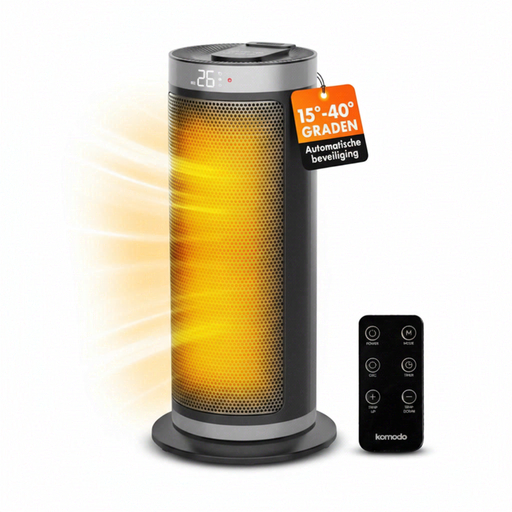
Why this product suits this profile: Its three power settings of 750, 1500 and 2000 watts, together with 90° oscillation, make it suitable for changing locations and rooms of up to around 25 m², according to the specifications.
The variable output helps you avoid running the appliance continuously at 2000 watts. A thermostat, automatic shut-off and tip-over protection are specified.
15–40 °C temperature range, ECO mode, LED display, remote control and a weight of 1.5 kg according to the product data.

Why this product suits this profile: According to the product data, this compact 1500-watt appliance is designed for 10 to 20 m² and has a stated noise range of 25 to 42 dB.
The stepped power settings of 900, 1300 and 1500 watts allow more targeted use than an appliance without intermediate settings.
5–35 °C thermostat, 12-hour timer, remote control and multi-layered safety features according to the product description.
We have put together a complete, regularly updated list of products that fully meet these strict selection criteria and the safety regulations applicable in the EU.
At full power, a 2000-watt appliance uses 2 kWh per hour. Calculate the cost using: power in kW × operating time × electricity price. A thermostat, ECO mode and lower heat settings can reduce the running time or average power consumption, but they do not change the maximum output.
A model with a low noise rating, thermostat, timer, overheat protection and tip-over protection may be suitable for a bedroom. The appliance should stand clear of other objects and should not be left running unattended for long periods. The relevant manufacturer’s safety instructions are decisive.
Its service life depends on operating time, exposure to dust, storage conditions and the quality of the fan, heating element and electronics. It is not possible to give a universal figure for service life. Check the warranty terms, spare-parts information and whether the instruction manual is clear and easy to understand.