
Lieferung heute & morgen

Qualitätsgarantie

Willkommens-Angebote freischalten: KOSTENLOSE Lieferung | Bis zu 80 % RABATT | Kostenlose 30-Tage-JoyPlus-Testphase
App herunterladen
A ceramic fan heater can quickly warm individual areas and can be moved flexibly between the bedroom, living room, office or study. However, the choice can be confusing: terms such as “rapid heating”, “Eco” or “quiet” say little about practical performance on their own. What matters are clearly defined power settings, suitable temperature control and tested safety features.
A 2000-W fan heater can provide more heating power than a 1500-W fan heater. At full power, however, it also uses more electrical energy. Power consumption can be roughly calculated as follows:
Wattage ÷ 1000 × operating hours = kilowatt-hours
A 2000-W fan heater uses 2 kWh during one hour at full power. A 1500-W fan heater uses 1.5 kWh over the same period. A thermostat or Eco mode can reduce the operating time or power setting, but it cannot replace a realistic assessment of the room size and insulation.
A quiet fan heater should ideally be described with a specific decibel rating. Figures such as 34 dB, 42 dB or below 51 dB come from the respective product specifications, but may be perceived differently depending on the measuring distance, power setting and room acoustics. For bedrooms and studies, several heat settings and a low operating mode are often more important than a single advertising claim.
A fan heater with overheat protection and a fan heater with tip-over protection switch off automatically when certain situations are detected. This reduces risk, but does not replace safe positioning. The appliance should stand on a firm, level and non-combustible surface. Curtains, furniture, paper and textiles must be kept at a sufficient distance. Never cover the air outlet.
A PTC ceramic heater uses a ceramic heating element with a positive temperature coefficient. When choosing a product, the specific operating modes available are particularly important. A 1500-W fan heater with 750-W and Eco settings may be more flexible in everyday use than a model that only switches between full power and off.
For smaller rooms or personal areas under a desk, 1500 to 1800 watts is often sufficient. A 2000-W fan heater may be useful for larger or particularly cold rooms, but should not automatically be considered suitable for every room size. The manufacturer’s recommended area is only a guide and depends, among other things, on ceiling height, insulation and outdoor temperature.
A fan heater with thermostat allows you to set a target temperature. Depending on the model, the range may be, for example, 5 to 35 °C or 10 to 35 °C. A fan heater with timer can switch off after a set period. This is convenient when the appliance is not intended to run continuously.
On certain models, Eco mode adjusts the heating power to the measured ambient temperature. The description “energy-efficient fan heater” should therefore always be checked against the actual functions: Are several power settings available? Does the thermostat switch off automatically? Can the temperature be set precisely? It is not possible to state a general saving reliably without knowing the electricity price, operating time and room conditions.
An oscillating fan heater distributes warm air across a particular angle. Depending on the product, specifications may include 45°, 70°, 90° or 120°. A wider oscillation can help distribute heat around the room, but does not affect the maximum heating power.
A fan heater with remote control and LED display is particularly convenient in the bedroom or living room. You should also check whether the timer, temperature and oscillation can actually be controlled by remote. For a portable fan heater, weight, a carry handle, cable length and stability are also important.

Why this product suits this profile: This model combines 750 W, 1500 W, fan-only operation and Eco mode with a remote control, LED display and a timer from 1 to 12 hours. This makes it suitable for smaller personal areas, bedrooms or studies.
The four operating modes avoid being limited to a single power setting. According to the product description, overheat protection and tip-over protection are integrated.
1500 W maximum power, 1–12-hour timer, remote control and wide oscillation.

Why this product suits this profile: The product specifications state a temperature setting range of 5 to 35 °C, an operating noise level of 25 to 42 dB, a remote control and a 12-hour timer. This suits users who value adjustable settings and low noise levels.
The specific decibel range is more informative than an unexplained description such as “whisper-quiet”. Multiple power settings support use according to your needs.
1500-W PTC heating, 5–35 °C thermostat, 8-layer safety protection according to the manufacturer’s specifications, and CE/CB marking.
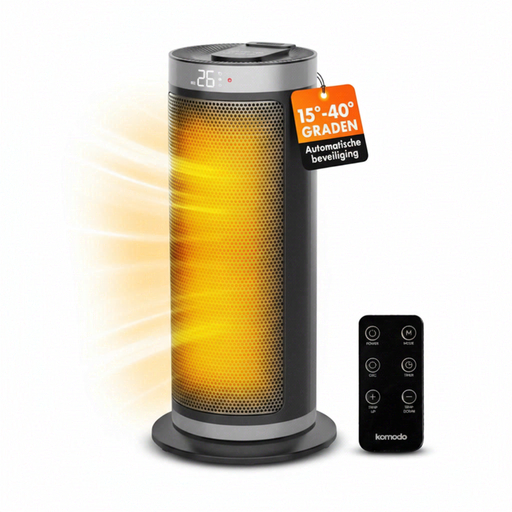
Why this product suits this profile: With 750 W, 1500 W and 2000 W settings, a thermostat from 15 to 40 °C, Eco mode, remote control and 90° oscillation, this appliance offers several adjustment options for changing rooms.
The three heat settings allow you to select a lower power level instead of running continuously at 2000 W. The product description also mentions overheat protection, tip-over protection and automatic switch-off.
Variable power, Eco mode, LED display and a stated 2-year warranty. Suitability for damp rooms should also be checked against the complete instruction manual.
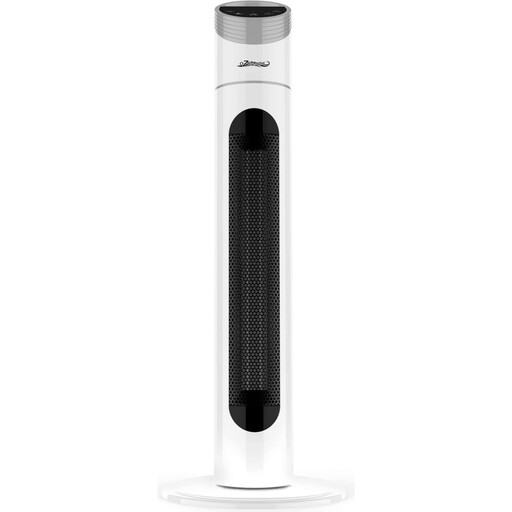
Why this product suits this profile: This appliance offers 2000 W, two operating levels, 120° oscillation and a compact, portable design. It is therefore an interesting choice for living areas or offices where heat needs to be distributed across a wider angle.
The recommended positioning on a stable surface, tip-over protection and overheat protection are expressly described. The two power settings allow you to adjust the output to your needs.
2000 W maximum power, 120° oscillation, quiet operation according to the product specifications, and a portable housing.
We have put together a complete, regularly updated list of products that fully meet these strict selection criteria and the safety regulations applicable in the EU.
This depends on the power rating and operating time. A 1500-W appliance uses 1.5 kWh during one hour at full power, while a 2000-W model uses 2 kWh. A thermostat, timer and Eco mode can reduce the actual operating time. The precise cost depends on your individual electricity tariff.
For a small bedroom or a single seating or work area, 1500 watts may be sufficient. In larger, poorly insulated or particularly cold rooms, a 2000-W fan heater can provide warmth more quickly. The manufacturer’s recommended room area should always be considered alongside the conditions in your home.
It is not possible to give a general fixed service life. This depends on operating hours, dust exposure, care, storage and the quality of the cable, switch and heating element. Regularly cleaning the air inlets, storing the appliance in a dry place and operating it according to the instructions can help extend its useful life.