
Lieferung heute & morgen

Qualitätsgarantie

Willkommens-Angebote freischalten: KOSTENLOSE Lieferung | Bis zu 80 % RABATT | Kostenlose 30-Tage-JoyPlus-Testphase
App herunterladen
A ceramic fan heater can warm rooms quickly and be moved flexibly between the bedroom, home office, living room or campsite. However, not every compact appliance is the right choice. Performance figures, coverage and energy-saving functions are often presented in ways that make important limitations easy to overlook.
This buying guide from the Joybuy Product Recommendation Officer provides an objective overview of the relevant specifications and explains which features matter for different uses.
A 2000-watt fan heater delivers more maximum heat output than a 1500-watt fan heater. However, this does not automatically mean that the appliance will heat every larger room sufficiently. Insulation, ceiling height, outside temperature, window area and the desired temperature all affect the result.
The room size stated by the manufacturer is therefore only a guide. A 1500-watt appliance may be sufficient for a well-insulated room, while a draughty space may require higher output or may simply not be economical to heat with a portable room heater.
An electric fan heater converts electricity directly into heat. At full power, the calculation is straightforward:
An Eco mode, thermostat and adjustable heat settings can reduce operating time or average power consumption. However, they do not fundamentally eliminate the maximum wattage. Claims such as “up to 40 per cent energy saving” should be understood as manufacturer claims and depend on usage, room conditions and the comparison method.
A fan heater for the bathroom requires a suitable IP rating and must be positioned in accordance with the operating instructions. A stated protection rating does not replace a safe electrical installation. The socket, splash zones, distance from water sources and the manufacturer’s instructions are all crucial.
Even with a stated rating such as IP66, the appliance must not be immersed in water, covered or operated directly next to a water source. Before buying, check whether the specific model is actually approved for the intended bathroom area.
Look for several heat settings rather than considering only the maximum output. An appliance with 750, 1500 and 2000 watts can be adapted to small rooms and different heating requirements. A fan heater with thermostat switches the heating on and off according to the selected temperature.
The control range is also important. Models with a setting range of 5 to 35 °C or 15 to 40 °C offer finer adjustment than appliances with a simple rotary control and no temperature display. Precise control can improve comfort, but it does not guarantee a perfectly consistent room temperature.
For a quiet fan heater, the heating elements are not the only factor. The fan motor and airflow design are particularly important. Manufacturer figures such as 25 to 42 dB or below 51 dB should be considered in the context of the relevant measuring conditions. In a bedroom, even fan noise or a bright display may be disruptive.
Oscillation of, for example, 45 or 90 degrees distributes warm air more widely. However, it cannot replace unobstructed positioning. The air outlet must not be blocked by furniture, curtains or laundry.
Look for clearly described features such as:
The appliance should be placed on a level, stable and unobstructed surface. It must not be covered and should be kept away from bedding, curtains, paper and other flammable materials. CE marking is relevant for distribution in Europe, but it is not an independent product test.
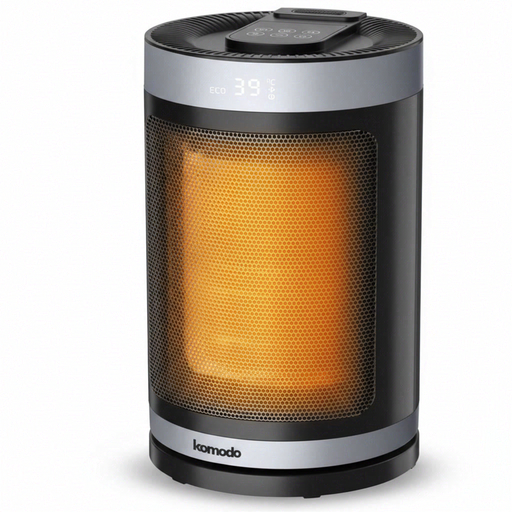
Why this product suits this profile: This model offers 750, 1500 and 2000 watts, a remote control, timer function and LED display. Measuring just 19,4 × 19,4 × 28,3 cm and weighing 1,5 kg, it can be moved easily between rooms.
The multiple heat settings mean you do not have to heat continuously at maximum output. The product specifications also state that it has a thermostat and Eco mode.
Compact design, remote control, timer and 90-degree oscillation according to the specifications.

Why this product suits this profile: The manufacturer states a noise level of 25 to 42 dB, a 12-hour timer, remote control, a thermostat range of 5 to 35 °C and suitability for 15 to 25 m².
The stated noise level, control range and safety features are described more specifically than a general claim of “quiet” or “safe” operation.
2000-watt output, eight specified safety features and temperature adjustment in 1-degree increments according to the manufacturer’s information.
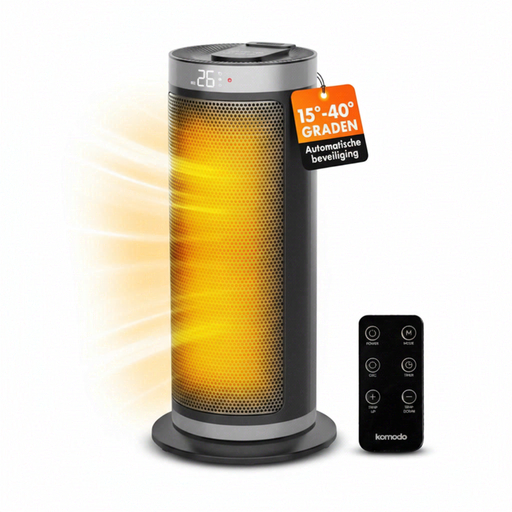
Why this product suits this profile: According to the product description, the appliance is designed for rooms of up to 25 m² and features 750, 1500 and 2000 watts, Eco mode, remote control, timer, 90-degree oscillation and an IP66 rating.
The protection rating is provided as a technical parameter. Before using the heater in a bathroom, you must still check the instructions, placement and electrical installation.
Variable heat settings, thermostat range of 15 to 40 °C, LED display and compact dimensions of 19,4 × 19,4 × 40,3 cm.
We have put together a complete, regularly updated list of products that fully meet these strict selection criteria and the safety regulations applicable in the EU.
A fan heater for the office or bedroom will often benefit from a lower heat setting and low noise levels. A fan heater for the bathroom, on the other hand, primarily requires a suitable protection rating and safe positioning. For larger rooms or continuous background heating, an electric fan heater may be less suitable than an existing central heating system because of its ongoing electricity consumption.
At full power, a 1500-watt appliance uses 1.5 kWh per hour of operation. The thermostat, Eco mode and lower heat settings can reduce average consumption. The cost is calculated by multiplying the electricity used by your personal electricity rate.
PTC ceramic elements are a particular heating technology. However, safety depends on the appliance as a whole: overheat protection, tip-over protection, housing, mains cable, positioning and operation are all equally relevant. A ceramic design alone is not a substitute for checking the safety information for the specific model.
It is not possible to give a reliable general lifespan. This depends on operating time, exposure to dust, transport, storage, and the quality of the motor, heating element and electronics. Check the warranty information, spare parts or service details, and clean the appliance properly.