People who feel cold at their desk
If you only need extra warmth at your own seat from time to time, adjustable settings and a suitable place to position the heater are important factors to consider.


For occasional extra warmth at an individual desk, a compact ceramic fan heater with adjustable settings may be a good fit, provided it can be positioned safely without creating a trip hazard. In a shared room, keeping it away from flammable items, along with noise and airflow, often matters more than the maximum wattage. Longer use will increase electricity consumption. Noise levels and safety features depend on the specific model, and do not remove the need to check the intended location.
If you only need extra warmth at your own seat from time to time, adjustable settings and a suitable place to position the heater are important factors to consider.
If you share the room for work or reading, consider how to minimise any disruption to others from the fan noise and airflow.
In shared areas, it’s important to keep walkways clear, leave space around flammable items and have a suitable electrical socket at the intended location.
Before buying, check whether the heater can be positioned safely where you intend to use it. Then consider the heat settings, noise levels and how long you plan to use it for, to see how it will work in your shared space.
| Consideration | What to check before buying | Who is this important to? |
|---|---|---|
| Safe positioning | Check the distance from flammable items, clear airflow, tip-over protection and cable routing for the specific model. | If there are papers, textiles or cables on the desk and other people walk through the room, finding a safe position is a priority. Around 33% of consumers prioritise safety. |
| Targeted warmth | Check whether the heat settings and thermostat suit your need for occasional warmth at your own desk. | If you only need occasional warmth at your own desk, you won’t necessarily want to heat the whole room. Around 27% of consumers put targeted warmth first. |
| Noise and airflow | Compare the stated noise levels with the operating mode and check whether you want an oscillating model. | When working or reading in shared spaces, noise and airflow may disturb others. Around 20% of consumers prioritise minimising disruption. |
| Electricity consumption | Consider the power consumption of the setting you’ll use and how many hours you expect to run the heater. | If you plan to use the heater regularly, you’ll want to estimate its electricity consumption in advance. Around 20% of consumers focus on running costs. |
The German Fire Service Association recommends positioning fan heaters a safe distance from flammable items. The Verbraucherzentrale points out that a small fan heater is not a suitable alternative to heating an entire room. Running costs depend on power consumption and how long you use the heater for.
Electricity consumption depends on the power used by the selected setting and how long the heater runs. The Verbraucherzentrale specifically warns against treating small plug-in fan heaters as an energy-saving way to heat a room.
Compare the power of the setting you’ll actually use, the available controls and the expected running time, rather than relying on marketing claims alone.
Repeated use will consume electricity. The cost will depend on how long you use the heater and your own electricity tariff.
The Güde GEH 2000 P was named a favourite in a test by F.A.Z. Kaufkompass. However, according to the manufacturer, the model has no tip-over protection – an important point if it will be positioned somewhere it could be knocked over by others.
Check the intended location and the safety features of the exact model version, rather than treating a test verdict as a substitute for doing so.
The Rowenta model page still refers to Regulation (EU) 2015/1188. Since 1 July 2025, new requirements under Regulation (EU) 2024/1103 have applied to the placing on the market of the electric space heaters covered by the rules.
For a specific offer, check the product version and its compliance information. An older reference on a product page does not, by itself, prove either compliance or non-compliance with the newer requirements.
The CX2120/01 is a compact option for an individual desk. Philips lists two heat settings of 600 and 1,500 W, as well as tip-over and overheat protection.
The Mini Excel SO9260F0 combines a compact design with two heat settings and a mechanical thermostat.
According to the manufacturer, the TFC 17 E has two heat settings of 1,200 and 2,000 W, with optional oscillation.
The GEH 2000 P, article 85122, is a PTC ceramic heater with two heat settings and an adjustable tilt.
The Atom One is a range of compact ceramic fan heaters.
This selection includes ceramic fan heaters for occasional extra warmth at a table or desk.
 No image available
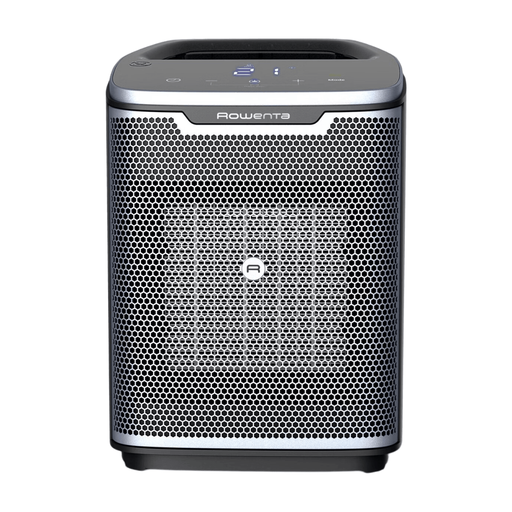
For occasional warmth at a table or bench, the product description lists a carry handle.
The model is listed at 2,000 W, with two heat settings, a timer and a maximum noise level of 55 dB. The description also lists IP20 and 1.5 m.
According to the instructions, place it on a stable, heat-resistant surface and keep it at least 1 m away from flammable materials. The stated noise level may be worth considering if you’ll be using it in a quiet shared space.
 No image available
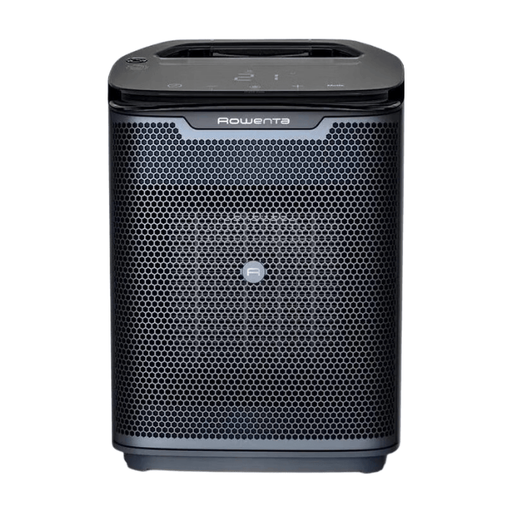
The product description lists a table or console as possible locations for this compact ceramic model.
It is listed at 2,000 W, with four heat settings, a timer, IP21 and a maximum noise level of 29 dB.
According to the instructions, place it on a stable, heat-resistant surface and keep it at least 1 m away from flammable materials. The stated noise level alone does not allow for comparison with measurements for other models.
 No image available
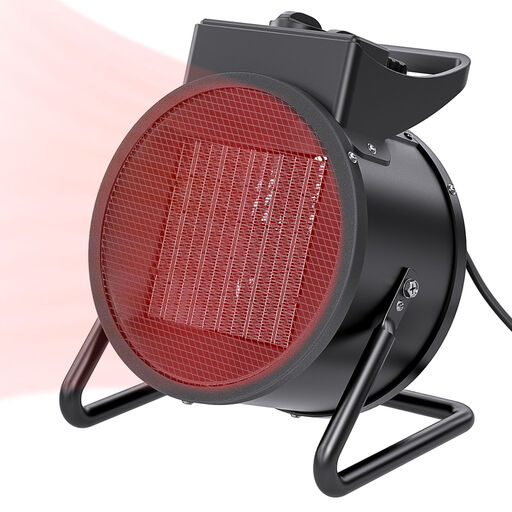
The description lists offices and living areas as suitable places to use it, and mentions a carry handle.
The title lists a thermostat and three settings. The product description specifies a PTC heating element and dual overheat protection.
 No image available
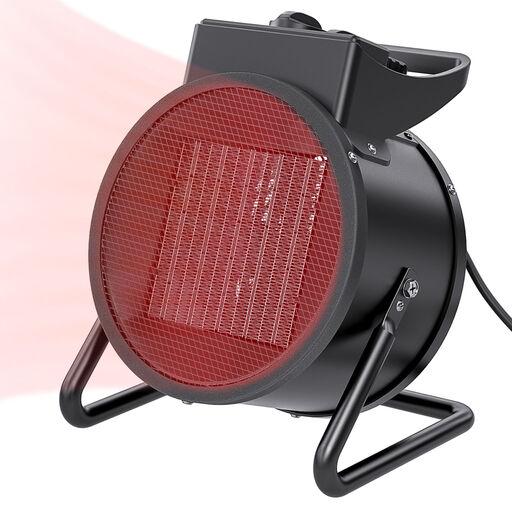
The description lists offices and living areas as suitable places to use it, and mentions a carry handle for moving it around.
The title lists 3 kW, a thermostat and three settings. The product description mentions an adjustable angled bracket and dual overheat protection.
The higher stated power should be taken into account when choosing a heater for a shared space and checking the intended electrical connection.
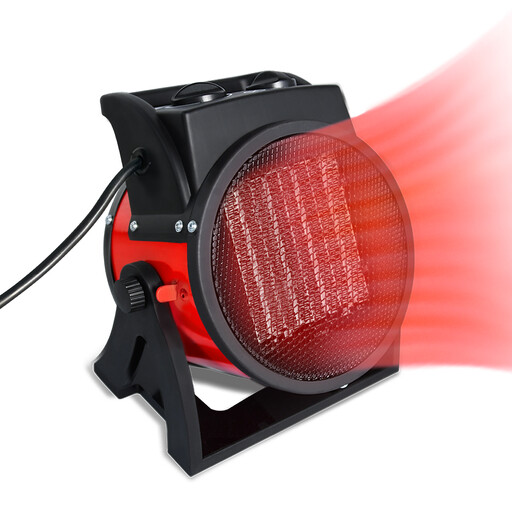 No image available
The description lists flats and apartments as suitable places to use it, and mentions a carry handle and adjustable support bracket.
It is listed at 2 kW, with three heat settings, a thermostat, a 1.4 m cable and overheat protection.
According to the description, use indoors only, in well-ventilated areas, and keep it at least 1 m away from flammable materials.
Position it well away from flammable items, keep the airflow clear and make sure the cable doesn’t cross a walkway. The German Fire Service Association also warns against drying clothes on fan heaters or overloading sockets. Always follow the instructions for your specific appliance, too.
For a setting used continuously, divide the wattage by 1,000 and multiply it by the number of hours used to calculate the theoretical consumption in kWh. For example, 1,000 W used for one hour equals 1 kWh; multiply this by your own tariff in euros per kWh to work out the cost. If a thermostat switches the heater off, the actual time spent running under load will vary.
Follow the instructions for the exact model version. For the Atom One, Dreo recommends switching the heater off, unplugging it and letting it cool before cleaning. Do not allow water to enter the motor housing. These manufacturer instructions apply to the model specified and do not set a general cleaning interval for all appliances.
Electrical and electronic appliances covered by the relevant harmonised EU rules are required to carry the CE mark. This indicates that the manufacturer considers the applicable requirements to have been met; it is not an independent EU quality mark. Since 1 July 2025, the relevant Ecodesign requirements under Regulation (EU) 2024/1103 have also applied when placing the electric space heaters covered by the rules on the market. An older reference to Regulation (EU) 2015/1188 does not show whether a specific appliance meets the newer requirements.
Don’t put it in your household rubbish. The German Environment Agency lists recycling centres and suitable retailer take-back points as possible disposal options for electrical appliances.