
Lieferung heute & morgen

Qualitätsgarantie

Willkommens-Angebote freischalten: KOSTENLOSE Lieferung | Bis zu 80 % RABATT | Kostenlose 30-Tage-JoyPlus-Testphase
App herunterladen
A ceramic frying pan can make everyday frying easier when the coating, hob type and care requirements suit the way you cook. However, promotional terms such as “scratch-resistant”, “healthy” or “suitable for all hob types” do not automatically lead to the right buying decision. The specific product details are what matter.
Most products are a frying pan with a ceramic coating applied to an aluminium or stainless steel body. This is not the same as a cooking vessel made entirely from ceramic. The pan body affects the weight, heat distribution and suitability for induction, while the coating is relevant to food release and cleaning.
A PFAS-free frying pan, PTFE-free frying pan or PFOA-free frying pan may meet the requirements of buyers who want to avoid certain coating materials. However, the lifespan also depends on the coating thickness, cooking temperature and how the surface is treated. Even a ceramic non-stick frying pan described as scratch-resistant should not be used with metal turners or abrasive scourers.
A ceramic frying pan for induction needs a magnetic base. Gas and electric hobs have different requirements. Some models are also not suitable for use in the oven, even though they can be used on several hob types. Before buying, check the hob compatibility, maximum oven temperature and instructions for using the lid.
Look for clear material specifications, such as aluminium with a ceramic coating or a multi-layer stainless steel body with an aluminium core. Aluminium conducts heat quickly and often reduces the weight. Stainless steel can offer greater stability, but is often heavier.
For specifications such as PFAS-free, PTFE-free or PFOA-free, it should be clear whether the statement applies to the coating or to the entire product. According to the product details, for example, the coating on the Redchef Starlight frying pans is PTFE-, PFOA- and PFAS-free. Such statements are provided by the manufacturer and should not be interpreted as indicating any medical effect.
A coated 24 cm frying pan is often suitable for smaller portions, eggs, pancakes or a meal for one or two people. A coated 28 cm frying pan provides more space for vegetables, meat or several portions. However, the diameter usually refers to the top rim rather than the actual cooking surface. The base size is also relevant to heat transfer from the hob.
For sauces, stews or larger quantities, a deep sauté pan with a lid can be more practical. If you prepare different quantities, a frying pan set with ceramic coating often offers a more flexible solution than just one standard size.
A dishwasher-safe ceramic frying pan is convenient, but many manufacturers still recommend hand washing to help protect the coating for longer. Regardless of the manufacturer’s specifications, a few basic rules apply:
Even with a non-stick frying pan, using a small amount of oil can be helpful, particularly when frying at a medium temperature.
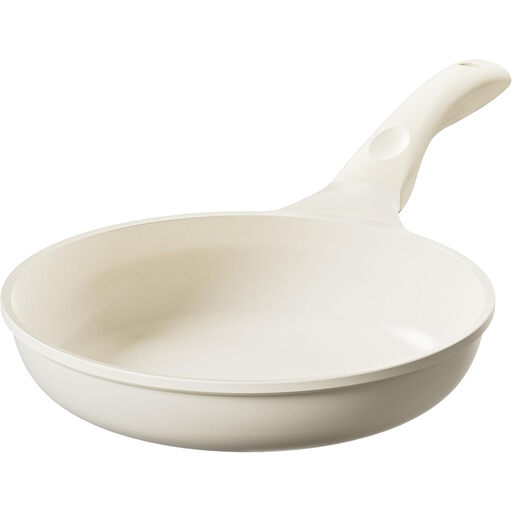
Why this product suits the profile: The 24 cm size is manageable for smaller households and everyday portions. According to the product details, the model is suitable for induction, gas and electric hobs.
The product description explicitly states that the coating is PTFE-, PFOA- and PFAS-free. It also provides guidance against using metal utensils and recommends gentle cleaning.
24 cm diameter, induction compatibility, dishwasher suitability according to the supplier, and an ergonomic Bakelite handle.
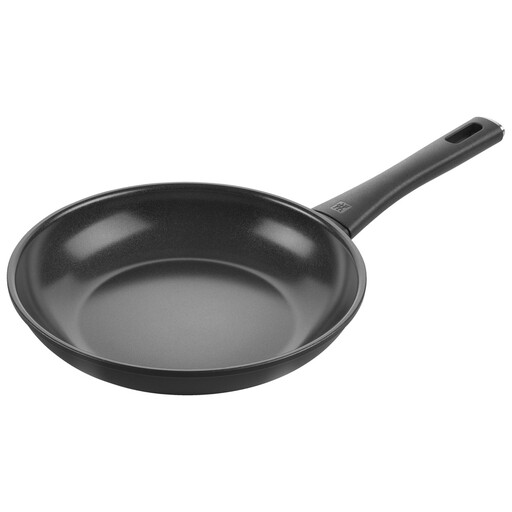
Why this product suits the profile: This model combines a forged aluminium body with a CeraForce Granite ceramic coating. It is suitable for various hob types, including induction, and for use in the oven.
The product details specify a diameter of 24 cm, a base width of 18 cm and a maximum oven temperature of 250 °C. This allows you to check the rim and base dimensions before buying.
PTFE- and PFOA-free coating according to the product details, aluminium body, stainless steel handle, and suitability for gas, induction, ceramic and halogen hobs.
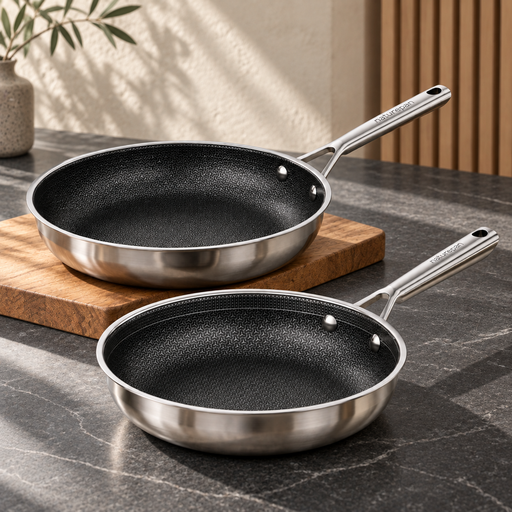
Why this product suits the profile: The 24 and 28 cm set accommodates different portion sizes. The hybrid structure described is designed for frying and searing.
The specifications distinguish between the stainless steel ridges and the coated areas. They also clearly state the compatible hob types, oven temperature of up to 230 °C and the recommendation to hand wash.
Two sizes, stainless steel body with aluminium core, suitable for induction, gas and electric hobs, and dishwasher suitability according to the product details.

Why this product suits the profile: According to the description, the deep pan with lid and 3.8-quart capacity is suitable for sautéing, stewing, frying and preparing larger meals.
The product details explicitly state that the pan is not dishwasher-safe and is not oven-safe. You can take these limitations into account before buying.
Deep design, lid, two pouring spouts and, according to the product details, suitability for all hob types including gas.
We have put together a complete, regularly updated list of products that fully meet these strict selection criteria and the safety regulations applicable in the EU.
Only if the base is explicitly stated to be induction-compatible. An aluminium body alone is not sufficient. Therefore, check the induction specification and bear in mind that the usable base area may be smaller than the pan’s top diameter.
There is no single answer for the lifespan. It depends on heat, cleaning, utensils and how frequently the pan is used. Low to medium temperatures, avoiding heating the pan empty and using soft kitchen utensils can help protect the coating. Reduced non-stick performance or visible damage are reasons to replace the pan.
That depends on the model. According to the product details, some products are dishwasher-safe, while others explicitly are not. Even when dishwasher use is permitted, hand washing with mild washing-up liquid may be gentler on the coating. Always follow the care instructions provided by the relevant manufacturer.