
Lieferung heute & morgen

Qualitätsgarantie

Willkommens-Angebote freischalten: KOSTENLOSE Lieferung | Bis zu 80 % RABATT | Kostenlose 30-Tage-JoyPlus-Testphase
App herunterladen
A ceramic frying pan can combine low-fat cooking, easy cleaning and versatile use. However, striking advertising claims do not automatically lead to the right purchasing decision. The key factors are the construction materials, hob compatibility, care instructions and the specific size.
Most products on offer are ceramic-coated frying pans: the pan body is made from materials such as aluminium or stainless steel and has a ceramic non-stick coating. This is not the same as cookware made entirely from ceramic.
The pan body affects, among other things:
Aluminium distributes heat quickly and is comparatively lightweight. Stainless steel is robust and hard-wearing, but often requires an integrated aluminium core for even heat distribution.
The terms PFAS-free frying pan, PFOA-free frying pan and PTFE-free frying pan describe different details about the coating. PFOA and PTFE belong to the larger group of PFAS, but are not identical to it. If you are looking for a specific feature, you should therefore check the complete product description and the manufacturer’s information.
A statement such as “free from intentionally added PFAS” does not automatically mean that every conceivable substance is excluded. For your purchasing decision, what matters is which substances are specifically mentioned in the individual product listing.
A dishwasher-safe frying pan is more convenient to clean. Manufacturers nevertheless often recommend washing by hand, as harsh detergents, high temperatures and cookware knocking together can put long-term strain on the coating.
For everyday use, the following are recommended:
An induction hob requires a pan with a magnetic base. An induction frying pan should be explicitly approved for induction use. Many models are also suitable for gas, electric and ceramic glass hobs. Compatibility can vary with halogen or infrared hobs, so this should be checked in the product details.
The diameter does not necessarily correspond to the actual usable cooking surface. A 28-centimetre model may distribute heat differently from a shallow frying pan because of its high sides or smaller base.
A ceramic-coated frying pan should clearly state, wherever possible, what materials are used for the body and base. Multi-layer stainless steel with an aluminium core can offer a balanced combination of stability and heat conduction. Cast aluminium is often lighter, while a reinforced base may be required for use on induction hobs.
Terms such as “diamond-reinforced”, “Titanium” or “multi-layer” should not be the sole deciding factors. More important are clear details about:
For eggs, pancakes or small portions, 20 to 24 centimetres is often sufficient. 28 centimetres is more suitable for family meals, vegetable dishes or larger cuts of meat. A ceramic frying pan set with 20, 24 and 28-centimetre pans covers different quantities, but requires more storage space.
Deep sauté pans with lids are an alternative for braised dishes, sauces and one-pot recipes. If you mainly shallow-fry food, a traditional frying pan is usually more efficient.
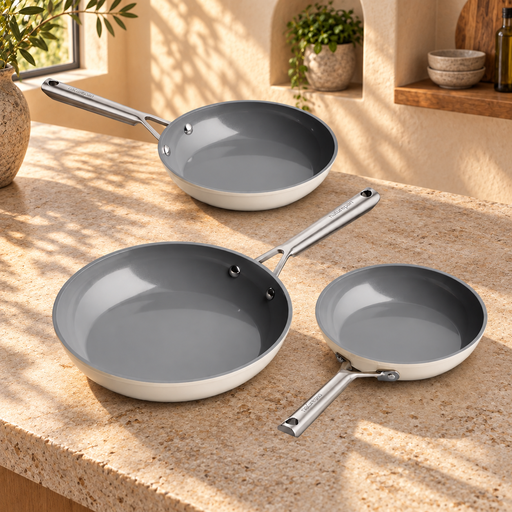
Why this product suits this profile: Three diameters cover small portions, meals for two and family-sized servings. The aluminium body is designed for rapid heat distribution; according to the product information, the set is suitable for induction, gas, electric and ceramic glass hobs.
The product description explicitly identifies the cookware as ceramic-coated metal and states care limitations such as low to medium heat and the use of suitable utensils.
20, 24 and 28-centimetre frying pans; ceramic coating with PFAS-free, PFOA-free and PTFE-free properties stated by the supplier; dishwasher-safe, although hand washing is still recommended.

Why this product suits this profile: This two-piece set combines 24 and 28-centimetre pans with a Cromargan stainless steel body and TransTherm universal base. According to the product information, it is suitable for all hob types, including induction.
The details specify the materials, two sizes and a universal base solution instead of relying solely on general non-stick claims.
Cromargan 18/10 stainless steel; ceramic coating with hard-mineral reinforcement according to the supplier; heat-resistant up to 400 °C according to the product description.
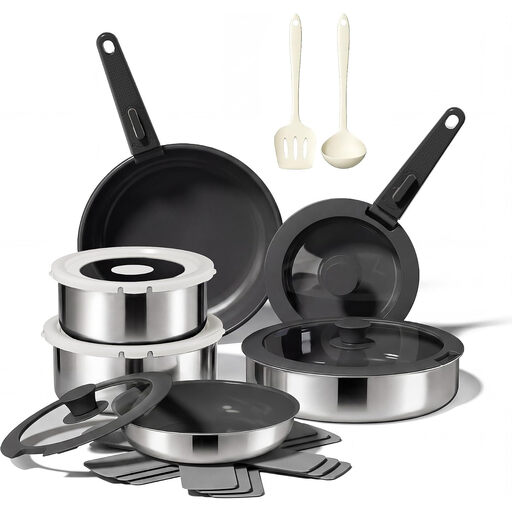
Why this product suits this profile: This set is aimed at households wanting comprehensive equipment, small kitchens and mobile use in a motorhome. It includes 16 pieces, two detachable handles and a stackable design.
According to the product information, the cookware can only be used in the oven when the handles have been removed; the handles are also excluded from dishwasher use. These limitations should be considered transparently before purchase.
Specified as suitable for induction, gas, electric, ceramic glass and halogen hobs; oven use up to 260 °C with the handles removed; stackable construction.
We have compiled a complete, regularly updated list of products that fully meet these strict selection criteria and the safety regulations applicable in the EU.
Even a high-quality non-stick frying pan needs to be treated appropriately. Metal turners can scratch the surface. Oil should be used sparingly, but in line with the recipe. With ceramic coatings in particular, it is advisable to avoid consistently high temperatures and heating the pan while empty.
If you notice visible chips, deep scratches or an unstable handle, stop using the pan. The actual service life depends on usage, temperature, cleaning and coating quality, so a blanket figure in months or years would not be meaningful.
Not every ceramic frying pan is automatically suitable for induction. The key requirement is a magnetic base or one explicitly approved for induction use. Before buying, compare the details of the relevant product listing with your own hob.
Allow the pan to cool first, then clean it with mild washing-up liquid and a soft sponge. If it is listed as dishwasher-safe, washing by hand is often the gentler option. Abrasive cleaners and metal utensils should be avoided.
It is not possible to give a reliable fixed lifespan for every model. Low to medium heat, suitable utensils and gentle cleaning can help reduce wear on the coating. When choosing a pan, clear manufacturer information about care, warranty and permitted use can help.