
Lieferung heute & morgen

Qualitätsgarantie

Willkommens-Angebote freischalten: KOSTENLOSE Lieferung | Bis zu 80 % RABATT | Kostenlose 30-Tage-JoyPlus-Testphase
App herunterladen
A ceramic frying pan can be practical for frying, sautéing and gentle cooking. However, the name alone says little about its construction, care requirements or actual suitability for your hob. If you only look for terms such as “non-stick”, “healthy” or “scratch-resistant”, you can easily overlook important details.
Typical buying problems arise from three recurring pitfalls:
A coated frying pan usually consists of a metal body and a ceramic non-stick coating. Aluminium conducts heat quickly and can reduce the weight. Multi-layer stainless steel with an aluminium core also distributes heat evenly and is often found in hybrid frying pans.
When you see terms such as PFAS-free frying pan, PTFE-free frying pan or PFOA-free frying pan, you should distinguish between them. Each statement refers to specific groups of substances or materials. What matters is whether, according to the product description, it applies to the coating or to the entire product. Several models explicitly state that PFAS, PTFE or PFOA are not intentionally added. This is a product characteristic, not a medical or therapeutic promise.
A hybrid frying pan often combines coated areas with exposed stainless steel ridges. This structure may be interesting for food that makes firmer contact with the cooking surface. Nevertheless, use wooden, silicone or nylon utensils unless the manufacturer approves other utensils.
An induction hob requires a frying pan with a magnetic base. An induction-compatible frying pan should be explicitly approved for induction in the product description. Gas, electric and glass-ceramic hobs usually have different requirements, such as the contact area of the base and even heat distribution.
An ovenproof frying pan is not automatically ovenproof with its lid fitted. For several models, only the pan body may be placed in the oven; the lid must be removed beforehand. Other products specify separate limits for the pan and glass lid. Therefore, check:
When cleaning, remember that “dishwasher-safe” is a practical option, but hand washing with mild washing-up liquid and a soft sponge is usually gentler on the coating.
A 24 cm frying pan is suitable for smaller portions, eggs, pancakes or a meal for one or two people. 28 cm provides more space for vegetables, meat or several portions. A 24 and 28 cm frying pan set can therefore be useful if you regularly prepare dishes of different sizes.
For stews, sauces and one-pot meals, a deep sauté pan with a lid is more practical than a shallow frying pan. High sides reduce splashing and make stirring easier. Also consider the weight, handle length and storage space. In small kitchens, a stackable set with removable handles can save space, but requires greater care when securing the handles safely.
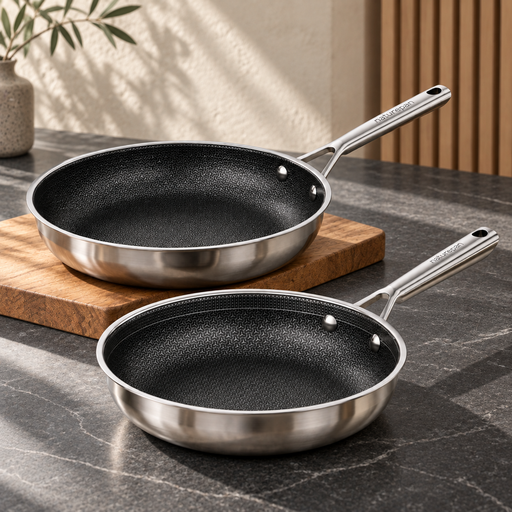
Why this product suits this profile: With 24 and 28 cm pans, the set covers two common household sizes and, according to the product details, is suitable for induction, gas, electric and glass-ceramic hobs.
The product description specifies a multi-layer stainless steel body with an aluminium core, as well as a textured, ceramic-coated surface. This makes the material details more transparent than a simple non-stick marketing claim.
Two sizes, induction compatibility and oven use up to 230 °C according to the product details. Hand washing is recommended to care for the coating.

Why this product suits this profile: This set is aimed at households looking for two standard diameters, a stainless steel body and induction compatibility.
The product description specifies Cromargan stainless steel, a ceramic coating and a TransTherm Universal base. This makes it easier to assess the materials and hob compatibility in concrete terms.
24 and 28 cm pans, suitable for all hob types including induction according to the supplier, with a wide pouring rim and oven compatibility according to the product description.
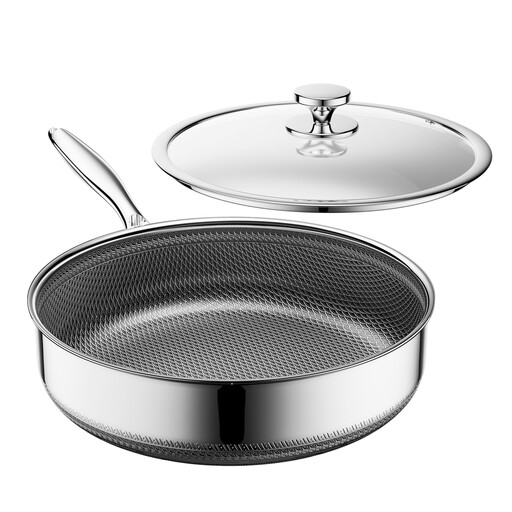
Why this product suits this profile: According to the product description, its deep shape and glass lid are suitable for sautéing, braising and dishes containing liquid.
The details distinguish between the temperature limits for the pan and the lid: up to 260 °C for the pan body and up to 148 °C for the glass lid. This avoids making a blanket assumption about oven suitability.
According to the product details, a PFAS-, PTFE- and PFOA-free coating, hybrid structure, lid and compatibility with gas, electric, glass-ceramic, halogen and induction hobs.
We have put together a complete, regularly updated list of products that fully meet these strict selection criteria and the safety regulations applicable in the EU.
The service life of a ceramic frying pan depends heavily on heat, cleaning and the kitchen utensils used. The following steps are sensible for most models:
Even a ceramic frying pan labelled as dishwasher-safe may be subjected to greater wear through frequent machine washing. Hand washing is therefore often the gentler option for the materials.
Only if the product description or manufacturer’s information explicitly mentions induction. An aluminium body alone is not sufficient. A magnetic base or a suitable stainless steel base is required. If you are unsure, compare the model description with your own hob before buying.
It is not possible to give a reliable fixed service life for all models. Frequent heating while empty, high temperatures, metal utensils and thermal shocks can place greater strain on the coating. Low to medium heat, gentle cleaning and suitable utensils can help extend its useful life.
These terms describe specific material properties according to the relevant product information. They do not replace a full check of the instructions for use, temperature limits and conformity information. Therefore, look for clear manufacturer details about the coating, maximum temperature and intended use.