
Lieferung heute & morgen

Qualitätsgarantie

Willkommens-Angebote freischalten: KOSTENLOSE Lieferung | Bis zu 80 % RABATT | Kostenlose 30-Tage-JoyPlus-Testphase
App herunterladen
A ceramic frying pan can be practical for frying, sautéing and preparing delicate foods. However, the name alone does not guarantee the right choice. Products sold as “ceramic frying pans” are often aluminium or stainless-steel pans with a ceramic coating. Material thickness, hob type, care instructions and included accessories can vary considerably.
If you are looking for a ceramic frying pan for everyday use, you should therefore look beyond terms such as “non-stick” or “PFAS-free”. What matters is whether the technical specifications suit your household and your preferred cooking style.
Many models are made from aluminium or stainless steel and simply have a ceramic non-stick coating. This is not necessarily a disadvantage: aluminium can heat up quickly, while stainless steel often allows for a robust construction. However, buyers should distinguish between:
A product description should therefore include details of the base material, coating and base construction.
Terms such as PFAS-free frying pan, PTFE-free frying pan and PFOA-free frying pan refer to specific groups of substances or coating materials. These claims should come directly from the manufacturer’s information. On their own, however, they say little about how the surface will perform after prolonged use, exposure to high heat or incorrect cleaning.
Ceramic coatings are often promoted for frying with little oil. In practice, their properties are more likely to last if the pan is not heated empty at high temperatures for extended periods and utensils made from wood, silicone or plastic are used.
A pan may be suitable for induction, gas, electric and ceramic hobs, while still not being suitable for use in the oven. Likewise, the pan body may be oven-safe, while the lid can only be used up to a lower temperature.
Before buying, you should check:
A coated frying pan should be cleaned with mild washing-up liquid and a soft sponge. Metal turners, steel wool and abrasive cleaning products can damage the surface. Even if a model is described as a dishwasher-safe frying pan, hand-washing may be advisable if you want to preserve the coating for as long as possible.
Look for clear information about:
“Non-stick coated” primarily describes the function of the surface. It is not an indication of an unlimited service life.
A 24 cm frying pan is suitable for smaller households, individual portions, egg dishes or side dishes. The stated diameter usually refers to the upper rim rather than the actual usable base surface.
A 28 cm frying pan provides more room for vegetables, several pieces of meat or family-sized portions. However, it requires more storage space and may heat unevenly on small hobs. With induction, it is particularly important that the base diameter matches the cooking zone.
Deep models are useful if you also want to braise or cook with liquid. In this case, a frying pan with lid or a deep sauté pan may be more practical than a shallow frying pan.
A cool-touch handle does not necessarily remain completely cool while cooking. It will generally become hot when the pan is used in the oven. You should therefore check the handle design and the guidance on using oven gloves.
The included accessories also affect the value of an offer. A frying-pan set with 24 and 28 cm pans caters for different quantities. A single deep pan with a lid, on the other hand, may be better suited to dishes such as braised meals, vegetable pans or one-pot recipes.
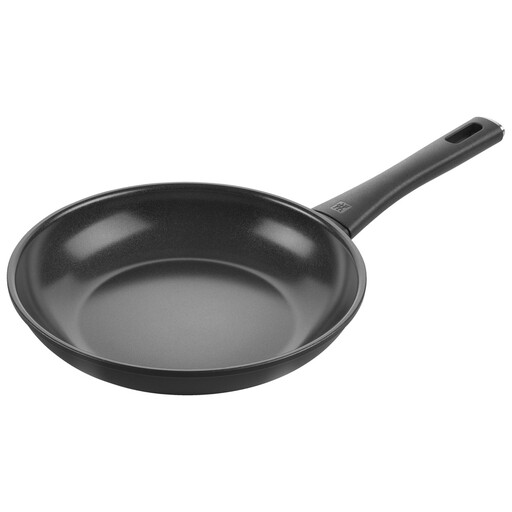
Why this product suits this profile: The compact 24 cm size is ideal for smaller portions and everyday cooking tasks. According to the product information, the forged aluminium body is suitable for gas, induction, ceramic, halogen and oven use.
The specifications state the coating type, compatible hob types and an oven temperature of up to 250 °C. This makes it easier to check whether the pan suits your household before buying.
24 cm diameter, aluminium body and, according to the manufacturer, PTFE- and PFOA-free CeraForce ceramic coating.

Why this product suits this profile: The set includes a 24 cm and a 28 cm frying pan. This allows you to prepare individual portions and larger meals using different pan sizes.
According to the product description, the universal TransTherm base is suitable for various hob types, including induction. The specific oven and care instructions should still be checked before buying.
Two diameters, Cromargan-18/10 stainless steel and ceramic coating with mineral reinforcement, according to the manufacturer’s information.
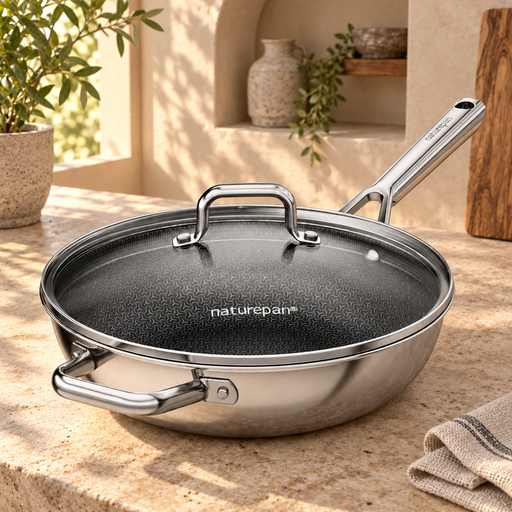
Why this product suits this profile: The deep 28 cm design with matching lid is aimed at households that want to braise or prepare larger quantities as well as fry.
The product data explicitly states that it is suitable for induction, gas, electric and ceramic hobs, with an oven limit of 230 °C without the lid. This reduces the risk of misunderstandings during use.
Hybrid construction with stainless steel and an aluminium core, ceramic-coated surface, 28 cm diameter and matching lid.
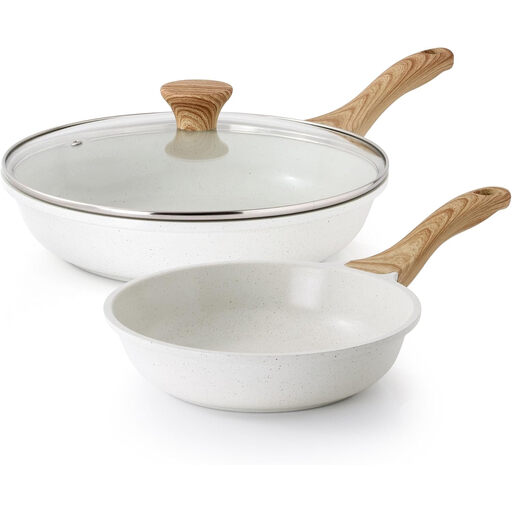
Why this product suits this profile: The set combines an 8-inch omelette pan with an 11-inch frying pan and glass lid. According to the product information, it is designed for induction, gas and electric hobs.
The information states that dishwasher use is not recommended. If you are happy to wash the pans by hand, you avoid having unrealistic expectations about cleaning.
Two frying pans, glass lid and, according to the manufacturer, a coating without intentionally added PFAS, PTFE, PFOA, PFOS, APEO, lead or cadmium.
We have put together a complete, regularly updated list of products that fully meet these strict selection criteria and the safety regulations applicable in the EU.
A few simple rules will help you use your pan while being as gentle as possible on the materials:
A dishwasher-safe frying pan can be cleaned in a dishwasher, but manufacturers often still recommend hand-washing. With stainless-steel or hybrid models, you should also check whether the lid and handle have the same temperature limits as the pan body.
Not every ceramic frying pan is automatically an induction frying pan. The key requirement is a magnetic or induction-compatible base. The product description should explicitly mention induction. If you are unsure, check the technical specifications or the manufacturer’s information.
There is no reliable one-size-fits-all answer. Its lifespan depends, among other things, on heat, frequency of use, utensils, cleaning and storage. Low to medium temperatures, hand-washing and protected storage can help preserve the surface. Even so, the non-stick performance may change over time.
That depends on how you intend to use it. A PTFE-free frying pan may appeal to buyers who want to avoid this type of coating. Other users place greater importance on weight, heat performance, dishwasher use or oven safety. It is therefore better to compare the specific material and care details rather than focusing solely on the name of the coating.