
Lieferung heute & morgen

Qualitätsgarantie

Willkommens-Angebote freischalten: KOSTENLOSE Lieferung | Bis zu 80 % RABATT | Kostenlose 30-Tage-JoyPlus-Testphase
App herunterladen
A ceramic frying pan can be a practical addition to your daily cooking: many models are lightweight, heat up quickly and can be used with very little oil. However, ceramic-coated pans differ significantly in terms of material, coating, hob compatibility and care.
If you only look out for terms like “non-stick” or “Titanium Ceramic”, you risk missing important details. Three common buying pitfalls are particularly worth noting:
If you’re looking for a PFAS-free pan, PTFE-free pan or PFOA-free pan, you should check the specific product description. These terms are not automatically interchangeable:
Usage instructions are also important. Metal utensils, abrasive sponges, harsh cleaning agents and prolonged heating without contents can all damage the surface. Even with a coated pan, low to medium heat is recommended unless the manufacturer states otherwise.
An induction-compatible pan needs a magnetic stainless steel or similar induction base. For gas, electric and ceramic hobs, compatibility is usually less demanding, but should still be stated in the product specifications.
Look for:
The BUYDEEM Ceramic Nonstick Frying Pan is said to have a 5.5 mm thick base with a stainless steel casing and is listed as suitable for gas, induction, electric, ceramic and halogen hobs. This could be relevant for households with multiple hob types. A frying pan for all hob types should still always be chosen based on the manufacturer’s specific instructions.
The size given usually refers to the top rim, not the actual heated surface area. The base diameter can be significantly smaller.
A 24 cm pan is often more practical for everyday use. A 28 cm pan offers more space, but may heat unevenly on small hobs. With a pan with lid, you should also check whether the lid is included and whether it’s suitable for oven use.
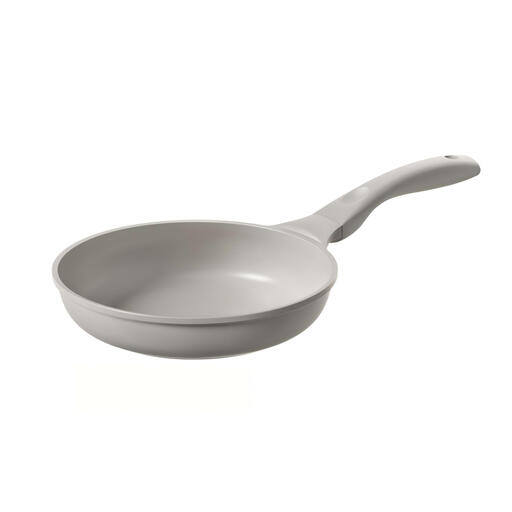
Why this product fits the profile: The 24 cm size is ideal for singles, couples and smaller portions. According to product information, the pan is suitable for induction, gas and electric hobs and features a PTFE-, PFOA- and PFAS-free ceramic coating.
The product data clearly states the coating type, size and hob compatibility. This means your choice doesn’t have to rely solely on general non-stick marketing claims.
24 cm diameter; according to product information, dishwasher-safe and suitable for multiple hob types including induction.

Why this product fits the profile: The set combines 24 cm and 28 cm, covering both small and larger cooking quantities. According to the product description, the body is made from Cromargan 18/10 stainless steel and features a TransTherm universal base for various hob types including induction.
The two diameters prevent you from having to use a large pan for small portions or a small pan for family-sized meals.
Two sizes; ceramic coating with mineral reinforcement according to the product description; oven-safe design as stated by the supplier.

Why this product fits the profile: The deep 3.8-quart pan with lid is suitable for sautéing, braising, frying and preparing larger meals, according to product information. It is designed for all hob types including gas.
The product data clearly states that the pan is not dishwasher-safe and not oven-safe. These limitations can be factored into your kitchen planning before purchase.
3.8-quart capacity; lid, two pouring spouts and accessories according to the product description.
We’ve put together a complete, regularly updated list of products that fully meet these strict selection criteria and the safety regulations in force in the EU.
With the right care, you can protect the coating during everyday use:
Only if the product description states that it is induction-compatible. What matters is a magnetic base, not the ceramic coating itself. An induction-compatible pan may also be approved for gas, electric or ceramic hobs.
It’s not possible to give a reliable lifespan for every model. It depends on temperature, utensils, cleaning and frequency of use. Low to medium heat, hand washing and avoiding metal cutlery can help preserve the coating.
No. The information about the coating and about cleaning relate to different properties. A pan may be PFAS-free according to product data, but still be recommended for hand washing only. So you should check both details before buying.