
Lieferung heute & morgen

Qualitätsgarantie

Willkommens-Angebote freischalten: KOSTENLOSE Lieferung | Bis zu 80 % RABATT | Kostenlose 30-Tage-JoyPlus-Testphase
App herunterladen
A ceramic frying pan can be practical for frying, braising and cleaning. However, the wide range of options can quickly lead to poor purchases: a pan may not be compatible with an induction hob, the coating may be damaged by incorrect cleaning, or claims about being free from harmful substances may not be clearly worded.
Our selection is aimed at UK households that want to understand technical specifications and find a suitable ceramic frying pan for everyday use. What matters is not an especially promotional product name, but the combination of coating, material, hob compatibility, size and care requirements.
Most products on the market are a pan with a ceramic coating applied to aluminium or stainless steel. This is different from a completely ceramic body. A coated pan may be lightweight and heat up quickly, but it needs to be handled with care.
Always check the material specifications for both the pan body and the cooking surface. Aluminium conducts heat quickly, while stainless steel is often used for durability and induction compatibility. A multi-layer construction can support even heat distribution, but it does not replace proper temperature control.
These terms are sometimes used alongside one another by retailers:
Such material information is not a medical efficacy claim. It simply describes the composition declared by the supplier. For products with specific claims, check the product page and the manufacturer information provided there.
A pan may be oven-safe while the lid or handle has lower temperature limits. Removable handles must be taken off before placing the pan in the oven. “Dishwasher-safe” also does not automatically mean that the coating will remain unchanged over the long term. Despite the stated approval, many suppliers still recommend hand washing.
Ceramic non-stick coatings generally work well in everyday cooking at low to medium heat. Prolonged heating while empty can put strain on the surface. Use wooden, silicone or nylon utensils, and avoid knives and metal cutlery.
The coating is also a wear part. Its lifespan depends on temperature, cleaning, stacking and frequency of use. Without specific warranty terms, it is not possible to give a reliable blanket figure in months or years.
For an induction hob, an induction frying pan needs a magnetic base. Check the specifications to see whether induction is explicitly listed. Gas, electric and ceramic hobs are suitable for many models, whereas halogen or infrared hobs are not always listed clearly.
24 cm is often suitable for smaller portions, while 28 cm provides more room for family meals. A deep frying pan with lid is useful for sauces, braised dishes and one-pot recipes. For eggs or small portions, a compact pan such as the COOKER KING Tamagoyaki pan, measuring 18 × 13 cm, may be more suitable.
A ceramic frying pan set can cover several sizes, but it requires more storage space. Check whether the handles are removable and whether the pans can be stored stacked together.
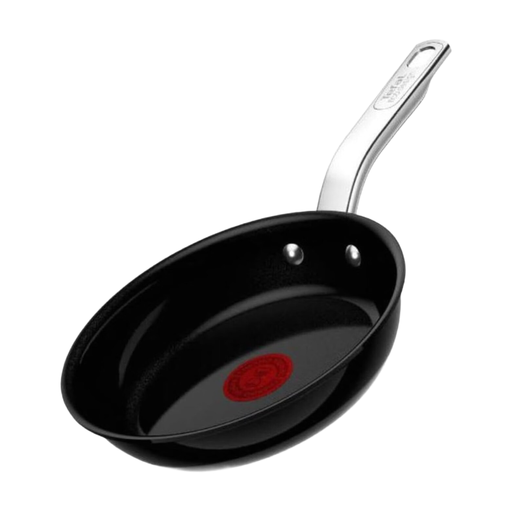
Why this product suits this profile: The 24 cm individual pan is ideal for households looking for a compact solution for eggs, vegetables or smaller portions. According to the product information, it is suitable for gas, electric and ceramic hobs, but not for induction.
The explicitly stated hob compatibility helps prevent an incorrect purchase for induction hobs. The care instructions recommend hand washing and avoiding metal utensils.
24 cm format, integrated Thermo-Signal indicator according to the product description, and a ceramic non-stick surface.
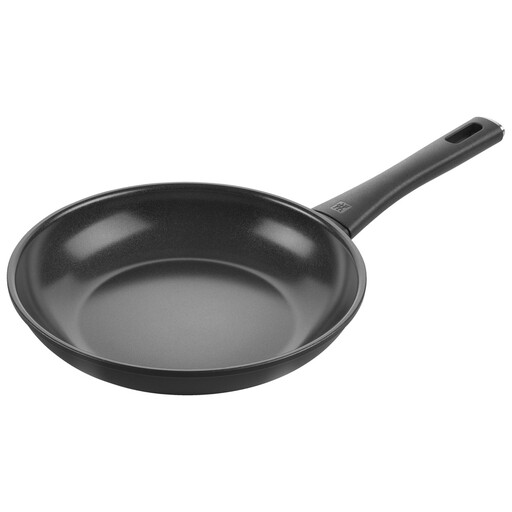
Why this product suits this profile: According to the product information, this forged aluminium pan has a CeraForce Granite ceramic coating and a stainless steel handle. It is suitable for gas, induction, ceramic and halogen hobs.
The product page states that the coating is PTFE- and PFOA-free and that the pan is oven-safe up to 250 °C. Hand washing and gentle utensils are recommended for protecting the coating.
24 cm diameter, net weight of 0.95 kg according to the stated specifications, and a base designed for several types of hob.
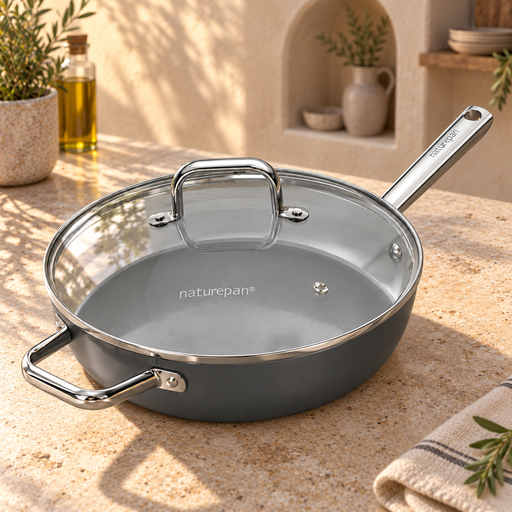
Why this product suits this profile: The high sides and glass lid are suitable for sauces, braised dishes, soups and larger portions. The supplier lists induction, gas, electric and ceramic hobs as suitable.
The technical limits are clearly stated: according to the product page, the pan body is oven-safe up to 260 °C, while the lid must be removed before use in the oven. Metal utensils and intense heating while empty should be avoided.
28 cm diameter, 7.5 cm-high pan wall, lid, and diamond- and titanium-reinforced ceramic coating according to the product information.
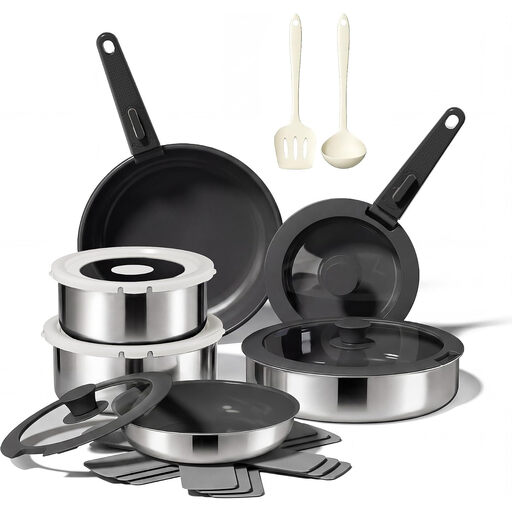
Why this product suits this profile: The stackable 16-piece set with two removable handles is designed for a range of cooking situations and space-saving storage. According to the product information, it is suitable for induction, gas, electric, ceramic and halogen hobs.
The specifications distinguish between oven-safe parts and handles: according to the product page, it can be used up to 260 °C with the handles removed. The handles are not dishwasher-safe.
Stackable design, two removable handles and, according to the manufacturer, a coating free from PFAS, PFOA, PTFE, lead and cadmium.
We have put together a complete, regularly updated list of products that fully meet these strict selection criteria and the safety regulations applicable in the EU.
Not every ceramic frying pan is automatically suitable for induction. The key requirement is a magnetic base. The product description must explicitly list induction as a compatible hob type. If you are unsure, check the manufacturer’s information before buying.
It is not possible to give a fixed lifespan that applies in every case. It depends, among other things, on temperature, frequency of use, cleaning method and the kitchen utensils used. Low to medium heat, hand washing and soft utensils can help protect the surface during everyday use. Visible flaking or deep scratches are a reason to stop using the pan.
“PFAS-free” describes a declared material property, but it is not a general health claim. Check carefully whether the statement refers to intentionally added PFAS or to the entire group of substances. You should also follow the guidance on temperature, damage, cleaning and contact with food.