
Lieferung heute & morgen

Qualitätsgarantie

Willkommens-Angebote freischalten: KOSTENLOSE Lieferung | Bis zu 80 % RABATT | Kostenlose 30-Tage-JoyPlus-Testphase
App herunterladen
A ceramic frying pan for induction should let you cook food with little oil, be easy to clean and perform reliably in everyday use. In practice, unclear coating details, unsuitable sizes or missing information about hob compatibility can quickly lead to disappointing purchases. Checking a few technical details before buying can significantly narrow down your options.
Many models described as ceramic frying pans are made from aluminium or stainless steel with a ceramic non-stick coating. This is not necessarily a disadvantage, but it should be stated clearly: an aluminium body usually heats up quickly, while a stainless-steel body with an aluminium core offers different characteristics in terms of weight and heat retention.
Claims such as “diamond-reinforced” or “multi-layered” initially describe the construction. They do not replace specific information about heat resistance, care requirements and suitable cooking utensils.
An induction frying pan needs a magnetic base that sits flat on the hob. The term “ceramic-coated aluminium frying pan” alone does not confirm this. Look for an explicit statement that the pan is suitable for induction hobs and compare the base diameter with the cooking zone.
The models considered here are also listed as suitable for gas, electric and glass-ceramic hobs. For halogen or infrared hobs, check the relevant manufacturer’s information.
A dishwasher-safe frying pan can be cleaned in a dishwasher, but several models still recommend hand washing to help protect the coating over the long term. Strongly alkaline detergents, high temperatures and contact with other metal items can put more strain on the surface than a soft sponge and mild washing-up liquid.
A non-stick ceramic frying pan usually consists of a metal body and a ceramic layer. The following details are relevant when choosing one:
A ceramic coating is not a licence for consistently using high temperatures. For everyday use, the products listed here are recommended for low to medium heat. Avoid heating the pan empty for long periods and exposing it to sudden, significant changes in temperature.
The 20, 24 and 28 cm diameters are suited to different tasks:
The upper diameter is not the only important measurement. The actual base diameter affects how much of the pan sits over the induction zone. With a set, the pans may have base diameters ranging from approximately 15.8 to 22.3 cm, depending on the model.
If you want to finish cooking pan dishes in the oven, check the permitted temperature and maximum usage time. Some models are specified for temperatures of up to 230 °C, while others can withstand up to 260 °C. For pans with lids, the lid must be removed before using the pan in the oven if required by the product description.
A pots and pans set with detachable handles saves space, but requires extra care: the handle must be securely locked in place before lifting the pan and must not remain attached when using it in the oven. Lids, protective parts and accessories may have their own care and temperature limits.
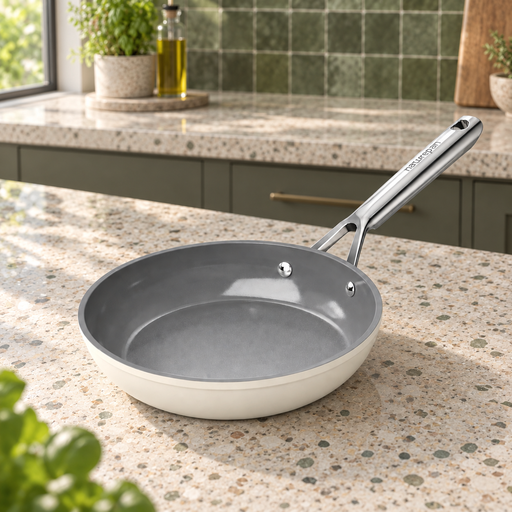
Why this product suits the profile: The compact 20 cm frying pan is suitable for small portions and kitchens with limited storage space. It is designed for induction, gas, electric and glass-ceramic hobs.
The product description explicitly states that it has an aluminium body and ceramic coating. This makes it easier to assess the advertised ceramic surface realistically.
20 cm diameter, stainless-steel handle, oven suitability up to 260 °C according to the product details, and dishwasher suitability.
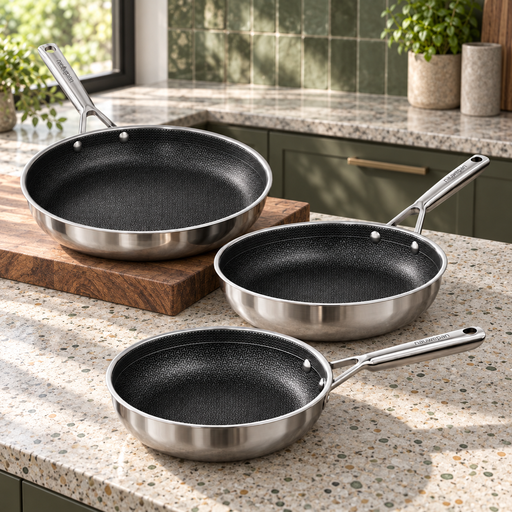
Why this product suits the profile: The set combines three diameters with a multi-layer stainless-steel body, aluminium core and textured cooking surface for different cooking tasks.
The details specify the stainless-steel body, aluminium core and exposed stainless-steel ribs of the hybrid surface. The structure should therefore not be equated with a completely smooth coating.
Three sizes, induction suitability, dishwasher suitability and a hybrid structure designed for roasting and searing.
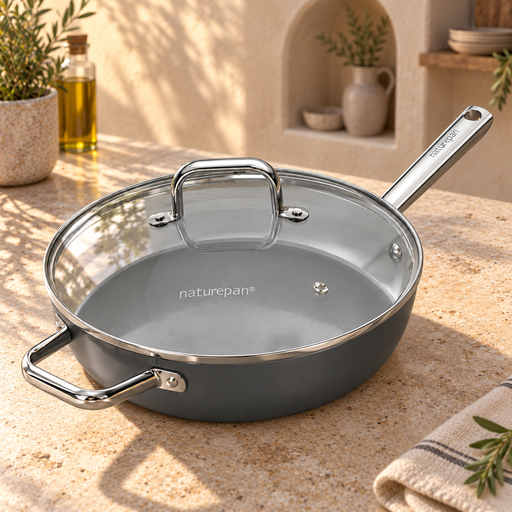
Why this product suits the profile: The 7.5 cm-deep pan with matching lid is suitable for slow-cooked dishes, sauces, vegetables and larger portions on an induction hob.
The lid, oven limit of up to 260 °C according to the product details, and exclusion of microwave use are clearly stated. The lid must be removed before placing the pan in the oven.
28 cm diameter, high sides, glass lid and ceramic non-stick coating for one-pan dishes.
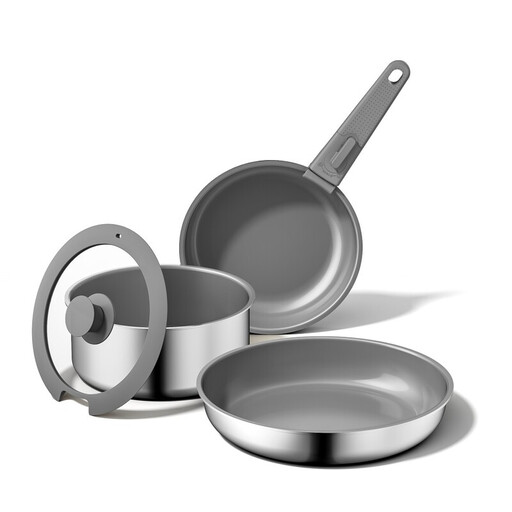
Why this product suits the profile: The 16-piece set includes pots, frying pans, lids, protective parts and detachable handles. The bodies can be stacked inside one another to save space.
The contents are listed individually. It is also clearly stated that the handles, lids and accessories should be cleaned by hand.
Nesting storage, several cooking vessels, induction suitability and oven use up to 230 °C without detachable parts attached.
We have put together a complete, regularly updated list of products that fully meet these strict selection criteria and the safety regulations applicable in the EU.
The lifespan of a coated frying pan depends largely on how it is used. The following basic rules apply to most ceramic-coated models:
A little oil can be useful for everyday frying, even when the surface is described as non-stick. It supports the cooking process and reduces unnecessary stress caused by intense heating.
A 20 cm ceramic frying pan is usually sufficient for individual portions. A 24 cm pan is a practical everyday size for smaller households, while 28 cm provides more space for family portions. Also check the base diameter and the size of the cooking zone.
There is no reliable universal service-life estimate. It depends on the heat, cleaning method, utensils and frequency of use. Low to medium temperatures, hand washing and avoiding metal utensils can help protect the surface. Visible scratches or reduced non-stick performance are signs that the pan should be replaced.
No. “Ceramic frying pan” initially describes the type of coating, not necessarily its complete chemical composition. A PFAS-free frying pan should be explicitly identified as such in the manufacturer’s information or product details. This feature is stated in the product descriptions of the Naturepan models mentioned here; the current information on the product page and packaging remains definitive.