
Lieferung heute & morgen

Qualitätsgarantie

Willkommens-Angebote freischalten: KOSTENLOSE Lieferung | Bis zu 80 % RABATT | Kostenlose 30-Tage-JoyPlus-Testphase
App herunterladen
A ceramic frying pan for induction can be practical for everyday cooking: it is usually easy to clean, often requires very little oil when fitted with a suitable coating, and is available in various sizes. However, product claims such as “scratch-resistant”, “healthy” or “suitable for all hob types” do not automatically lead to the right purchase decision.
What matters are verifiable details about hob compatibility, coating structure, diameter, care requirements and temperature limits. This buying guide is aimed at home cooks, families and consumers looking for a durable, easy-care frying pan that is suitable for induction hobs.
A ceramic non-stick frying pan is usually made from metal with a ceramic non-stick coating. The pan body is often made from aluminium or stainless steel. This is not the same as solid ceramic.
The entire construction is therefore important for heat performance: an aluminium core can conduct heat quickly, while a multi-layer stainless steel body may be designed for stability and heat retention. Look for specific material details rather than relying solely on the term “ceramic frying pan”.
An induction-compatible frying pan needs a magnetically suitable base. For the models listed here, induction is expressly stated as a compatible hob type. Nevertheless, buyers should also check whether the pan is suitable for their own hob, the size of the cooking zone and the pan’s weight.
Information about gas, electric and ceramic hobs does not automatically confirm suitability for infrared or halogen hobs. For some Naturepan models, contacting the manufacturer is recommended for this purpose.
Even a PFAS-free frying pan or a ceramic-coated pan should not be heated empty at a high setting for extended periods. Several products recommend using a low to medium temperature for everyday cooking. Metal turners, abrasive sponges and significant temperature changes can damage the surface.
“Dishwasher-safe” also describes the technical possibility of cleaning the pan, not necessarily the gentlest method of care. For many coatings, hand washing is recommended to help preserve their performance for as long as possible.
A ceramic-coated frying pan can be made from aluminium, stainless steel or a multi-layer material. Aluminium is comparatively lightweight and conducts heat quickly. Stainless steel is dimensionally stable and robust, but may be heavier depending on the construction.
When choosing a coated stainless steel frying pan, it is worth looking at the base construction. According to the product information, the Naturepan Hybrid model has a multi-layer stainless steel body with an aluminium heat core. Its etched hexagonal surface combines exposed stainless steel ridges with coated areas, making it suitable for frying and searing.
Terms such as “diamond-reinforced” or “titanium-reinforced” should be regarded as material descriptions. They do not replace specific care instructions and are not, in themselves, proof of a particular service life.
A 28 cm frying pan is practical for family portions, vegetables, meat or one-pan dishes. However, bear in mind that the stated diameter does not correspond to the actual base area. For induction cooking, the contact area with the hob is particularly important.
A 24 cm pan is more suitable for smaller portions, eggs or side dishes. An induction pan set with 20, 24 and 28 cm pans covers a range of cooking situations, but requires more storage space. Deep sauté pans with 7.5 cm-high sides are better suited to casseroles, sauces and dishes containing liquid than shallow frying pans.
Check whether the pan is dishwasher-safe and what temperature limit applies when using it in the oven. With pans featuring a glass lid, the lid often needs to be removed before placing the pan in the oven. A pan with lid is more versatile, but the lid and high sides can add to the overall weight.
As a general care routine, allow the pan to cool down, wash it with mild washing-up liquid and a soft sponge, then dry it before storing. Use wooden, silicone or nylon turners and avoid heating the pan empty for extended periods.
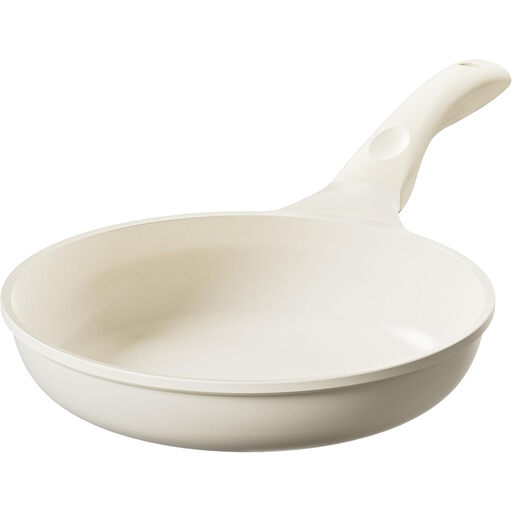
Why this product suits the profile: The 24 cm size is designed for smaller households, breakfast and side dishes. According to the product information, the pan is suitable for induction, gas and electric hobs.
The product description specifies the compatible hob types and recommends avoiding metal utensils. This clearly sets out important usage limitations.
24 cm diameter, ergonomic Bakelite handle and, according to the product information, a PTFE-, PFOA- and PFAS-free ceramic coating.
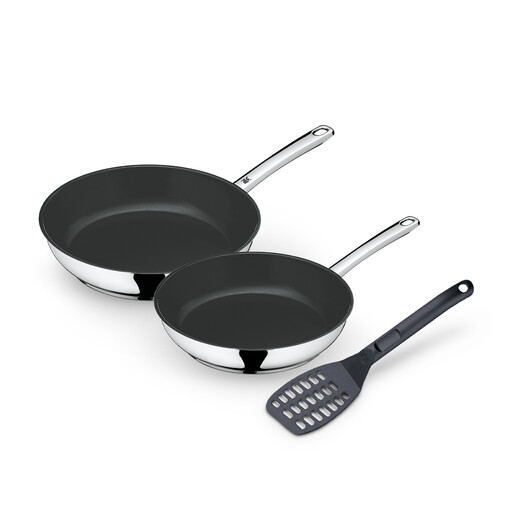
Why this product suits the profile: The set combines two coated frying pans with a turner, making it suitable for households that regularly prepare different portion sizes.
The product information specifically lists the TransTherm base, hob compatibility and oven temperature limit. The recommended use at medium heat helps limit unnecessary strain on the coating.
24 and 28 cm pans, Cromargan stainless steel 18/10, ceramic coating and a dishwasher-safe turner according to the product description.
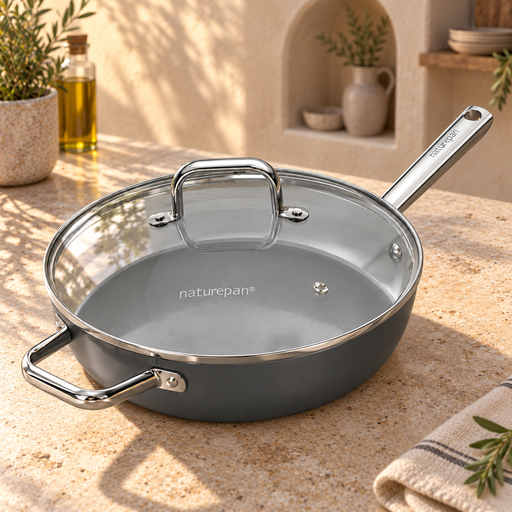
Why this product suits the profile: The high sides and glass lid are suitable for sautéing, braising, making sauces and preparing dishes containing liquid. The size is designed for family portions.
The product information specifies the material, hob types, maximum oven temperature and care instructions. The lid must be removed when using the pan in the oven.
28 cm diameter, 7.5 cm-high sides, glass lid and ceramic non-stick coating; according to the product information, suitable for induction and other common hob types.
We have put together a complete, regularly updated list of products that fully meet these strict selection criteria and the safety regulations applicable in the EU.
A coating is a wear part. Even with careful use, its non-stick properties may change as a result of frequent use, incorrect temperature selection or scratches. Cookware with visible flaking or a deformed pan should no longer be used.
A 28 cm frying pan provides more usable cooking space for several portions. For individual eggs, small side dishes or smaller households, a 20 or 24 cm pan may be easier to handle. A set with 20, 24 and 28 cm pans covers different quantities, but requires additional storage space.
No. The term “ceramic” alone is not enough to confirm this. If you are looking for a PFAS-free frying pan, the specific product description should include a corresponding statement. According to the product information, several of the Redchef and Naturepan models mentioned feature a PTFE-, PFOA- or PFAS-free coating. These details should be checked on the relevant product page before buying.
There is no universal service life. It depends, among other things, on the temperature, frequency of use, utensils used, cleaning and storage. Low to medium heat, soft sponges and gentle kitchen utensils can put less strain on the coating during everyday use. Dishwasher-safe does not mean that every wash will be equally gentle in the long term.