
Lieferung heute & morgen

Qualitätsgarantie

Willkommens-Angebote freischalten: KOSTENLOSE Lieferung | Bis zu 80 % RABATT | Kostenlose 30-Tage-JoyPlus-Testphase
App herunterladen
A ceramic frying pan for induction can make everyday cooking easier: food is more likely to release cleanly at the right temperature, cleaning is often straightforward and many models are suitable for low-fat frying. However, ceramic-coated frying pans vary considerably in their construction, heat resistance and care requirements.
If you focus only on terms such as “non-stick”, “PFAS-free” or “suitable for all hob types”, you can easily overlook important details. The following points will help you choose an induction-compatible frying pan that suits your household.
Most products are either a ceramic-coated aluminium frying pan or have a stainless-steel body with a ceramic interior coating. The body of the pan is therefore made of metal; only the surface that comes into contact with the food has a ceramic coating. This is not a disadvantage, but it should be taken into account transparently when making your choice.
Aluminium is often used because it is comparatively lightweight and distributes heat quickly. Stainless steel may feel more robust, but on its own it is not a particularly good conductor of heat. Models with an aluminium core therefore often combine both materials.
An induction-compatible frying pan needs a magnetic or induction-ready base. The base diameter should also match the cooking zone. A 20-cm pan is not automatically ideal for every 20-cm cooking zone, as the base that is actually usable may be smaller.
The following details are relevant when choosing:
A coated frying pan is not designed for every type of heat or oven temperature. The handle in particular can limit the permitted temperature. For example, a model with a plastic handle may only be suitable for use in the oven up to 70 °C, while a stainless-steel handle allows considerably higher temperatures.
Even a dishwasher-safe frying pan should not automatically go in the dishwasher after every use. Mild washing-up liquid, a soft sponge and avoiding significant temperature changes can help protect the coating in everyday use.
A 20 cm frying pan is suitable for individual portions, fried eggs, small omelettes or side dishes. For two or three portions, 24 cm is often more practical. A 28 cm sauté pan offers more surface area and a higher rim. It is suitable for vegetable stir-fries, casseroles, larger portions and recipes requiring a lid.
An induction frying pan set with 20, 24 and 28 cm pans can be useful if you regularly prepare different quantities. If you have limited storage space or usually cook for one person, a single 20-cm frying pan is often the simpler option.
For a ceramic non-stick frying pan, the product description should be as clear as possible about:
Several of the Naturepan models listed here specify a ceramic coating reinforced with diamond and titanium particles. According to the product details, certain Naturepan frying pans are free from PTFE, PFAS and PFOA. This information applies to the relevant product specification and should not be automatically extended to all ceramic frying pans.
An oven-safe frying pan is especially versatile when the handle and lid can also withstand the relevant temperature. According to the product details, the Naturepan Deep Sauté Pan can be used up to 230 °C without the lid. The Naturepan 20-cm models with stainless-steel handles are stated to be oven-safe up to 260 °C. Although the coated aluminium body of the Silit Belluna is suitable for induction, the plastic handle limits oven use to 70 °C according to the stated specifications.
Before putting the pan in the oven, always check:
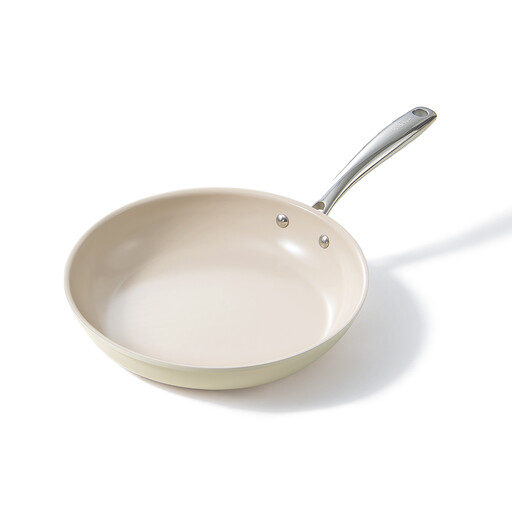
Why this product suits the profile: The 20-cm pan is compact, designed for induction, gas and electric hobs, and is suitable for individual portions and everyday frying.
The product details specify the material, size, hob types and care instructions. This makes it possible to compare the pan with your own cooking zone before buying.
Aluminium body, three-layer ceramic coating, stainless-steel handle, plus stated oven and dishwasher suitability.
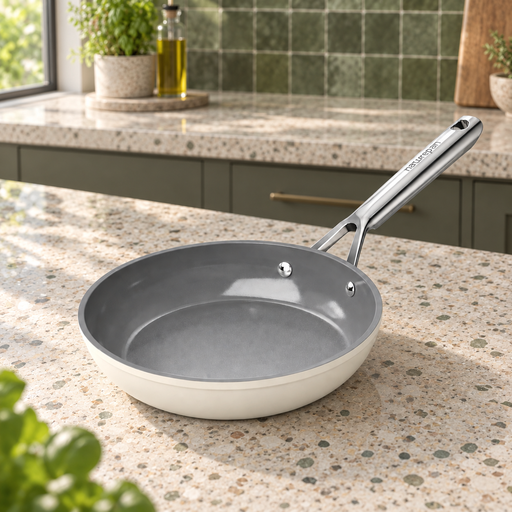
Why this product suits the profile: This compact pan combines an aluminium body with a reinforced ceramic coating and a stainless-steel handle for versatile use on different hob types.
The product details state a maximum oven temperature of 260 °C, induction compatibility and a recommendation to use low to medium heat.
According to the product details, a PFAS-, PTFE- and PFOA-free coating, stainless-steel handle, 20 cm diameter and dishwasher suitability.
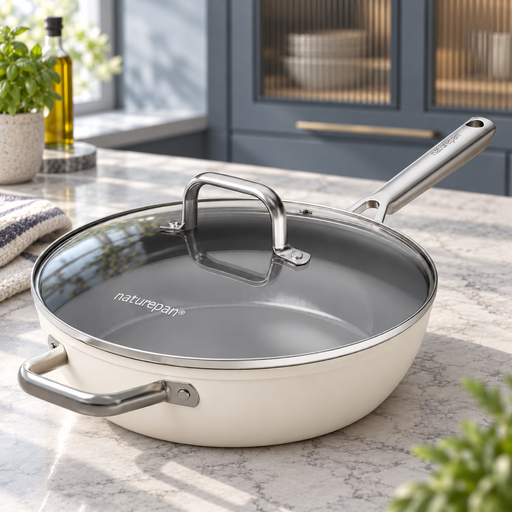
Why this product suits the profile: The higher 7.5-cm rim and supplied lid are ideal for larger portions, sauté dishes and braised food in family households.
Oven use is clearly limited to up to 230 °C without the lid. This takes into account the often-overlooked restrictions relating to the handle and lid.
28 cm diameter, 7.5 cm body height, stainless-steel handle, lid and suitability for induction, gas, electric and ceramic hobs.
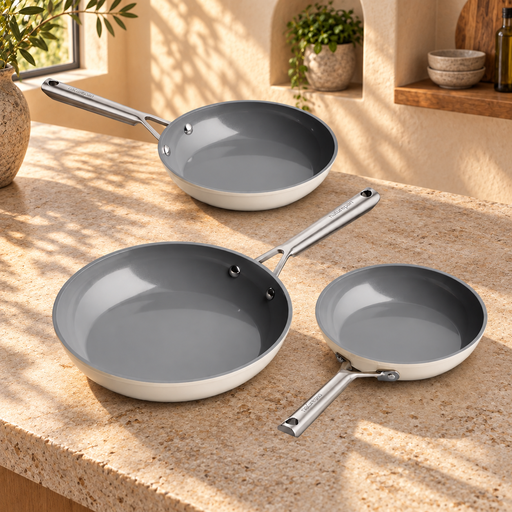
Why this product suits the profile: Three graduated sizes cover small portions, side dishes and larger meals, without the need to make several separate purchasing decisions.
The sizes are clearly specified. This makes it easy to check whether you have enough storage space and suitable cooking zones for the complete set.
Three ceramic frying pans, aluminium bodies, stainless-steel handles, induction compatibility and stated dishwasher suitability.
We have compiled a complete, regularly updated list of products that fully meet these strict selection criteria and the safety regulations applicable in the EU.
Even a high-quality coating requires careful handling. These practical rules apply to most models:
“Dishwasher-safe” describes the possible cleaning method, not necessarily the gentlest one. Hand-washing is recommended for many coated models to help preserve the surface performance for as long as possible.
A 20 cm frying pan is usually enough for an egg, a small omelette, vegetables or an individual portion. For several people, 24 or 28 cm is often more practical. The key point is still that the pan base must match the induction cooking zone.
It is not possible to give a reliable fixed service life. It depends, among other things, on heat, utensils, cleaning and frequency of use. Low to medium temperatures, gentle hand-washing and avoiding heating the pan empty can help reduce everyday stress on the coating.
No. “Ceramic frying pan” initially refers to the coating or the term used to market it. A PFAS-free frying pan should explicitly state this property in the product details. It is specified for certain Naturepan models according to the product specifications provided; blanket statements covering all products are not appropriate.