
Lieferung heute & morgen

Qualitätsgarantie

Willkommens-Angebote freischalten: KOSTENLOSE Lieferung | Bis zu 80 % RABATT | Kostenlose 30-Tage-JoyPlus-Testphase
App herunterladen
A ceramic frying pan set can make everyday cooking easier: different diameters cover a range of uses, from frying a single egg to preparing a family meal. At the same time, ceramic frying pan sets vary considerably in terms of coating, hob compatibility, cleaning and oven use. If you only pay attention to advertising claims such as “scratch-resistant” or “suitable for all hob types”, you may overlook important details.
This buying guide from the Joybuy Product Recommendation Officer explains which details in the product information for an non-stick frying pan set are genuinely relevant before you buy, and which options suit different households.
In most products, the pan body is made from aluminium or stainless steel, with only the interior featuring a ceramic coating. This is not necessarily a disadvantage, but it does affect heat conduction, weight and care. An aluminium body often heats up quickly, while stainless steel with an aluminium core is designed to combine durability with even heat distribution.
So always check the specific material details. Terms such as ceramic-coated, aluminium body or stainless steel with aluminium core are more informative than a general description as a ceramic frying pan.
For induction cooking, a frying pan needs a magnetic base. For a frying pan set for all hob types, the product description should explicitly mention induction, gas, electric and ceramic hobs. Different guidance may apply to halogen or infrared hobs, depending on the model.
A flat, sufficiently large base is also important to ensure that the frying pan is reliably detected by an induction hob. The diameter of the pan rim does not always correspond to the actual heated base.
Although dishwasher-safe frying pans can generally be cleaned in a dishwasher, many manufacturers still recommend hand washing for coated frying pans to help protect the coating for longer. The same applies to ovenproof frying pans: the permitted temperature may only refer to the pan body. Removable handles, lids or silicone components often need to be removed.
Before buying, always check:
A ceramic non-stick coating can help you fry with very little oil or butter. However, its actual durability depends heavily on the temperature, cleaning products and kitchen utensils used. Metal turners can damage the surface unless they are expressly approved for use.
With PFAS-free frying pans, this claim should appear directly in the product information. In the recommendations below, the relevant statement is understood as a manufacturer or product claim, not independent verification. Terms such as PTFE-free, PFOA-free and PFAS-free should not be treated as interchangeable, as they refer to different groups of substances and definitions.
A 24 and 28 cm frying pan set covers many everyday cooking tasks. The 24 cm frying pan is suitable for smaller portions, side dishes or one to two people. The 28 cm pan offers more room for family portions, vegetables or several pieces of meat or fish.
A third diameter of 20 cm is useful for small quantities, breakfast or sauces. Before buying, it is worth checking the base diameter: a large frying pan with a narrow base may not use an induction hob as evenly.
Even heat distribution is influenced by the construction of the materials. According to the product description, the TransTherm base of the WMF model is designed for heat distribution and heat retention. Other models use an aluminium body or an aluminium core within a stainless-steel construction.
As a rule, ceramic-coated frying pans should not be used continuously at the highest heat setting. Several products expressly recommend preheating at a higher setting and then cooking at low to medium heat. This helps prevent unnecessary stress on the coating.
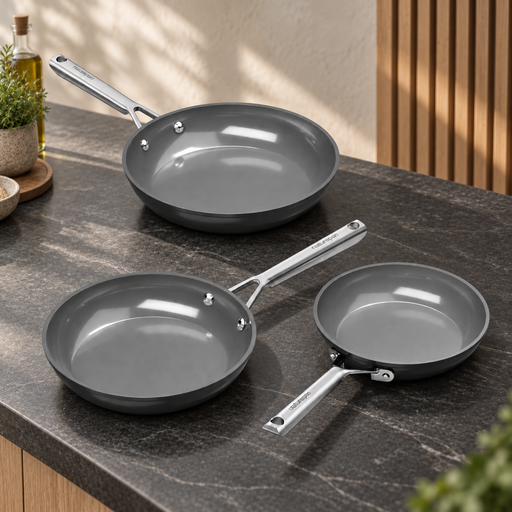
Why this product suits this profile: Three popular sizes cover both small and larger portions. According to the product information, the frying pans are suitable for induction, gas, electric and ceramic hobs.
The material description explicitly states that the pans have an aluminium body and ceramic coating. This makes it clear what the term ceramic refers to.
Three diameters, induction compatibility and a stated oven temperature of up to 260 °C.
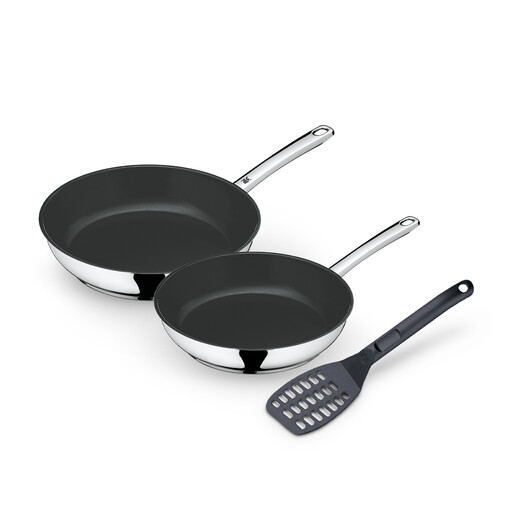
Why this product suits this profile: The set combines two coated frying pans with a turner and a stainless-steel body made from Cromargan 18/10.
The product information states that the pans are suitable for induction, gas, electric and ceramic hobs, and have a PTFE-free ceramic coating. The temperature limits for oven use and the material should be observed before use.
TransTherm base according to the manufacturer’s information, 24 and 28 cm frying pans, plus a dishwasher-safe turner.
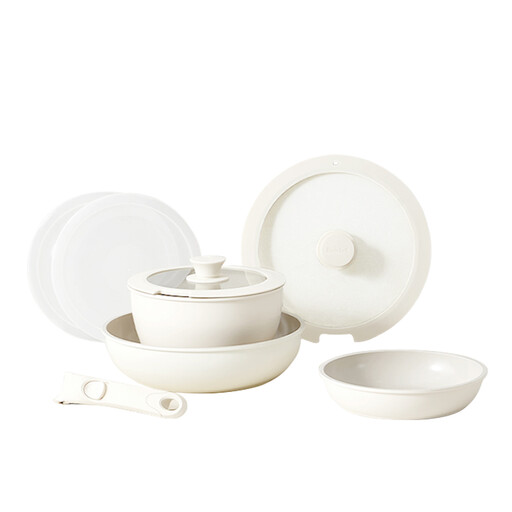
Why this product suits this profile: Several frying pans, a milk pan, lids and a removable handle offer flexible use and space-saving storage.
The product information states that the coating is free from PFAS, PFOA and PTFE. The handle must be removed before using the cookware in the oven and securely attached when cooking.
Suitable for all the stated hob types, stackable and, according to the product information, dishwasher-safe once the handle has been removed.
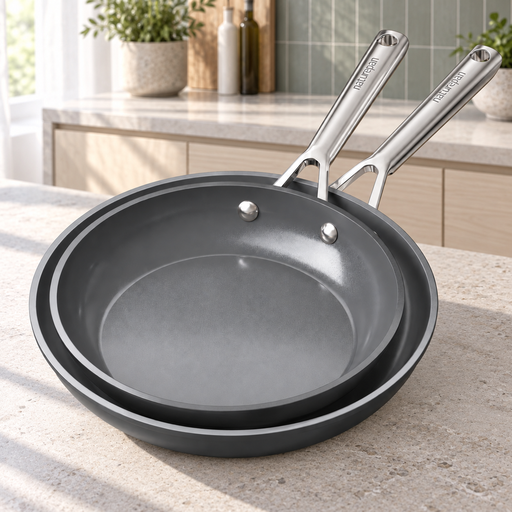
Why this product suits this profile: The combination of 24 and 28 cm is designed for everyday main meals and different portion sizes.
The description explicitly states that the pan has a ceramic-coated aluminium body, lists the compatible hob types and gives an oven temperature limit of 230 °C.
Two popular sizes, induction compatibility and stated dishwasher suitability; hand washing is recommended to help protect the coating.
We have put together a complete, regularly updated list of products that fully meet these strict selection criteria and the safety regulations applicable in the EU.
Even a high-quality ceramic frying pan set requires the right care:
Not every set is automatically suitable for induction. Look for an explicit statement such as “induction frying pans” or “suitable for induction”. The base of the frying pan should also sit flat on the hob. If you are unsure, consult the technical product description or the manufacturer’s instructions.
It is not possible to give a reliable general lifespan. Among other things, it depends on heat, cleaning, kitchen utensils and how often the pan is used. Low to medium temperatures, hand washing and non-abrasive utensils can help protect the coating. Visible flaking or deep scratches are a reason to stop using the frying pan.
According to the product information, the pan bodies of several products are dishwasher-safe. Nevertheless, hand washing is often recommended because harsh detergents and high temperatures can put greater long-term strain on the coating. With sets featuring removable handles, the handles and accessories often must not be put in the dishwasher or need to be cleaned separately.