
Lieferung heute & morgen

Qualitätsgarantie

Willkommens-Angebote freischalten: KOSTENLOSE Lieferung | Bis zu 80 % RABATT | Kostenlose 30-Tage-JoyPlus-Testphase
App herunterladen
Ceramic frying pans and ceramic cookware combine a coated surface with different base materials, such as aluminium or stainless steel. This can make cleaning easier and allow you to cook with less oil. However, not every ceramic frying pan is suitable for every hob, temperature or storage situation.
When choosing, specific details about the coating, hob type, oven temperature, handle system and cleaning matter more than eye-catching marketing claims. Our selection shows what households in Germany should look out for when buying.
Most products are ceramic-coated metal pans. Aluminium, stainless steel or a combination of stainless steel and an aluminium core are commonly used. An aluminium pan generally heats up quickly, while stainless steel can provide a robust outer construction.
The material construction affects:
When buying a ceramic frying pan, you should therefore read the full material description rather than relying solely on the product name.
A ceramic non-stick frying pan should generally be used at low to medium heat. Heating it empty for a long time, using very high temperatures and exposing it to sudden temperature changes can damage the coating. This also applies if the packaging states a high maximum temperature.
For everyday cooking, suitable kitchen utensils made from wood, silicone or nylon are a sensible choice. Metal turners and knives can scratch the coated pan.
Some models and sets are sold as dishwasher-safe cookware. This means that the manufacturer permits cleaning in a dishwasher. For the coating, however, gentle hand washing with mild washing-up liquid and a soft sponge may still be the better routine.
With a set featuring a removable handle, the handle, lid and accessories will also often need to be washed separately by hand.
Terms such as PFAS-free frying pan, PTFE-free frying pan or PFOA-free frying pan should always be taken from the specific product description or the manufacturer’s information. For some of the models listed here, these properties are explicitly stated. This does not allow a general claim to be made about all ceramic coatings.
Other practical considerations include:
An induction-compatible frying pan needs a suitable magnetic base. Many ceramic frying pans are suitable for gas, electric and ceramic hobs, but different manufacturer guidance may apply to halogen or infrared hobs.
Before buying, compare the information about your hob with the product description. This is particularly important with a frying pan set: check that every included piece is genuinely suitable for the same type of hob.
For one or two people, a frying pan with a diameter of 20 to 24 cm is often sufficient. Sizes from 26 to 28 cm are more suitable for family meals or several portions. A deep sauté pan provides more room thanks to its higher sides, making it useful for vegetables, pasta, braised dishes or saucy pan meals.
Stackable pots and pans with removable handles are practical for small kitchens. When choosing, pay attention to:
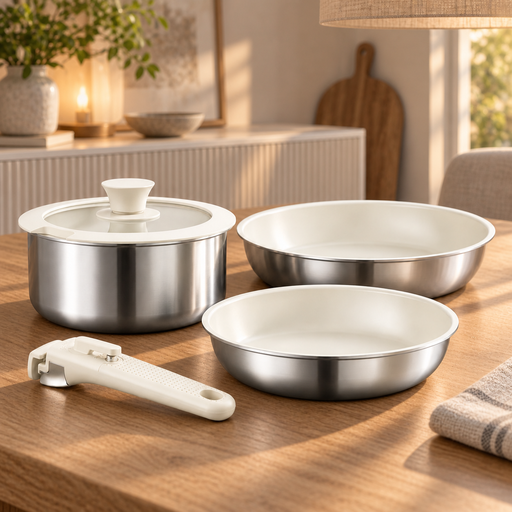
Why this product suits the profile: The set combines two frying pans, a 20-cm pot, a lid and a removable handle. It is suitable for households that need several essential shapes and want to store them compactly.
The description explicitly states that the pans have a metal body with a ceramic interior coating, distinguishing them from solid ceramic cookware. Oven use is specified up to 230 °C without the handle, lid and accessories.
Suitable for induction, gas, electric and ceramic hobs; stackable cookware bodies and dishwasher-safe cookware components make storage easier.

Why this product suits the profile: According to the product description, the 24- and 28-cm duo is made from Cromargan 18/10 stainless steel and features a TransTherm universal base for various hob types, including induction.
The description specifies the dimensions, material construction, hob compatibility and coating heat resistance of up to 400 °C. Actual oven use should be checked against the relevant manufacturer’s instructions.
Two practical sizes, broad pouring rims and reduced heat at the handle according to the product details.
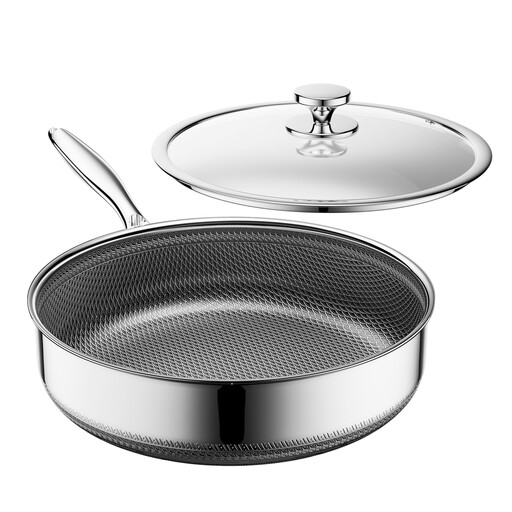
Why this product suits the profile: The deep frying pan with glass lid is suitable for braised dishes, sauces and larger portions. According to the product details, it is designed for gas, electric, ceramic, halogen and induction hobs.
The product description explicitly states that the coating is PFAS-, PTFE- and PFOA-free. This information comes from the product description and should be checked again before purchase if the details change.
Oven-safe up to 260 °C for the pan and up to 148 °C for the glass lid; dishwasher-safe according to the product details.
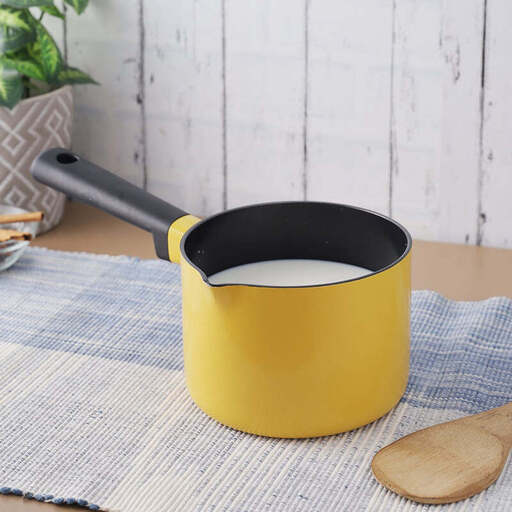
Why this product suits the profile: The 14-cm pot is designed for milk, sauces and small quantities. The product description specifies an aluminium body with a ceramic coating and a Bakelite handle.
Its compact size prevents a small portion from being prepared in an oversized pan. At the same time, use at medium to low heat is expressly recommended.
Specified for induction, gas, electric and ceramic hobs; compact 14-cm design for small portions.
We have put together a complete, regularly updated list of products that fully meet these strict selection criteria and the safety regulations applicable in the EU.
Even a coated frying pan needs to be treated appropriately:
Oven-safe cookware must only be used within the specified temperature limit. Lids, handles and accessories may have lower limits or may not be suitable for use in the oven.
Many models are labelled as induction-compatible frying pans. However, the base of the individual pan is the decisive factor. With sets, you should check that all pots and pans are approved for use on your induction hob.
There is no fixed general service life. It depends, among other things, on heat, utensils, cleaning and how often the pan is used. Low to medium temperatures, hand washing and protection when stacking can help preserve the coating. If the non-stick performance noticeably decreases or the surface is visibly damaged, the cookware should be replaced.
Some models are described as dishwasher-safe in the product details. With sets, this often applies only to the cookware bodies; handles, lids and accessories may need to be cleaned by hand. The manufacturer’s instructions are therefore more important than the general term “dishwasher-safe”.