
Lieferung heute & morgen

Qualitätsgarantie

Willkommens-Angebote freischalten: KOSTENLOSE Lieferung | Bis zu 80 % RABATT | Kostenlose 30-Tage-JoyPlus-Testphase
App herunterladen
Ceramic frying pans and ceramic cookware are often promoted as requiring little oil, being easy to clean and featuring PFAS-free coatings. However, not every ceramic frying pan is made from solid ceramic, and not every set suits every hob or kitchen routine. If you focus only on the price or grand promises, you may end up with a product that loses its non-stick performance after a short time, is too heavy for everyday use or cannot be used in the oven.
These three points are particularly likely to result in a poor purchase:
A coated frying pan with a ceramic surface is usually made with a metal body. Aluminium heats up quickly and is comparatively lightweight. Stainless steel provides a robust outer construction, while an aluminium core supports heat distribution.
If you are looking for a PFAS-free frying pan, PFOA-free frying pan or PTFE-free cookware, check the specific product description and the manufacturer’s information. Some models explicitly state that their coating is free from PFAS, PFOA or PTFE. Such statements cannot automatically be applied to all ceramic frying pans. Claims such as ‘healthy’ or ‘non-toxic’ should therefore not be interpreted as universal guarantees.
A genuine ceramic cooking pot made from stoneware or ceramic has different properties from a metal frying pan with a ceramic coating. It may retain heat for longer, but is often heavier and more sensitive to significant temperature changes.
For an induction hob, the frying pan needs a suitable magnetic base. An induction frying pan should therefore be explicitly stated as being suitable for induction. There is usually a wider choice for gas, electric and ceramic hobs.
Oven suitability is equally important:
For example, according to the product information, some Naturepan sets are oven-safe up to 230 °C without handles, lids and accessories. According to the manufacturer, the Ballarini frying pan can be used up to 250 °C and is suitable for gas, induction, ceramic and halogen hobs, as well as the oven. The Tefal C43604 Renew+ is not designed for induction.
A 24-cm non-stick frying pan is suitable for smaller portions and compact kitchens. For family meals, 26 or 28 cm is often more practical. A deep sauté pan with lid provides extra height for casseroles, vegetable dishes or larger quantities.
Weight and storage also matter. Sets with a removable handle can be nested inside one another and save space in small kitchens, motorhomes or holiday homes. Before buying, however, check whether the handle locks securely, needs to be cleaned separately and is compatible with the relevant lid.
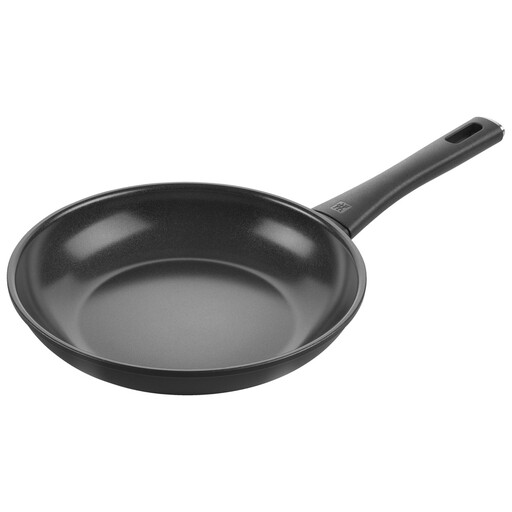
Why this product suits this profile: The 24-cm frying pan is suitable for smaller households and everyday portions. According to the product information, the forged aluminium body weighs 0.95 kg.
The coating is specifically stated to be free from PTFE and PFOA. The suitable hob types, including induction, are also clearly listed.
24 cm diameter, stainless steel handle and oven suitability up to 250 °C according to the product information.
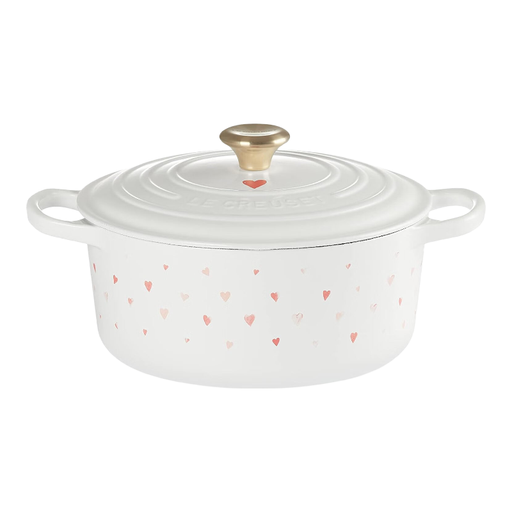
Why this product suits this profile: With a capacity of 3.3 litres, the enamelled cast-iron casserole is designed for casseroles, soups, roasts and oven recipes.
The product data clearly states the material, capacity, hob types and temperature limit. This makes it easier to assess whether the heavy casserole suits your cooking style.
Suitable for induction, gas, ceramic hobs and the oven; the lid and enamelled interior help with covered casseroles.
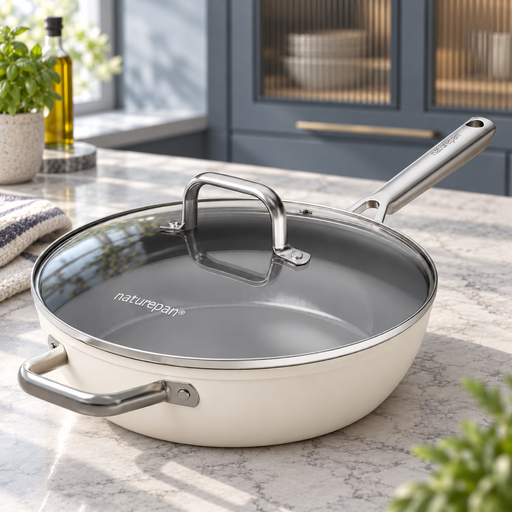
Why this product suits this profile: The 28-cm sauté pan with lid offers extra height for vegetables, casseroles and larger portions.
The product information distinguishes between ceramic-coated aluminium and solid ceramic. Temperature and hob limits are also specified.
28 cm diameter, 7.5 cm body height, matching lid and suitability for induction, gas, electric and ceramic hobs.

Why this product suits this profile: Two frying pans, one pot, a lid and a removable handle can be nested together, making the set suitable for households where space is at a premium.
The product description highlights the need to check the handle. Handles, lids and accessories must not be used in the oven.
Suitable for induction and other hob types; 20-cm pot with a 3-litre capacity and stackable design.
We have put together a complete, regularly updated list of products that fully meet these strict selection criteria and the safety regulations applicable in the EU.
A ceramic frying pan should initially be cleaned with warm water and mild washing-up liquid. For everyday cooking, low to medium temperatures are generally best. Many manufacturers’ instructions advise against heating the pan empty for extended periods.
The following is also recommended:
A ceramic cookware set can be economical thanks to its range of sizes and accessories. However, the key question is whether the included pieces will actually be used regularly. A small household does not necessarily need a 16-piece frying pan set. For frequent one-pot dishes, an enameled cast-iron Dutch oven may be the more practical choice. If you enjoy cooking Asian food, you should also look for a suitable wok pan, sufficient base space and compatibility with your hob type.
Not automatically. Only models with an explicitly stated induction base are suitable. The specific manufacturer’s information should also be followed for halogen and infrared hobs.
There is no universal service life. It depends, among other things, on the temperature, utensils, cleaning method and storage. Low to medium heat, gentle hand washing and avoiding metal utensils can help reduce wear on the coating during everyday use.
That depends on your actual needs. A set can combine several sizes and accessories. However, if individual pots or frying pans are rarely used, buying the right individual pieces may be more economical and save space.