
Lieferung heute & morgen

Qualitätsgarantie

Willkommens-Angebote freischalten: KOSTENLOSE Lieferung | Bis zu 80 % RABATT | Kostenlose 30-Tage-JoyPlus-Testphase
App herunterladen
Choosing a new ceramic hob can quickly become overwhelming. The market is flooded with models advertising numerous features, but not all are genuinely relevant for everyday kitchen use. Often, overlooked details lead to costly post-purchase problems. As your Joybuy Product Recommendation Officer, I'll help you navigate the common pitfalls and make an informed decision that perfectly suits your cooking habits and your kitchen.
Before we dive into the key features, let's look at the three most common mistakes that cost buyers time, money, and frustration.
To avoid these mistakes, focus on the following three core aspects. They will determine if a glass-ceramic hob is truly the right fit for you.
The most important distinction is between a dependent and a standalone hob.
Before purchasing, always check the product description for the required voltage (220–240V or 400V) and connection type. Models with a standard plug are easier to install, while units designed for a hardwired connection require a qualified electrician.
The choice of cooking zones depends directly on your household size and cooking style.
A glass-ceramic hob is easy to maintain, but only with the right tools. Burnt-on food residue is most effectively removed with a special ceramic hob scraper without scratching the surface. For daily cleaning, a damp cloth with a suitable cleaner is sufficient.
Equally important is choosing the right pan for a ceramic hob. Pots and pans must have a completely flat, clean base to ensure optimal heat transfer and prevent scratches. Health-conscious cooks are also increasingly looking for a PFAS-free pan to avoid the release of potentially harmful chemicals during heating.
Here are some product recommendations tailored to specific user profiles that take the aforementioned pitfalls into account.

Why this model is a great fit: This 2-zone hob is ideal for kitchens with limited space. With 3000W of total power, it has enough muscle for daily cooking and can be easily connected to a standard socket thanks to the included plug.
The clear specifications for cutout dimensions (26 × 49 cm) and the standard plug connection prevent the most common installation errors.
Features essential safety functions like a child lock, residual heat indicator, and overheating protection. 9 power levels and a timer allow for precise cooking.
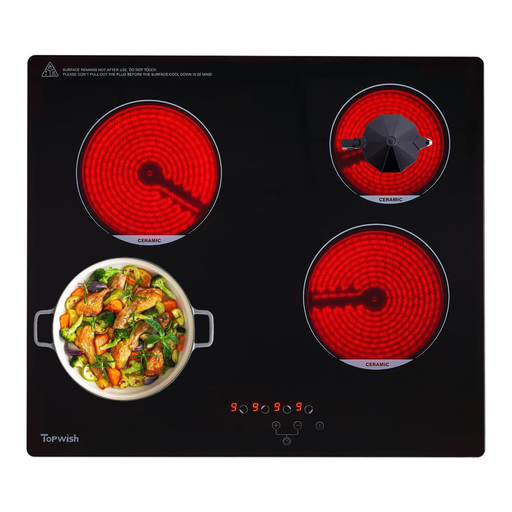
Why this model is a great fit: As a classic 60cm built-in hob, it fits into most standard kitchens. With four cooking zones, including two flexible dual-ring zones, and 6600W of power, it is perfectly equipped for preparing elaborate meals.
This model requires a hardwired connection by a professional, ensuring correct electrical installation from the start. Its standard dimensions minimise the risk of fitting issues.
Comprehensive safety features (child lock, timer, residual heat indicator). The flexible cooking zones adapt to different pot sizes, ensuring efficiency.
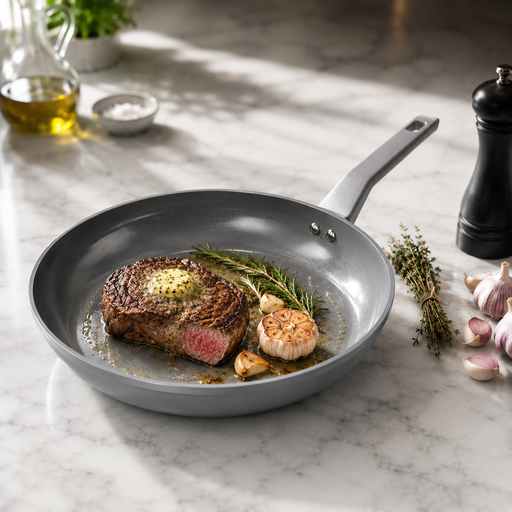
Why this accessory is a great fit: This pan for ceramic hobs is the ideal addition to any kitchen. It is suitable for all hob types and focuses on healthy cooking with a coating that is free of harmful substances.
It addresses the often-overlooked aspect of cookware quality. Instead of focusing only on the hob, this provides the foundation for safe and healthy cooking.
According to the manufacturer, the multi-layer ceramic coating is 100% free of PFAS, PFOA, and PTFE. The diamond-titanium reinforced surface ensures durability and excellent non-stick properties.
We have compiled a complete, up-to-date list of products that fully meet these strict selection criteria and rigorous safety standards.
1. How do you clean a ceramic hob correctly? After use, let the hob cool down completely. Remove loose debris with a damp cloth. For stubborn, burnt-on residue, use a special ceramic hob scraper, like the Poliboy Replacement Blades. Hold the scraper at a shallow angle. Always avoid abrasive cleaners or scouring pads, as they can permanently damage the glass surface.
2. What cookware is suitable for a ceramic hob? The ideal cookware has a thick, completely flat base to ensure optimal heat distribution. Suitable materials include stainless steel, enamelled cast iron, and pots and pans specifically designed for glass-ceramic hobs. Products like the LocknLock Décor IH Induction Frying Pan are explicitly suitable for ceramic hobs and offer additional benefits through their coating. Always lift pots and pans instead of dragging them across the surface to prevent scratches.
3. What does "standalone hob" mean? A standalone hob operates completely independently. It has its own power supply and its own controls located directly on the surface. Unlike hob-and-oven sets where the two are a single unit, you can install a standalone model anywhere in your worktop, regardless of your oven's location. This provides greater design freedom in modern kitchen planning.