
Lieferung heute & morgen

Qualitätsgarantie

Willkommens-Angebote freischalten: KOSTENLOSE Lieferung | Bis zu 80 % RABATT | Kostenlose 30-Tage-JoyPlus-Testphase
App herunterladen
A ceramic hob combines electric heating with a smooth glass-ceramic surface. This makes cleaning relatively straightforward and allows for finely graduated temperature settings. Depending on the model, such an electric hob can be suitable for a fixed kitchen installation, a small flat, a student hall of residence, or as a portable electric hotplate for a motorhome or camping.
Before you buy, however, it is worth taking a close look at the technical specifications. Marketing terms like "fast", "universal" or "scratch-resistant" alone tell you little about how well it will actually perform in everyday use.
A built-in ceramic hob must fit your existing worktop. What matters is not just the external width, but above all the cut-out in the worktop, the installation depth, and the required clearance from drawers, walls and heat-sensitive components.
A 60 cm hob, for example, may need a cut-out of around 56 × 49 cm. If this doesn't match your kitchen, you'll face additional adjustment work. For a fixed connection without a plug, installation should be carried out by a qualified electrician.
A high total power rating does not automatically mean that every cooking zone can operate at full power simultaneously. With a 4-zone hob, it is also important to consider how the power is distributed across the individual zones. Large dual or bridge zones are practical for different-sized pots, but they require suitable cookware sizes and enough space.
For portable appliances, a power output of 2,000 W is intended for many everyday cooking tasks. However, the available power should match the circuit's rating. Running several high-power appliances from the same socket can overload the circuit.
A touch-control hob looks sleek, but it can be less responsive when your fingers are wet or dirty. Rotary knobs are often more intuitive on portable single hotplates. A hob with a timer can switch off after the set time, but it does not replace the need to supervise when frying with oil or fat.
Safety features should be clearly specified: child lock, overheat protection, automatic shut-off and residual heat indicator. The residual heat indicator shows that the surface may still be hot; it is not a signal that the hob can be safely touched.
A 2-zone hob often suits singles, couples or small kitchens. Two differently sized zones are useful if you want to use a small pan and a larger frying pan at the same time. A 4-zone model is more suited to households that regularly prepare several dishes simultaneously.
Pay attention to:
A ceramic hob normally works with heated cooking zones. Therefore, smooth, stable pan bases are advisable. Unlike induction, compatibility with many appliances is broader; the respective manufacturer's instructions remain definitive.
The rated power is given in watts. It describes the maximum electrical power the appliance is designed for, not necessarily the power available continuously at each zone. For a fixed built-in glass-ceramic hob, voltage, frequency, connection type and circuit protection are particularly important.
An appliance without a plug must not simply be connected to any socket. Check the specifications for 220–240 V, fuse, connection cable and installation instructions. For portable hotplates, a suitable household mains connection is required.
A smooth glass-ceramic surface can be cleaned with a soft cloth once it has cooled down. Burnt-on residues should not be removed with harsh abrasive cleaners or unsuitable metal objects. Even a surface described as scratch-resistant remains sensitive to sand, salt, rough pan bases and point impacts.
Useful features include:
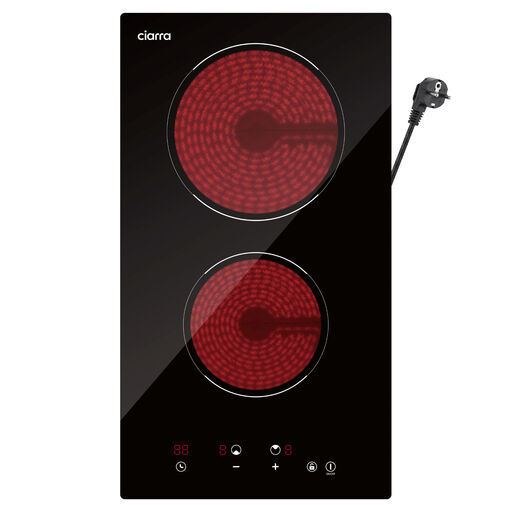
Why this product fits the profile: This compact 2-zone ceramic hob is designed for smaller kitchens and households with limited space. It offers 9 power levels and a total output of 3000 W.
The specifications provide concrete external and cut-out dimensions of 290 × 520 × 50 mm and 260 × 490 mm respectively. This allows you to check the installation situation in advance.
Individual timer up to 99 minutes, child lock, residual heat indicator and automatic pan detection according to the product description.
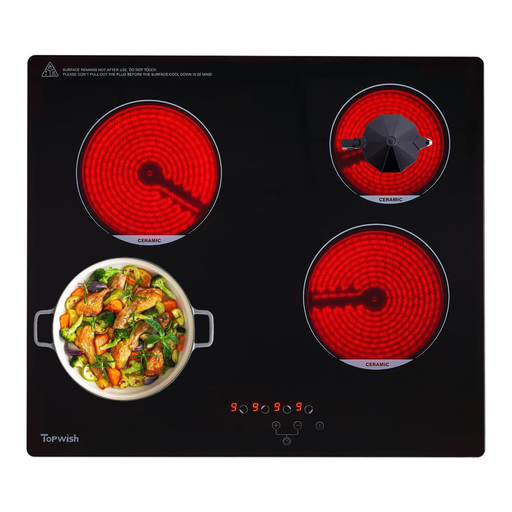
Why this product fits the profile: This fixed built-in 4-zone hob is aimed at households that use multiple pans at the same time and value clearly defined installation dimensions.
The product specifications state the cut-out as 560 × 490 mm. At the same time, there is no plug; the required fixed connection should be planned for before purchase.
Four cooking zones, 9 power levels, timer from 1 to 99 minutes, child lock and residual heat indicator according to the product description. The power ratings should be checked again before connection, as 6600 W is stated in the product title and 6000 W in the technical data.
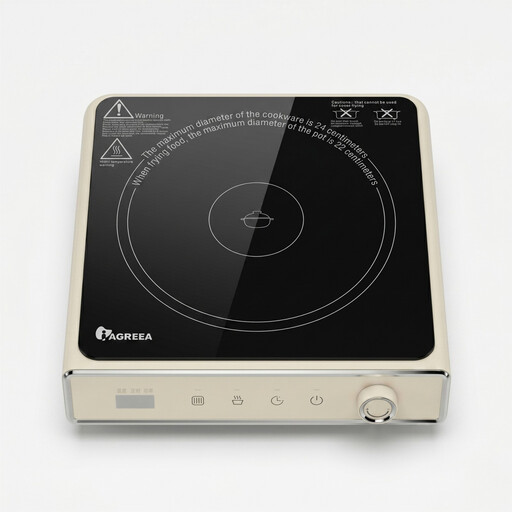
Why this product fits the profile: This portable single hotplate, measuring 288 × 270 × 65 mm and weighing 1.5 kg, is intended for small kitchens, offices, motorhomes or camping.
Instead of unclear temperature control, a frying mode with 8 temperature levels from 60 to 240 °C and a cooking mode with 8 power levels are specified.
2000 W, rotary knobs, timer up to 180 minutes and automatic shut-off after one hour without detected operation according to the product description. The appliance is intended for use with various cookware materials.
We have compiled a complete, regularly updated list of products that fully meet these strict selection criteria and the safety regulations in force in the EU.
Many models work with cookware made from stainless steel, cast iron, aluminium or ceramic. What matters are the specifications of the respective manufacturer. The pan base should be flat, clean and heat-resistant and should match the size of the cooking zone as closely as possible. Uneven bases can impair heat transfer and put greater strain on the surface.
A fixed built-in ceramic hob is connected to the mains via a suitable connection, depending on the model. Appliances without a plug are not intended for use with any standard socket. Check the connection power, fuse, cable and installation ventilation, and have the connection carried out by a qualified electrician.
The costs depend on the power output, usage time and your electricity tariff. A cooking zone with 2,000 W theoretically consumes 2 kWh during one hour of operation if it runs at full power for the entire time. In practice, the heating is regulated depending on the selected level. Therefore, pay attention to actual usage and switch the hob off completely after cooking.