
Lieferung heute & morgen

Qualitätsgarantie

Willkommens-Angebote freischalten: KOSTENLOSE Lieferung | Bis zu 80 % RABATT | Kostenlose 30-Tage-JoyPlus-Testphase
App herunterladen
A ceramic induction frying pan can be practical for frying, searing and low-fat cooking. However, glossy marketing promises do not automatically lead to the right choice. The key factors are the material construction, hob compatibility, care instructions and how the pan will actually be used at home.
Many products are advertised as a ceramic frying pan, even though they consist of an aluminium or stainless-steel body with a ceramic coating. This is not necessarily a disadvantage, but it should be clearly stated. Solid ceramic and ceramic-coated metal differ in terms of weight, heat distribution, sensitivity to knocks and care requirements.
With coated cookware, the product information about the coating is also important. Terms such as “non-stick”, “Titanium” or “Diamond Enhanced” initially describe the construction, but they are not general proof of a specific service life.
A pan may be suitable for induction, gas, electric and ceramic hobs, while additional checks are required for infrared or halogen hobs. Before buying, you should compare your hob type with the manufacturer’s information. The condition of the base is particularly relevant for older hobs and special glass surfaces.
A dishwasher-safe frying pan can be cleaned in a dishwasher, but many manufacturers still recommend washing it by hand. Strong detergents, high temperatures and contact with other dishes can put greater long-term strain on the surface. If you use a coated frying pan regularly, you should factor this care requirement into your buying decision.
A non-stick frying pan is useful for delicate foods such as eggs, fish or pancakes. Ceramic surfaces often require very little oil; nevertheless, you should not heat the pan empty on a high setting for an extended period. Wooden, silicone or nylon utensils help reduce the risk of scratches.
If you are looking for a PFAS-free frying pan, you should only rely on clear product information. According to the product description, the Redchef Starlight Series features a PTFE-, PFOA- and PFAS-free ceramic coating. This statement refers to the manufacturer’s information and cannot be applied generally to all ceramic frying pans.
An stainless-steel frying pan without a coating works differently. According to the product description, the Maxcook model uses 304 stainless steel without a non-stick coating. The so-called hot-pan, cold-oil method and a medium to low temperature can help reduce sticking. In return, it requires a little more practice than a coated frying pan.
A 28 cm frying pan provides space for several portions, but requires a sufficiently large hob. For one or two people, a 20 or 24 cm pan may be easier to handle. A 24 and 28 cm frying pan set covers typical cooking tasks: the smaller pan is suitable for eggs, vegetables or individual portions, while the larger one is ideal for meat, fried potatoes or family meals.
With high sides and a lid, a flat frying pan becomes a versatile sauté pan with lid. This allows food to be seared and then braised or steamed. Check the internal height, weight and storage space required.
The oven temperatures specified often apply only to the pan body. Several Naturepan models are listed as suitable for temperatures of up to 230 °C; lids must be removed before using them in the oven. A metal pan is not suitable for microwave use. Handles and pan bodies can become hot during cooking, so oven gloves are advisable.
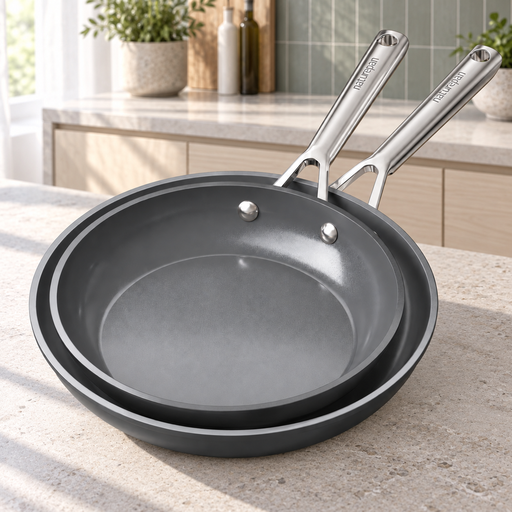
Why this product suits this profile: The two-piece set covers smaller and larger portions and, according to the product description, is suitable for induction, gas, electric and ceramic hobs.
The information clearly states the material, dimensions, hob types and recommended hand washing. This makes it easier to assess expectations regarding the coating and compatibility.
24 and 28 cm pans, aluminium body with ceramic coating, oven-safe up to 230 °C according to the product information.

Why this product suits this profile: The set combines two diameters with Cromargan 18/10 stainless steel and a TransTherm universal base for different hob types.
The product description states the coating type, material, hob compatibility and oven use. Before use, the heat-resistance information should be checked against the specific manufacturer’s instructions.
Two sizes, stainless-steel construction and universal base; according to the product description, suitable for induction, gas, ceramic and other hob types.
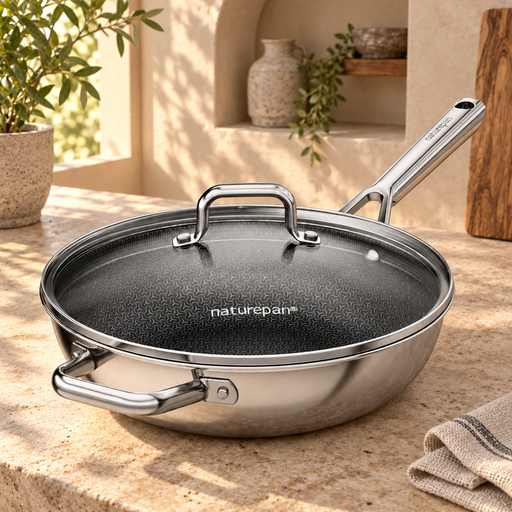
Why this product suits this profile: The high sides, lid and etched honeycomb structure are designed for searing, braising and covered dishes.
The description distinguishes the coated metal body from solid ceramic and states the 230 °C limit when the lid is removed.
28 cm diameter, 7.8 cm body height, glass lid and hybrid surface with both coated and exposed stainless-steel areas.
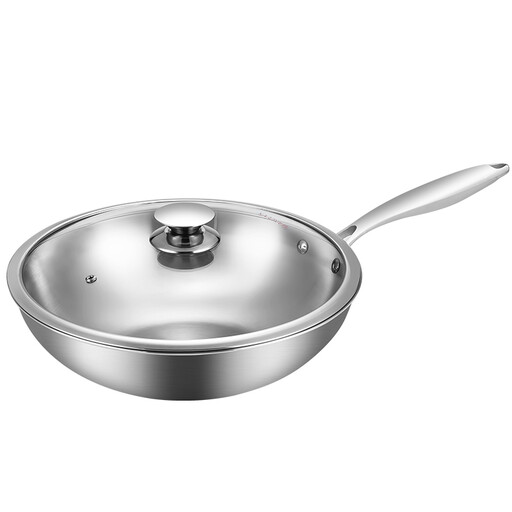
Why this product suits this profile: The uncoated 304 stainless steel is suitable for users who want to avoid ceramic or PTFE coatings and who are confident using the correct frying technique.
The product description explicitly states that it has no non-stick coating. This avoids creating false expectations of a coated surface.
Tri-Ply construction, 304 stainless steel, glass lid and, according to the product description, suitability for induction, gas, electric and ceramic hobs.
We have put together a complete, regularly updated list of products that fully meet these strict selection criteria and the safety regulations applicable in the EU.
It is not possible to give a general service-life estimate. This depends on the temperature, frequency of use, cleaning method, utensils used and the condition of the coating.
A 28 cm frying pan is generally more practical for cooking several portions. A 24 cm pan complements the set for smaller quantities. If storage space is limited, a single 28 cm pan may be sufficient, provided the hob suitably accommodates its diameter.
Possible causes include a temperature that is too high or too low, an overheated surface, too little fat or residue on the pan. With uncoated stainless steel, the correct preheating and oil technique is particularly important. Coated models should not be heated empty and on a high setting for a long time.
Yes, if you want to protect the coating for as long as possible. The dishwasher may be permitted according to the product information, but washing by hand with a soft sponge reduces mechanical and chemical wear. Dishwasher cleaning is generally more straightforward with uncoated stainless steel; hand washing may nevertheless help preserve the surface.