
Lieferung heute & morgen

Qualitätsgarantie

Willkommens-Angebote freischalten: KOSTENLOSE Lieferung | Bis zu 80 % RABATT | Kostenlose 30-Tage-JoyPlus-Testphase
App herunterladen
The search for the right ceramic pan for induction can quickly become overwhelming. The market is filled with promises of effortless cooking and long-lasting durability. Yet, all too often, the reality after just a few months falls short of the marketing claims: the non-stick effect fades, the base warps, or food cooks unevenly. As your Joybuy Product Recommendation Officer, I'll help you identify these pitfalls and make an informed decision.
Before you invest, you should be aware of the typical flaws that often only become apparent with everyday use and lead to disappointment.
To avoid the problems mentioned above, you should focus your attention on three core technical parameters. These are the primary determinants of your new pan's performance and longevity.
A simple ceramic layer is good, but a reinforced one is better. Look for terms like titanium ceramic pan or diamond-reinforced coatings. These particles increase the hardness and abrasion resistance of the surface, which preserves the non-stick properties for longer. For anyone looking to buy a healthy pan, the composition is crucial. A high-quality ceramic frying pan should be explicitly declared as a PFOA-free pan and ideally as a completely PFAS-free pan. This ensures that no unwanted substances are released, even at high temperatures.
The base is the heart of a ceramic induction pan. A thick, multi-layered sandwich base with an integrated ferromagnetic core (usually stainless steel) is the standard for good quality. This ensures fast and, most importantly, perfectly even heat distribution across the entire cooking surface. Such a construction also often makes the pan a pan for all hob types and prevents the base from warping due to temperature fluctuations.
Check the maximum heat resistance of the entire pan. There is an important distinction between the heat resistance of the coating and that of the handle. Pans with stainless steel or detachable handles are often oven-safe up to high temperatures (e.g., 260°C). Models with plastic or Bakelite handles offer good insulation on the hob but are usually only suitable for lower oven temperatures or not for the oven at all.
To make your decision easier, we have selected a few models based on different usage scenarios and the quality criteria mentioned above.
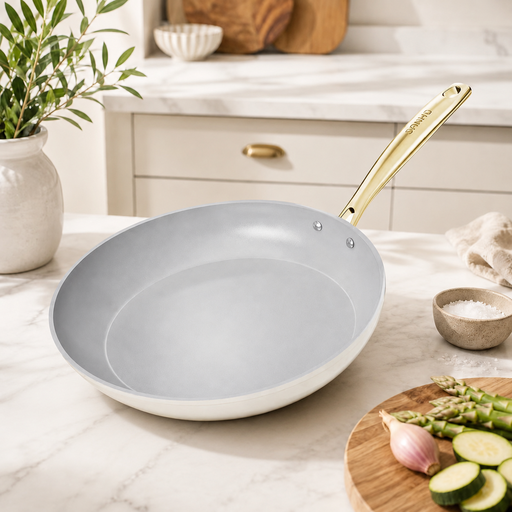
Why This Fits Their Persona: Ideal for daily use in families or for couples. The 26 cm size is versatile for everything from pancakes to sautés. Its high oven-safe temperature allows for flexible cooking methods.
According to the manufacturer, the patented diamond-titanium coating is more resilient than standard ceramic, counteracting the rapid loss of non-stick performance. The encapsulated base ensures even heat distribution on induction hobs.
Completely PFAS-free and oven-safe up to 260°C. The PVD handle stays cool on the hob and ensures safe handling.
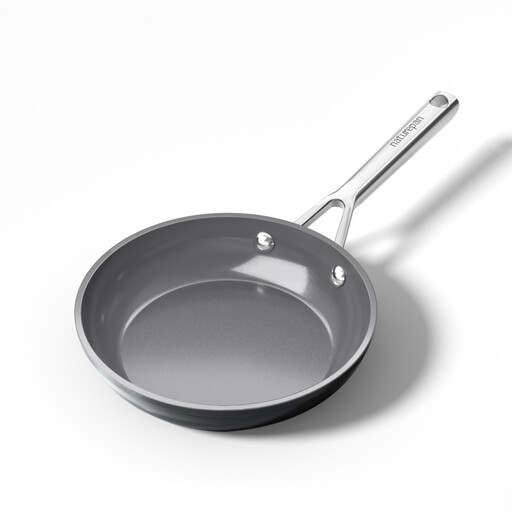
Why This Fits Their Persona: Perfect for single households or for preparing smaller portions like fried eggs or omelettes. The clear focus is on a toxin-free coating for a healthy diet.
The explicit declaration as PTFE/PFOA/PFAS-free provides peace of mind. The coating, reinforced with diamond and titanium particles, promises greater durability than simple ceramic pans. The optimised base is designed for even heat distribution.
Compact size and high oven safety (up to 260°C). The stainless steel handle stays cool on the hob and allows for flexible use in the oven.
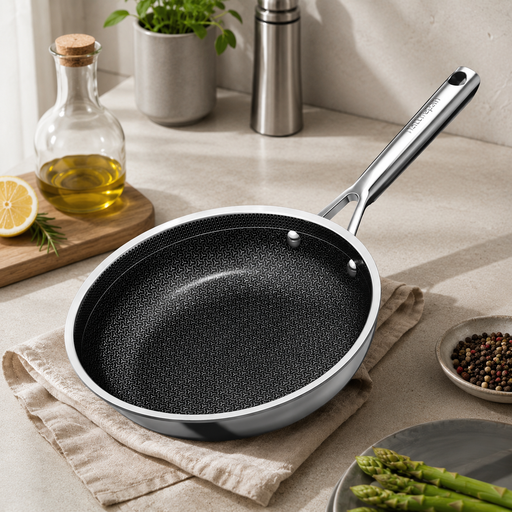
Why This Fits Their Persona: For chefs who want to combine the high-heat searing of stainless steel with the non-stick properties of ceramic. The large surface is ideal for steaks, whole chickens, or dishes for 4-6 people.
The hybrid technology, featuring a honeycomb pattern of stainless steel and ceramic, offers high scratch resistance and resolves the conflict between searing and sticking. The 5-ply construction prevents warping and hot spots.
Combines the benefits of two materials: high-heat searing on stainless steel and easy cleanup thanks to ceramic. The pan is robust, suitable for all hob types, and oven-safe up to 260°C.
We have compiled a complete, up-to-date list of products that fully meet these strict selection criteria and German safety regulations.
To maximise the lifespan of the Teflon-free non-stick surface, you should follow a few basic rules:
High-quality ceramic coatings are made on a mineral basis (sand derivatives) and are generally free of per- and polyfluoroalkyl substances (PFAS), including PFOA and PTFE. This is one of the main reasons why many health-conscious consumers opt for a ceramic pan. When buying, look for an explicit label from the manufacturer confirming that the product is free of these substances.
For a pan to work on an induction hob, its base must be made of a ferromagnetic material. If it is not, the hob's magnetic field cannot generate heat. Before purchasing, be sure to look for the induction symbol (a stylised coil) on the packaging or in the product description. A missing or only partially magnetic base is a clear quality defect and renders the pan useless for induction cooking.