
Lieferung heute & morgen

Qualitätsgarantie

Willkommens-Angebote freischalten: KOSTENLOSE Lieferung | Bis zu 80 % RABATT | Kostenlose 30-Tage-JoyPlus-Testphase
App herunterladen
A high-quality ceramic induction pan is a valuable addition to any kitchen, especially for health-conscious cooks. However, the market is full of promises that don't always deliver. Before you make a decision, it's crucial to understand the common pitfalls that often lead to buyer's remorse. This guide will help you identify the key features and find a pan that meets your standards for durability and cooking performance.
Many products advertise attractive features, but the devil is in the details. Pay attention to these three points to avoid disappointment:
To make an informed decision, you should focus on the technical fundamentals rather than marketing buzzwords.
The core of a good induction pan is its base. For optimal performance on induction cooktops, a ferromagnetic, multi-layered construction is essential. A design with three or more layers (often called "Tri-Ply" or "5-Ply"), where a heat-conducting aluminium core is sandwiched between layers of a stainless steel pan, ensures fast and, most importantly, even heat distribution across the entire cooking surface. This prevents the aforementioned hot spots and allows for precise cooking.
The longevity of a scratch-resistant pan depends directly on the quality of its non-stick layer.
Beyond the basic functions, other features determine a pan's versatility:
Based on the criteria above, we have identified a few models suitable for different needs and cooking styles.
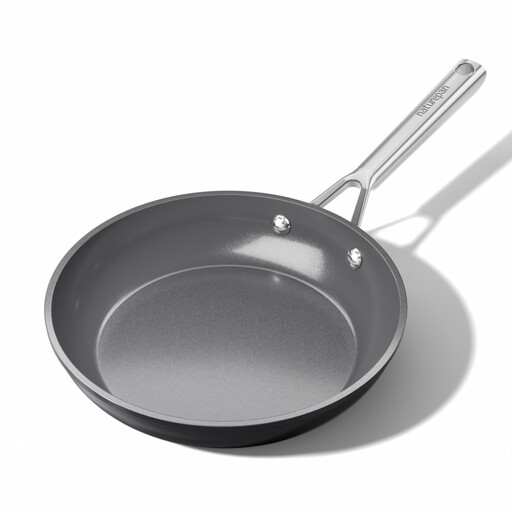
Why This Fits Their Persona: Ideal for the daily preparation of healthy meals for 2-3 people. The non-toxic, reinforced coating supports low-oil cooking, while the size is perfect for everyday use.
The ceramic coating, reinforced with diamond and titanium particles, is significantly more robust than basic coatings, thus avoiding the low-durability trap. The optimised base ensures even heat distribution and prevents hot spots.
Completely PFAS, PFOA, and PTFE-free. Oven-safe up to 260°C for versatile applications.
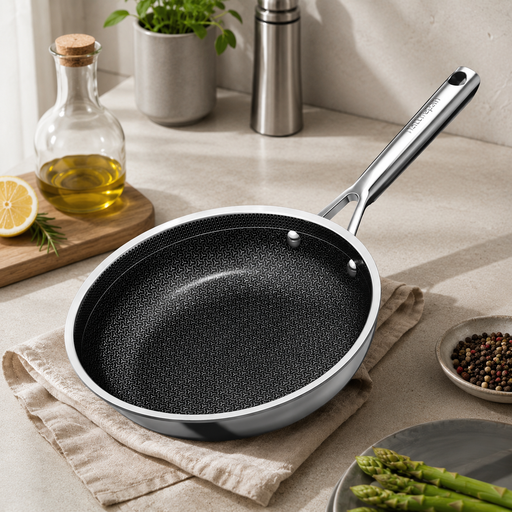
Why This Fits Their Persona: Perfect for chefs who want both the non-stick properties of a ceramic pan and the searing capability of a stainless steel one. The hybrid technology and 5-ply construction offer professional-grade performance.
The laser-etched hexagonal structure with raised stainless steel ridges provides physical protection for the ceramic coating, solving the problem of scratch sensitivity. The 5-ply construction guarantees excellent heat distribution on induction cooktops.
Combines high-heat searing with non-stick functionality. According to the manufacturer, the coating is 5x more scratch-resistant than standard coatings. High oven safety up to 260°C.
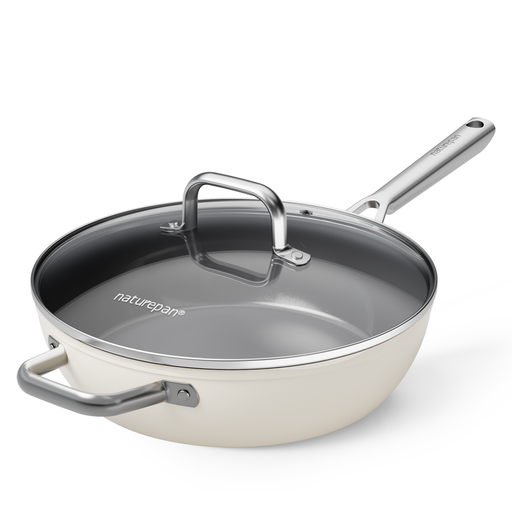
Why This Fits Their Persona: The combination of a large 28 cm diameter, high sides, and a matching lid makes this pan the ideal sauté pan with a lid for families. It's perfect for one-pot meals, sauces, and braises.
This model is delivered as a complete system with a matching lid, avoiding compatibility issues. The robust, reinforced coating is designed for intensive family use and resists the wear-and-tear trap.
High sides and a lid for splatter-free cooking and simmering. Large capacity for family-sized portions. Also oven-safe up to 260°C.
We have compiled a complete, up-to-date list of products that fully meet these strict selection criteria and German safety regulations. From classic frying pans to versatile induction woks.
1. How long does a ceramic coating really last? The lifespan heavily depends on the quality of the coating and its care. Basic ceramic coatings can lose their effectiveness after 1-2 years of daily use. Models with reinforced coatings (e.g., with diamond or titanium particles) and hybrid structures can have a significantly longer lifespan with proper handling—avoiding metal utensils, using medium heat, and washing by hand.
2. Is a more expensive ceramic induction pan always the better choice? Not necessarily. The price should reflect the material quality and construction. A higher price is often justified by a multi-layered base for better heat distribution, a reinforced and more durable coating, or higher oven safety. Compare the technical specifications rather than focusing solely on the price.
3. Can I use oil for frying in a ceramic pan? Yes, and using a small amount of oil is even recommended. It protects the non-stick coating at high temperatures and improves the frying result. The advantage of a good ceramic pan is that significantly less fat is needed for an optimal result compared to an uncoated pan, which supports healthy cooking.