
Lieferung heute & morgen

Qualitätsgarantie

Willkommens-Angebote freischalten: KOSTENLOSE Lieferung | Bis zu 80 % RABATT | Kostenlose 30-Tage-JoyPlus-Testphase
App herunterladen
A high-quality ceramic pan for an induction hob promises healthy, low-fat frying and easy cleaning. However, the market is flooded with products whose marketing claims often don't hold up in practice. Before you make a decision, it's crucial to understand the common pitfalls that can quickly render a seemingly good pan useless.
As your Joybuy Product Recommendation Officer, I'll help you identify the key features and distinguish marketing hype from genuine signs of quality.
Many buyers are disappointed after just a few months because their new pan doesn't perform as expected. This is often due to three prevalent issues:
To avoid these pitfalls, you should focus on three core technical parameters. These are the primary determinants of your pan's longevity and functionality.
For a ceramic pan for induction, the base is the most critical component. An induction hob generates heat directly in the pan's base via a magnetic field. For this to work efficiently, the base must meet two criteria:
A modern frying pan with a ceramic coating is more than just a white surface. The quality and composition of the coating determine its non-stick performance and durability.
The best pans are versatile tools. An oven-safe frying pan allows you to sear a dish on the hob and finish it in the oven.
Here are some models that represent a considered choice for different user profiles, based on their objective features.
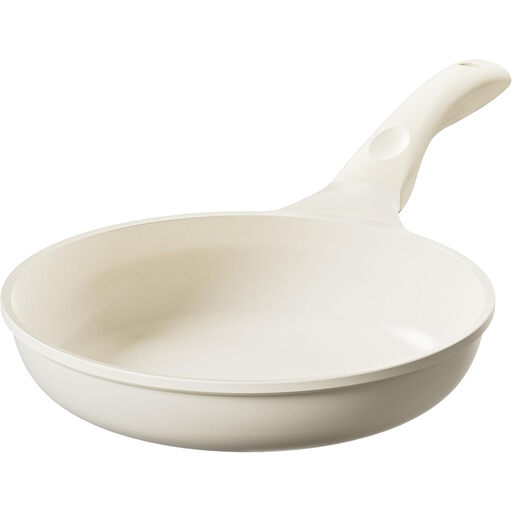
Why This Fits Their Persona: Ideal for daily use in a standard kitchen. The 24 cm size is perfect for preparing meals for two to three people, from breakfast eggs to sautéed vegetables. The focus is on straightforward handling and quick cleaning.
The thickened base is designed for fast and even heating on induction, thus avoiding the typical "hot spots." The Bakelite handle stays cool on the hob, preventing the risk of hot handles during stovetop-only use.
The ceramic coating, explicitly declared as PFAS-free, enables health-conscious cooking. Its compatibility with all hob types, including induction, makes it a flexible all-rounder.
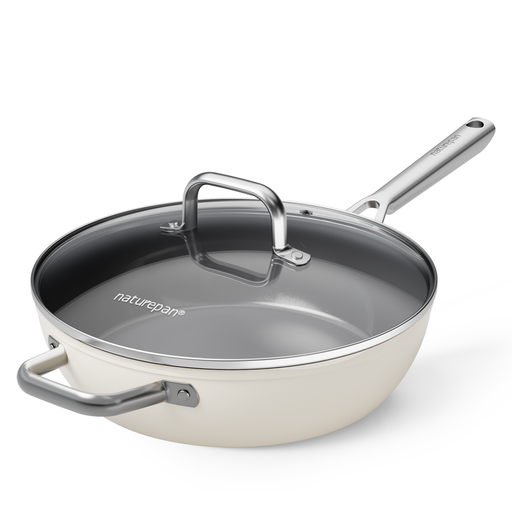
Why This Fits Their Persona: Perfect for chefs who want to do more than just fry. The high sides and included lid are ideal for braising, making sauces, and one-pot meals. The oven-safe design allows for a seamless transition from hob to oven.
The coating, reinforced with diamond and titanium particles, offers high durability and counters the "scratch-resistant illusion." The high oven-safe temperature of up to 260°C, thanks to the stainless steel handle, overcomes the limitations of basic pans.
The combination of high sides, a lid, and high oven-safe temperature offers maximum versatility. The optimised base ensures excellent, even heat distribution on induction hobs.
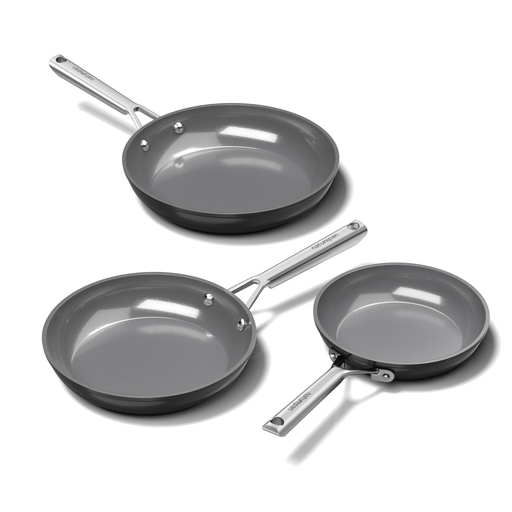
Why This Fits Their Persona: This induction pan set, with sizes 20, 24, and 28 cm, covers all the common needs of a family kitchen—from a small fried egg to a large one-pan meal. A uniform set for consistent cooking results.
All three pans share the same quality features: a reinforced titanium-ceramic coating, a base optimised for induction, and an oven-safe temperature of up to 260°C. This ensures consistently high performance and avoids quality differences within the set.
A complete set designed for durability and versatility. All pans are PFAS-free, dishwasher-safe, and optimised for all hob types, making it a future-proof investment for the family kitchen.
We have compiled a complete, up-to-date list of products that fully meet these strict selection criteria and rigorous safety standards.
To maintain the non-stick properties, you should let the pan cool down after use before cleaning it with warm water and a soft sponge. Even if many models are dishwasher-safe, hand washing is gentler on the coating. Use only wooden, silicone, or plastic cooking utensils and avoid heating the empty pan on the highest setting.
Ceramic coatings are made without PFOA and PTFE, the chemicals used in traditional Teflon coatings (a brand name for PTFE). A ceramic pan certified as PFAS-free will not release harmful fumes, even if accidentally overheated. This is a key reason why health-conscious cooks opt for this type of non-stick pan without Teflon.
Look for the official induction symbol (a stylised coil) on the packaging or the bottom of the pan. A simple test: hold a magnet to the base of the pan. If it sticks firmly, the base is ferromagnetic and suitable for induction. However, for optimal performance, it's not just compatibility that matters, but also the quality and thickness of the base.