
Lieferung heute & morgen

Qualitätsgarantie

Willkommens-Angebote freischalten: KOSTENLOSE Lieferung | Bis zu 80 % RABATT | Kostenlose 30-Tage-JoyPlus-Testphase
App herunterladen
A high-quality ceramic induction pan is an investment in your kitchen. It promises healthy, low-fat cooking and easy cleanup. However, the market is flooded with products whose marketing claims often don't hold up in practice. Many buyers find that after just a few months, the non-stick coating begins to fail, or the pan doesn't deliver the expected performance on their induction hob. This guide will show you which critical features to look for to find a durable and high-performing pan.
Before we dive into the important product features, let's highlight the typical problems that lead to disappointment. Understanding these will help you search for quality more effectively.
To avoid the pitfalls mentioned above, you should focus on three core technical specifications. These determine the longevity, safety, and performance of your new pan.
The non-stick pan has evolved. First-generation pure ceramic coatings were often prone to wear and tear. Modern models use composite materials that offer greater durability.
The efficiency on an induction hob depends directly on the pan's base. An optimal base has the following characteristics:
A modern pan should do more than just fry. Being suitable for the oven significantly expands its range of uses.
Based on the criteria above, we have identified several models that are a great fit for specific user profiles.
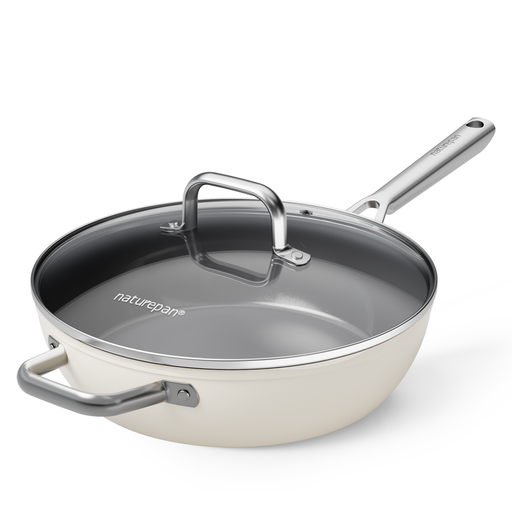
Why This Fits Their Persona: Ideal for families looking for a universal pan for daily use. The 28 cm frying pan with its high sides and lid is perfect for saucy dishes, braises, or one-pot pasta, while also reducing grease splatter.
The diamond and titanium-reinforced ceramic coating is explicitly certified as PFAS-free and offers greater durability than basic coatings. The fully encapsulated base ensures efficient performance on induction.
High sides and a matching lid for versatile cooking; oven-safe up to 260°C (500°F) for maximum flexibility from hob to oven.
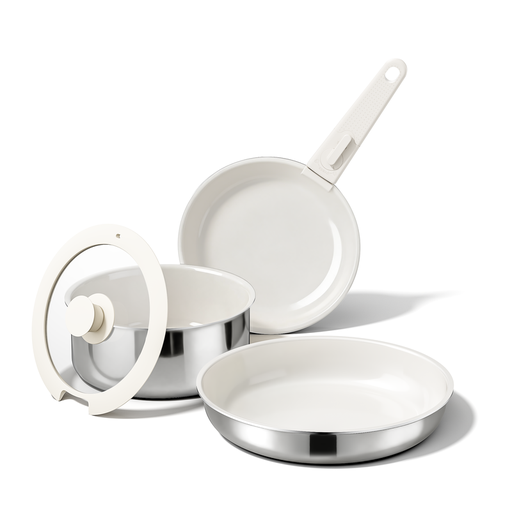
Why This Fits Their Persona: Perfect for small kitchens, RVs, or anyone who values a tidy setup. This induction pan set can be stacked with an extremely small footprint thanks to the detachable handle, saving valuable cupboard space.
This set combines a robust tri-ply stainless steel construction for optimal induction performance with the durable, PFOA-free diamond-titanium ceramic coating. The handle locks securely and won't detach accidentally.
Innovative detachable handle saves up to 70% more space; the entire set is dishwasher and oven-safe (up to 250°C / 482°F).
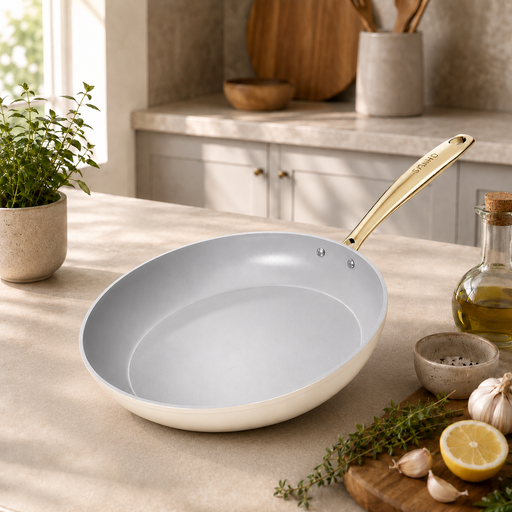
Why This Fits Their Persona: An excellent choice for individuals or couples seeking a compact yet uncompromisingly healthy pan. The 20cm size is ideal for breakfast eggs, omelettes, or small portions without sacrificing high-quality materials.
This pan is explicitly declared free of PFAS, PFOA, PTFE, lead, and cadmium, directly addressing the "healthy" loophole. The thick, die-cast aluminium body ensures excellent and even heat conduction on induction.
Comprehensive toxin-free certification for health-conscious cooking; oven-safe up to 260°C (500°F), which is not a given in this price and size category.
We've compiled a complete, up-to-date list of products that fully meet these strict selection criteria and safety standards.
To maintain the non-stick performance long-term, you should follow a few basic rules. Only use utensils made of silicone, wood, or heat-resistant plastic. Avoid heating the pan while empty on the highest setting. Although many models are dishwasher-safe, cleaning by hand with a soft sponge and mild dish soap is recommended, as aggressive dishwasher detergents can damage the coating over time.
No, this is a common misconception. While most ceramic pans are free of PFOA and PTFE, other chemicals from the PFAS group may still be used in the manufacturing of other components or bonding agents. If being completely free of these substances is important to you, look for the manufacturer's explicit "PFAS-free" declaration.
This problem usually occurs with pans that have a low-quality base. A loud humming or buzzing can happen if the base is not perfectly flat on the hob or if the ferromagnetic layer is too thin. Slow heating indicates that the base is not efficiently absorbing energy from the induction field. A high-quality ceramic induction pan has a thick, flat, and fully magnetic sandwich base to prevent exactly this issue.