
Lieferung heute & morgen

Qualitätsgarantie

Willkommens-Angebote freischalten: KOSTENLOSE Lieferung | Bis zu 80 % RABATT | Kostenlose 30-Tage-JoyPlus-Testphase
App herunterladen
Ceramic mugs are part of the daily essentials in many British households. Yet it is often only after buying one that you find out whether it really suits the way you drink: the handle gets hot, the capacity is not enough for your morning coffee, or a decorative tea strainer is difficult to clean.
This guide helps you compare ceramic mugs using objective criteria. It focuses on size, features, care and intended use – whether you are looking for a ceramic coffee mug, a ceramic tea mug or a mug as a gift.
The stated capacity usually describes the volume filled right to the rim. In practice, you need to leave some space for safe carrying and comfortable drinking. A large ceramic mug with a capacity of 475 ml is therefore not automatically suitable for every coffee machine or drinks holder.
As a general guide:
A dishwasher-safe mug can generally be cleaned in a dishwasher. However, glazes, prints and textured surfaces can still be affected by harsh detergents, high temperatures or rubbing against other crockery. For hand-painted or textured ceramic mugs, hand washing is often the gentler option.
For this reason, look for clear information from the manufacturer and distinguish between “dishwasher-safe” and a mere assumption made in a product description.
A microwave-safe mug may be suitable for heating drinks. However, this does not automatically protect it from cracks caused by sudden changes in temperature. Do not place a hot mug directly on a very cold stone worktop, and do not continue using damaged crockery. Ceramic can break into sharp pieces if dropped.
Ceramic is made from fired ceramic material and is often finished with a glaze. This can smooth the surface, make cleaning easier and define the design. For products intended for food contact, information about applicable requirements is relevant, such as EU Regulation (EC) No 1935/2004 on materials intended to come into contact with food.
For glazes, statements such as lead- and cadmium-free provide useful product information. However, you should always check the relevant product page or packaging. It is not possible to make a general statement about all ceramic mugs.
A handle keeps your hand away from the hot outer surface and makes the mug easier to hold. Handleless Japanese tea cups or matcha bowls, by contrast, are generally held with both hands and suit traditional serving styles. A handle can be more practical for everyday office use, while a stackable mug set saves space in the kitchen cupboard.
Wall thickness also plays a role: it affects weight, heat distribution and how quickly the outer surface warms up. A mug will not automatically remain cool when filled with a hot drink.
A mug with a strainer or lid is practical for loose-leaf tea, but requires additional cleaning. Check the following:
A ceramic mug must not generally be used on a hob or over an open flame unless the manufacturer expressly states that it is suitable.
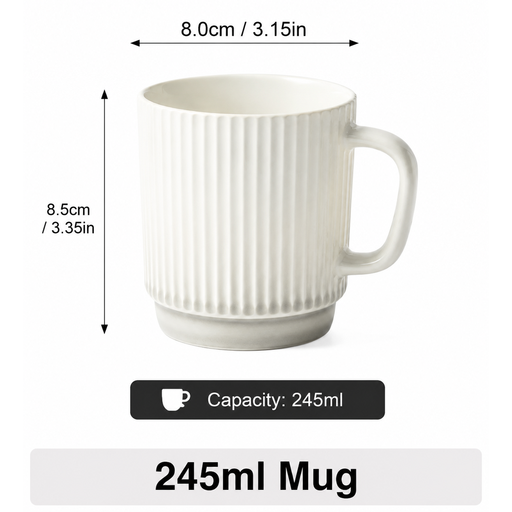
Why this product suits the profile: With a capacity of 245 ml, this mug is well suited to smaller servings of coffee and tea at home or in the office, while the classic handled design makes it easy to use every day.
The specific 245 ml capacity means you do not have to estimate the desired portion size from a product photo alone. According to the product information, the smooth glaze is designed for everyday cleaning.
245 ml capacity; dishwasher- and microwave-safe according to the product description.
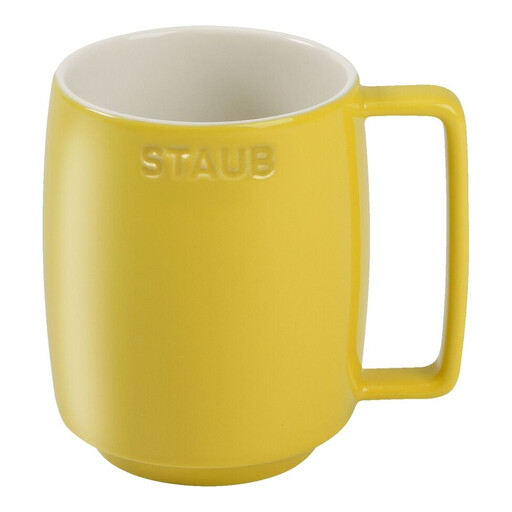
Why this product suits the profile: The generous size is ideal for anyone who wants to serve coffee, tea, cocoa or individual oven-baked dishes in a spacious mug.
The product information specifies a 475 ml capacity, microwave and dishwasher suitability, as well as oven use up to 300 °C. This makes it easy to check the features you want before buying.
475 ml capacity; stackable and suitable for the oven, microwave and dishwasher according to the product description.
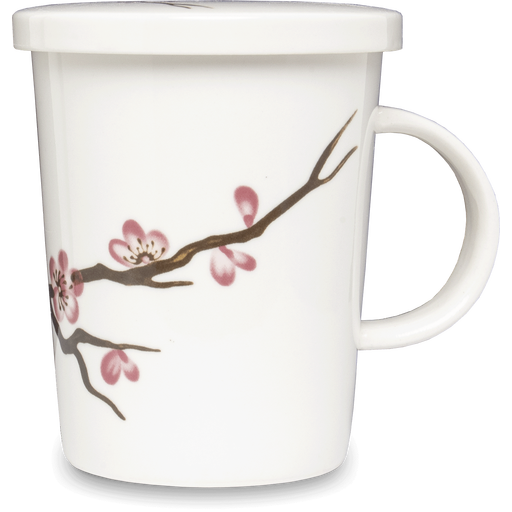
Why this product suits the profile: This ceramic tea mug combines a removable porcelain filter with a lid, making it suitable for anyone who wants to brew loose-leaf tea at their desk or at home.
The filter and lid are listed as specific components. The product description also clearly states that the mug is not microwave-safe.
Approximately 300 ml capacity; removable filter and lid for loose-leaf tea.
We have put together a complete, regularly updated list of products that fully meet these strict selection criteria and the safety regulations applicable in the EU.
For filter coffee or café au lait, 300 to 390 ml is often a good choice. If you drink smaller portions, you can choose a mug with a capacity of around 245 ml. The height of your machine, the saucer and the storage space available are also important considerations.
Not every ceramic mug is microwave-safe. Look for an explicit statement from the manufacturer. Designs containing metallic elements and damaged glazes should not be placed in the microwave. The mug itself may be hot after heating.
Their service life depends on the material, glaze, frequency of use and care. Knocks, scratches and significant temperature changes can cause damage. For safety reasons, a mug with cracks or chipped areas should no longer be used for drinks.