
Lieferung heute & morgen

Qualitätsgarantie

Willkommens-Angebote freischalten: KOSTENLOSE Lieferung | Bis zu 80 % RABATT | Kostenlose 30-Tage-JoyPlus-Testphase
App herunterladen
A good ceramic pan promises a lot: healthy, low-fat cooking, effortless cleanup, and freedom from potentially harmful chemicals. But the market is crowded, and not every product lives up to its advertising claims. As a Joybuy Product Recommendation Officer, I analyse product information daily to help you separate marketing hype from verifiable facts.
Many buyers invest in a new coated frying pan with a ceramic surface, only to be disappointed after just a few months. This is often due to three common but avoidable pitfalls:
To avoid these disappointments, it's crucial to pay attention to a few key technical specifications before you buy.
An informed purchasing decision is not based on advertising slogans, but on objective material and construction features. Look for the following three points to find a durable, high-performance pan.
A high-quality non-stick ceramic surface is more than just a thin layer. It's based on sol-gel technology, where ceramic particles are bound in a matrix. The crucial difference lies in the reinforcement:
Always check the manufacturer's specifications for a complete absence of PFAS, not just PFOA.
A pan's performance lives or dies by its base. A thin, stamped aluminium base is prone to warping under heat ("wobbling") and distributing warmth unevenly. The result is burnt spots while other areas are still raw.
Look for a multi-layer sandwich base. A thick aluminium core ensures fast and even heat conduction. For an induction-compatible pan, an outer layer of ferromagnetic stainless steel is essential. The thicker and more extensive this layer is, the more efficiently and evenly the pan will heat up on an induction hob.
A pan's versatility is often limited by its handle.
Based on these objective criteria, we have identified several models that offer a suitable solution for different needs and cooking habits.
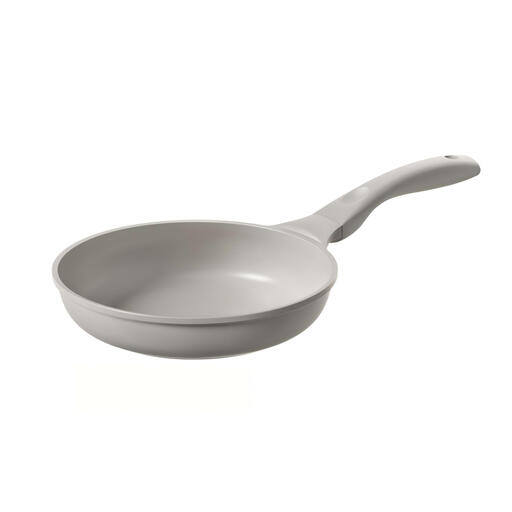
Why This Fits Their Persona: Delivers reliable, toxin-free non-stick performance for everyday use. Ideal for beginners or small households who value healthy, low-effort cooking and need a pan for all common hob types.
The explicit claim of being PTFE/PFOA/PFAS-free goes beyond just PFOA-free and offers transparency. The base is designed for all hob types, including induction.
Completely toxin-free coating and universal hob compatibility at an accessible price point.
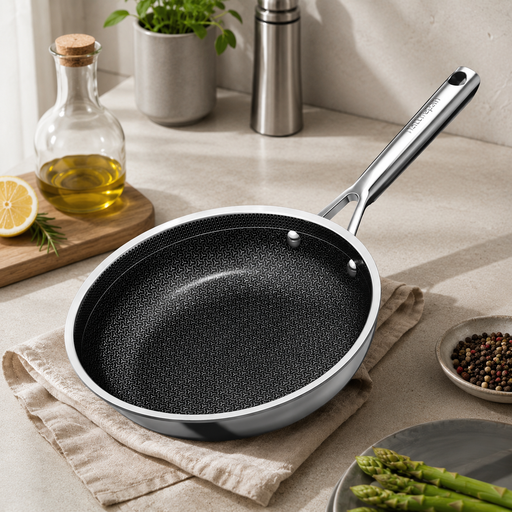
Why This Fits Their Persona: The hybrid technology, with its stainless steel mesh and recessed ceramic coating, allows for high-heat searing like a stainless steel pan while offering the benefits of a non-stick surface. Its high oven-safe temperature vastly expands its range of use.
The 5-ply construction with a titanium-ceramic coating is engineered for durability and scratch resistance, withstanding the rapid wear and tear of simpler coatings. The solid build ensures stability and excellent heat distribution.
Combines the benefits of stainless steel (high-heat searing) and ceramic (non-stick); oven-safe up to 260°C (500°F).
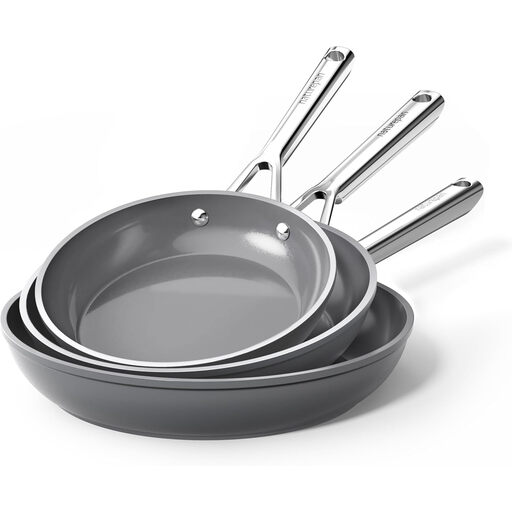
Why This Fits Their Persona: This ceramic pan set covers all daily cooking needs with three common sizes (20, 24, 28 cm), from small egg dishes to large family meals. The consistent quality and easy maintenance are ideal for a busy family routine.
Offers consistently high quality across the entire set. The reinforced diamond-titanium coating is designed for frequent use, and its dishwasher-safe feature simplifies cleanup.
Complete set for various applications; reinforced, durable coating and dishwasher-safe convenience.
We have compiled a complete, up-to-date list of products that fully meet these strict selection criteria and German safety regulations.
To maintain the non-stick properties, you should follow a few basic rules:
High-quality, reinforced ceramic coatings (e.g., with titanium or diamond particles) can have a higher hardness and thus better scratch resistance than many standard PTFE coatings (often known as Teflon). However, no non-stick coating is completely indestructible. The main advantage of ceramic is that if the surface is damaged, no PFAS particles are released, provided the pan is PFAS-free.
The easiest way is to look for the induction symbol (a stylised coil) on the bottom of the pan or in the product description. A practical test: hold a magnet to the base of the pan. If the magnet sticks firmly, the base is ferromagnetic and therefore suitable for induction hobs.