
Lieferung heute & morgen

Qualitätsgarantie

Willkommens-Angebote freischalten: KOSTENLOSE Lieferung | Bis zu 80 % RABATT | Kostenlose 30-Tage-JoyPlus-Testphase
App herunterladen
Finding the right frying pan can be frustrating. With ceramic pans in particular, marketing often makes big promises, but the reality in the kitchen can be quite different. Common frustrations include non-stick coatings that fail after just a few months or uneven heat distribution. As your Joybuy Product Recommendation Officer, I'm here to help you spot the common pitfalls and make an informed decision that suits your cooking habits.
Before you buy a new ceramic pan, you should be aware of three common marketing traps that often lead to disappointment:
To avoid a bad purchase, you should focus on three objective criteria that determine a pan's quality and longevity.
The quality of the non-stick coating is crucial. Ceramic coatings are made from a mineral base (sand) and are a common alternative to traditional PTFE coatings (known by the brand name Teflon). A key advantage is that they are manufactured without potentially harmful chemicals like PFOA or the broader group of PFAS. A high-quality ceramic coated pan offers excellent non-stick properties for low-fat frying. Look for manufacturer specifications that explicitly confirm the product is free from PFAS and PFOA.
The base construction is especially critical for an induction frying pan. For a pan to work on an induction stovetop, it needs a ferromagnetic base. For optimal and even heat distribution, this base should also be sufficiently thick and perfectly flat. A solid, full-contact base prevents "hot spots" and ensures your food cooks evenly. A label indicating it's a pan for all stovetops is often a sign of quality, highlighting its versatility.
The diameter alone says little about a pan's usability. A deep 28 cm pan offers significantly more volume and flexibility than a shallow model of the same diameter. It's suitable not only for frying but also for braising, making sauce-based dishes, or cooking larger portions. A frying pan with a lid is particularly practical here, as it retains heat, speeds up cooking, and protects against grease splatters. Before buying, consider which dishes you cook most often to find the right shape for your needs.
Based on these objective criteria, we have selected a few models from our range that are suitable for different user profiles.
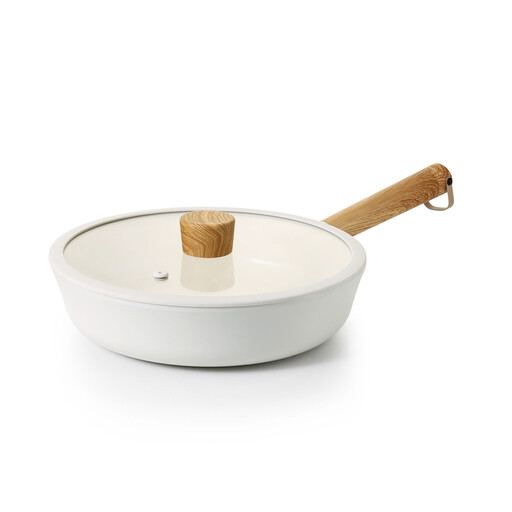
Why it's a good fit: Ideal for families who need a versatile and spacious pan for daily meal preparation. The high sides and included lid make it perfect for stews, sauce-based dishes, and searing larger quantities.
The combination of a deep 28 cm shape and a lid makes it a multi-functional tool, preventing the need to buy multiple specialized pans.
According to the manufacturer, the ceramic coating is free of PTFE, PFAS, and PFOA. The magnetic stainless steel base ensures compatibility with all stovetops, including induction.
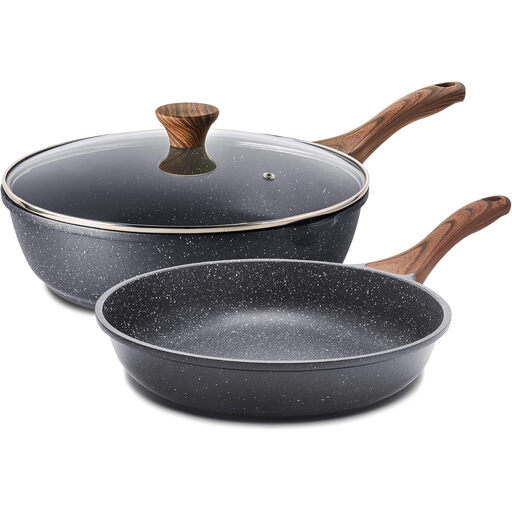
Why it's a good fit: This set is a great choice for individuals or couples looking to switch to toxin-free cookware without a large initial investment. The two sizes cover the most common uses.
Directly addresses the "Health Illusion": According to the manufacturer, the Swiss ILAG non-stick coating is free of PFOA, PFOS, lead, and cadmium.
The set offers excellent value for money, and the highly magnetic stainless steel base ensures compatibility with all stovetops, including induction.
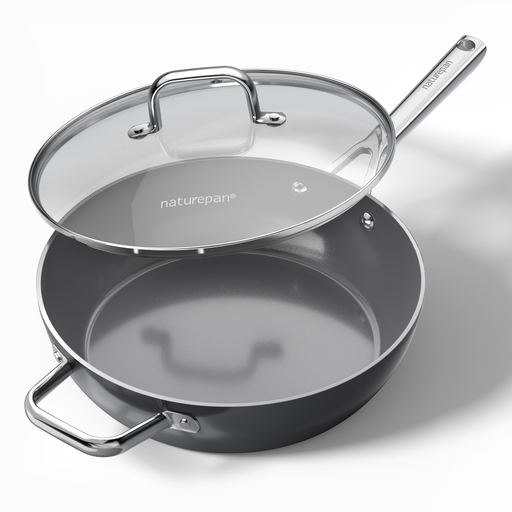
Why it's a good fit: For ambitious cooks seeking a robust, high-performance pan that can also be used in the oven. The reinforced coating promises a longer lifespan under heavy use.
Counteracts the "Scratch-Resistant" trap with a ceramic coating that, according to the manufacturer, is reinforced with diamond and titanium particles. The optimized base addresses the "Induction Lottery" by ensuring fast, even heat distribution.
Its high oven-safe temperature of up to 260°C (500°F) significantly expands its uses, such as for gratinating or finishing dishes. The coating is explicitly declared as PTFE/PFOA/PFAS-free.
We have compiled a complete, up-to-date list of products that fully meet these strict selection criteria and safety standards.
The lifespan of a ceramic coating depends heavily on use and care. With proper handling—avoiding metal utensils, preventing overheating, and washing by hand—a high-quality ceramic pan can perform well for several years. Harsh detergents and the dishwasher can shorten its lifespan.
The term scratch-resistant frying pan is relative. Ceramic coatings are harder and more resistant to scratches than many conventional non-stick coatings. However, they are not indestructible. Using utensils made of wood, silicone, or plastic is always recommended to protect the surface and preserve the non-stick properties for as long as possible.
You can identify a good induction frying pan by several features. Look for a thick, heavy base that sits perfectly flat on the stovetop. The product description should explicitly mention its suitability for induction. A simple test: If a magnet sticks to the bottom of the pan, it is ferromagnetic and therefore suitable for induction cooktops.