
Lieferung heute & morgen

Qualitätsgarantie

Willkommens-Angebote freischalten: KOSTENLOSE Lieferung | Bis zu 80 % RABATT | Kostenlose 30-Tage-JoyPlus-Testphase
App herunterladen
A new frying pan is on your shopping list, and a ceramic pan seems like a great choice, promising healthy cooking and easy cleanup. But the market is flooded with options, and not every pan lives up to its advertising claims. Many buyers find that after just a few months, the non-stick performance fades or the pan warps on the stovetop.
As your Joybuy Product Recommendation Officer, I'm here to help you identify the common pitfalls and make an informed decision. We'll focus on the facts so you can find a durable and safe pan for your kitchen.
Before we dive into the key features, let's highlight the three most common issues that lead to disappointment.
To avoid these pitfalls, you should focus on three technical features. These determine the durability, safety, and functionality of your new pan.
The quality of a non-stick pan depends directly on its coating. Simple ceramic layers are prone to scratches and rapid wear. Multi-layer systems offer a significant improvement, especially a titanium-ceramic pan. Here, ceramic particles are reinforced with titanium or diamond particles, making the surface more resilient and durable.
Look for manufacturer specifications that confirm a multi-layer construction and freedom from harmful substances like PFAS and PFOA. The pan's core, usually made of aluminium, is responsible for fast and even heat conduction. A thicker aluminium core retains heat better and distributes it all the way to the rim.
For those with an induction stovetop, the base construction is crucial. A high-quality ceramic induction pan features a fully encapsulated, ferromagnetic stainless steel base. This ensures maximum energy transfer and prevents "hot spots" (localised points of overheating). Such a base also makes the pan warp-resistant, preventing it from deforming at high temperatures. Check the product description for terms like "encapsulated base" or "suitable for all stovetops, including induction."
A pan's versatility is reflected in its heat resistance. To make a pan oven-safe, it needs both a heat-resistant coating and a suitable handle. Stainless steel handles are often oven-safe up to 260°C (500°F), while handles made of Bakelite or plastic have lower temperature limits or are not oven-safe at all. An oven-safe handle allows you to sear dishes on the stovetop and then finish cooking or keep them warm in the oven. Pay close attention to the exact temperature rating in the product details.
Here are some recommendations tailored to different household sizes and cooking styles.
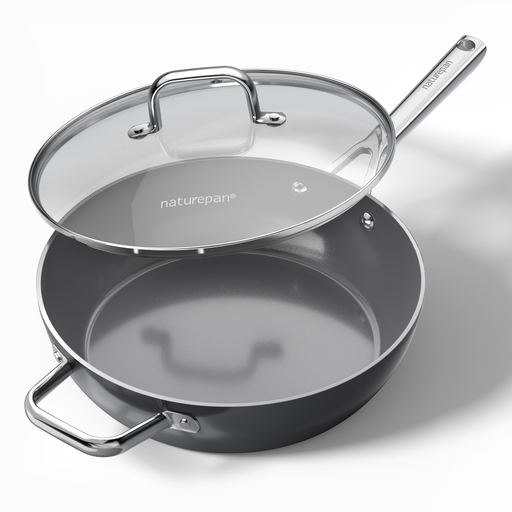
Why it's a great fit: With a 28 cm diameter, high sides, and a matching lid, this pan is perfect for one-pot meals, braised dishes, or larger portions for the whole family. It minimises splatters and allows for versatile cooking methods.
The coating, reinforced with diamond and titanium particles, is designed for durability. It is explicitly declared PTFE/PFOA/PFAS-free, and the encapsulated base ensures excellent performance on induction stovetops.
Highly versatile with oven safety up to 260°C (500°F); includes a lid for braising; large diameter for family-sized portions.
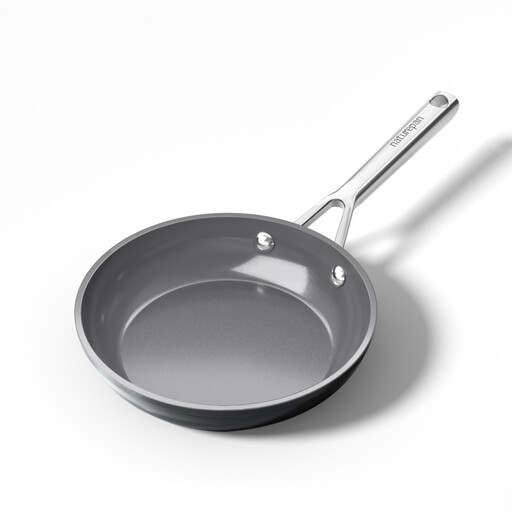
Why it's a great fit: The compact 20 cm size is perfect for cooking fried eggs, omelettes, or small portions. It has a small footprint that fits in any kitchen and is ideal for one- to two-person households.
Despite its smaller size, it features the same durable, reinforced titanium-ceramic coating. The optimised base ensures good and even heat distribution on induction stovetops for this model as well.
Space-saving yet powerful; oven-safe up to 260°C (500°F) for maximum flexibility; suitable for all stovetops.
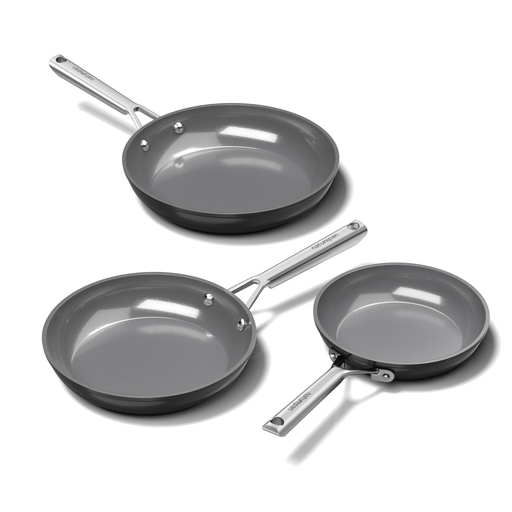
Why it's a great fit: This ceramic pan set fully equips your kitchen. With three different sizes, you're prepared for any task—from a small snack to a main course and side dishes.
The set ensures consistently high quality across the board. All three pans feature the same reinforced, toxin-free coating and are optimised for all stovetops. This helps you avoid performance inconsistencies between different pans.
A complete set for any cooking scenario; uniform, durable coating quality; all pans are oven-safe up to 260°C (500°F).
We have compiled a complete, up-to-date list of products that meet strict selection criteria and German safety regulations.
To maximise the coating's lifespan, you should hand-wash the pan with a soft sponge and mild dish soap. Avoid steel wool or abrasive scouring agents. Always let the pan cool down before washing to prevent thermal shock. Heating on a medium setting is generally sufficient and helps preserve the material.
No, this is not recommended. Even though reinforced coatings are more robust, sharp or pointed metal utensils can scratch the surface and compromise the non-stick performance. Instead, use utensils made of wood, silicone, or heat-resistant plastic.
Look for explicit labels from the manufacturer. Trustworthy claims are "PFAS-free," "PFOA-free," and "PTFE-free." These certifications ensure that these groups of substances were intentionally avoided during the coating's manufacturing process. Products without these clear declarations offer no guarantee of being toxin-free.